One of the most appealing investments in 2026 across the industries, commercial units, and renewable energy developers is a 1 MW solar power plant. As electricity costs in India continue to rise, sustainability requirements tighten, and industries increasingly source green power, MW-scale solar has become a preferred long-term energy solution.
The timing is also ideal. The prices of solar modules have fallen by 18-22% since 2023, and technologies such as TOPCon and bifacial modules have pushed the efficiency to new levels. The states are easing open-access regulations, enabling the industries to purchase or produce solar energy at predictable costs over a long-term period of 15-25 years. Also, renewable development in India is still growing at a high rate, owing to policies such as ALMM, PLI-favoured domestic production, and the enhancement of the grid infrastructure.
Due to such changes, a 1 MW solar plant in 2026 will have a shorter payback period, higher production, and more predictable income. This is why it is now widely adopted by factories, warehouses, industrial parks, commercial complexes, institutions, and renewable developers.
What is a 1 MW Solar Power Plant?
A 1 MW (1,000 kW) solar power plant is a large-scale installation, which is able to produce clean energy to be consumed by a factory or company or sold to the grid.
The fundamentals of performance expectation are as follows:
- Daily generation of 4,000–4,500 units per day (kWh)
- Annual production: 14–16 lakh units (kWh)
Land requirement
- Ground-mount: 2.5 – 3.5 acres
- Rooftop (rare): 80,000–1,00,000 sq. ft.
Due to its size, a 1 MW power plant can be used to enable businesses to achieve substantial savings on grid power consumption and diesel usage, and provides long-term, predictable energy costs, which are typically 40–60% lower than traditional grid tariffs.
These plants are commonly deployed by:
- Mass production (textile, pharma, ceramics, steel, food processing)
- Shopping malls and information technology zones
- Institutions & universities
- Power generators under PPAs through renewable energy
Types of 1 MW Solar Power Plants
The main types of 1 MW solar power plants include:
- On-Grid (Most Common)
This is the most popular model in the industry since it is directly linked to the grid; thus, it does not need any battery storage. Power moves through panels to the inverter to the grid, which compensates for the consumed electricity.
They are best for high-daytime load industries, commercial properties, EPC developers, and open-access consumers.
Key advantages include low capital cost and maximum return on investment.
- Off-Grid (Battery-Based)
Plants in the off-grid 1 MW category are uncommon since battery storage at the MW-scale is very costly.
Best for very rural locations without access to the grid.
- Hybrid System (Solar + Battery)
Provides on-grid production with a battery bank as the back-up or peak-hour supply. Demand for hybrid systems is increasing in 2026, driven by:
- Data centres
- The manufacturing units with critical loads.
- Business centres where power is a necessity.
Why choose a hybrid system?
Maintains stability, accommodates peak loads, and optimises power consumption despite intermittent grid supply.
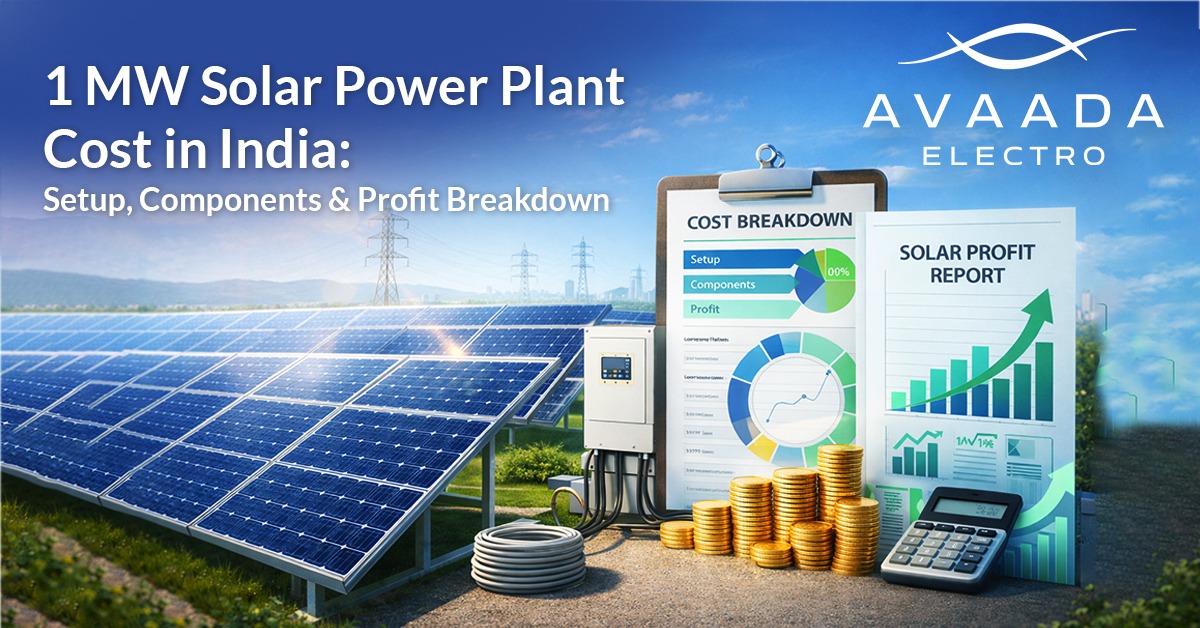
1 MW Solar Power Plant Cost in India (2026)
The cost depends on technology, location, components, and plant type. Below is a clear breakdown:
| Type of 1 MW Solar Plant | Cost in 2026 (Approx.) |
| Standard Mono-PERC | ₹3.8–4.2 crore |
| N-Type TOPCon (higher efficiency) | ₹4.3–₹4.7 crore |
| Hybrid Plant (Battery-Based) | ₹5.5–₹7 crore |
| Region-Wise Labour Variation | North and East India typically have slightly higher labour costs, while West and South India offer more competitive EPC rates. |
Detailed Cost Breakdown (Component-Wise)
| Component | Approx. Share of Total Cost | What It Includes |
| Solar Modules | 60–65% | TOPCon or Mono-PERC modules, bifacial modules, glass-to-glass design |
| Inverters | 8–12% | Central or string inverters, protections, smart monitoring |
| Module Mounting Structures | 6–10% | Galvanised steel structures, foundations, and trackers (if used) |
| Cables & Connectors | 3–5% | DC cables, AC cables, MC4 connectors |
| ACDB/DCDB & Protection Systems | 2–3% | Switchgear, MCBs, SPD, earthing |
| Civil Work & Land Development | 5–7% | Boundary, levelling, pathways, and inverter room |
| Installation & Labour | 4–6% | Mechanical & electrical installation & commissioning |
| Transmission/Evacuation Line | 2–4% | Connecting to the nearby grid substation |
| Approvals & Project Management | 1–2% | Engineering design, regulatory coordination, and statutory approvals |
What is the Power output of a 1 MW Solar System?
A 1 MW solar power plant in India produces 4,000 -4,500 units of electricity per day, depending on location, module technology, inverter quality, and seasonal variation. In one year, this will be approximately 14-16 lakh units of clean electricity.
Stronger solar irradiation in regions such as Rajasthan, Gujarat, Karnataka, and Uttar Pradesh results in high generation, whereas States with longer monsoons, such as Kerala, Karnataka (coastal), and Northeast India, can generate a little less.
The large output in 1 MW plants within a year makes it attractive to industries with massive activities during the day, business premises, and captive or open-access solar developers.
Land Requirement for a 1 MW Solar Plant (Rooftop vs Ground-Mount)
The size of land required will be determined by the layout and technology:
Ground-Mounted Plants
The average ground-mounted 1 MW plant will need 4–5 acres of shadow-free land.
A 1 MW capacity can be achieved with only a few panels (high-efficiency N-type TOPCon modules), which can reduce land requirements by approximately 10–12%.
Rooftop MW-Scale Systems
On large roofs (factories, warehouses, malls) in industries and commercial buildings, a maximum of 1 MW can be installed:
- 80,000–1,10,000 sq. ft. of rooftop space
- Relies on structural strength and panel wattage
Rooftop MW plants eliminate land acquisition costs and are more favored in the highly populated industrial belts.
Approvals & Permissions Required (State-Wise Overview)
A 1 MW solar project will require a number of technical and regulatory approvals. The processes vary by state, but the major requirements are similar:
Key Approvals
- CEIG/CEA Safety Approval
- Net-Metering/Gross Metering/Open Access Permission.
- Approval of DISCOM connectivity.
- Permission for grid synchronization.
- Evacuation line (where applicable), Right of Way (RoW).
- Environmental clearance (only for some large-scale layouts)
Which states are faster in solar policy approvals?
States that have the most simplified solar policies:
- Gujarat
- Rajasthan
- Maharashtra
- Karnataka
These areas consist of dedicated RE nodal agencies, accelerated CEIG clearance, and robust grid infrastructure, which make them favorable in terms of MW-scale projects.
Estimated Expected Savings and Profitability
Depending on the model (captive, group captive, open access, third-party sale), a 1 MW solar plant can save a considerable amount of money by lowering power bills.
Industrial Captive Use
Industries that purchase grid power at 7-10/unit would be able to reduce the cost to 2.5-3.5/unit, which would save:
- ₹1.2–1.6 crore per year
- Payback in 4-5.5 years
- 25-year lifetime savings: ₹25–35 crore
Selling Power Under Open Access
The power to sell in open access exists and is present in the market.
At a price of 4.5-6 per unit of power, the plant will be able to produce:
- ₹6.5–9.6 lakh per month
- Increased margins in states that are favourable on charges.
Green Benefits (Enterprises and ESG)
1 MW solar offsets about:
- 1,200–1,500 tonnes of CO₂ per year
- The same number of trees planted in a single year equals 55,000-70,000.
This is used by many corporations in sustainability reporting and green certification.
Overview of Return on Investment (ROI) & Payback Period
Solar is now one of the most stable and predictable long-term investments in India.
| Scenario | Payback Period | 25-Year ROI |
| Captive Industrial Use | 4–5.5 years | 700–900% |
| Third-Party/Open Access Sale | 5–7 years | 550–750% |
| Hybrid & Battery Systems | 7–9 years | 450–600% |
1 MW Solar Plant Subsidy & Policy Support (2026 Update)
Although the government does not offer subsidies on large-scale commercial plants, it has a number of indirect financial incentives that shorten the payback period of a 1 MW project.
Does a 1 MW plant get a subsidy?
No, MNRE central subsidies are applicable to residential rooftops only.
Solar projects, which are commercial and industrial, are unsubsidized in terms of capital.
However, this is what improves project economics in 2026:
- Accelerated Depreciation (AD)
Accelerated depreciation of up to 40% allows businesses.
This alone improves ROI by 8–12%.
- GST Input Credit
Purchases of modules and inverters are subject to GST, which can be claimed as ITC by businesses.
- Open Access Solar Policies
Other states such as Gujarat, Rajasthan, Maharashtra, Coastal Karnataka, and MP have favourable open access policies that allow purchase of solar power at cheaper rates.
- Waivers and concessions (State-specific)
Some states offer:
- Wheeling charge waivers
- Concessions on transmission charges.
- Banking of surplus energy
These go a long way in enhancing the profitability of plants in the long term.
- LTA / GNA Reforms
In 2026, grid integration becomes simpler and quicker for the new developers of the General Network Access system.
Takeaway
A 1 MW solar plant is among the best ROI clean energy projects even without subsidy, primarily because of machine-accelerated depreciation, reduced solar tariffs, and robust open-access reforms.
Power Generation of 1 MW Solar Plant (Daily, Monthly, and Yearly Production)
The output of a 1MW solar facility will be dependent on the area, the type of panels, the design, and the quality of the irradiation. However, in the climatic settings of India, the figures are constant and foreseeable.
Average Solar Generation (India, 2026 Data)
| Parameter | Generation |
| Daily Generation | 4,000 – 4,500 units/day |
| Monthly Generation | 1.2 – 1.35 lakh units |
| Annual Generation | 14–16 lakh units (kWh) |
These values are consistent with national averages of the solar radiation and confirmed by industry data from large EPC companies.
Generation by Panel Type
Mono-PERC Modules
→ 14–15 lakh units/year
N-Type TOPCon Modules
→ 15–16 lakh units/year
(Higher gain on bifacial + lower degradation).
Region-wise Differences
- Rajasthan, Gujarat, MP → Maximum production.
- Tamil Nadu, Karnataka, and Maharashtra are strong and stable.
- East/North-East India: Slightly lower owing to cloud cover.
Why Power Generation Matters?
The generation of power dictates:
- Revenue (for developers)
- savings (for C&I consumers)
- payback period
- long-term plant viability
Final Takeaway
The 1 MW solar power plant will continue to be one of the surest long-term investments in India in 2026. As the price of modules has gone down, open access is becoming easier, and power tariffs are growing annually; large consumers and developers are able to commit to 25 years of inexpensive electricity.
A 1 MW system will produce as many as 16 lakh units per annum, reduce huge operation expenses, and result in a 4.5 to 6.5-year payback, which outperforms most conventional industrial investments. Advancements in module efficiency, AI-driven manufacturing, and modern EPC practices have significantly improved plant performance. As a result, today’s solar plants deliver higher reliability and longer operational life.
No matter the captive industrial consumption, the group captive, or third-party sale, a 1 MW project in 2026 is a predictable, scalable, and decades-long asset to any business interested in ensuring predictable power prices and lowering carbon footprint.
Frequently Asked Questions
What is the energy output of a 1 MW solar power plant on a daily basis?
A 1 MW solar power plant generates 4,000-4,500 units/day relative to location, the type of modules, and the amount of irradiation.
What size (in terms of land) is needed to support a 1 MW solar farm?
The size of a typical ground-mounted system is 4–5 acres. When trackers are used, the space can go up by 10-15%.
How profitable is the 1 MW solar power plant?
The annual revenue is between 70 lakh and 1.2 crore based on the PPA tariff, the third-party sale rate, and state policy.
In the year 2026, what will be the overall cost of establishing a 1 MW solar plant?
It ranges between 3.8 crore and 4.7 crore, depending on the module technology, EPC scope, and the layout of the plant (on-grid/hybrid/tracker).
What is the recovery time of the investment?
A PPA or captive consumption model has a payback of about 4.5–6.5 years.
Is it possible to create a 1 MW plant on the industrial land owned by businesses?
Yes. The factories, warehouses, data centres, and commercial parks are typical captive systems.
What are the most suitable solar modules to use in a 1 MW plant in 2026?
Top developers are inclined toward N-type TOPCon (630-720 Wp), which is more efficient and lower degradation rates than mono-PERC.
What is the construction time of a solar project of 1 MW in size?
The average project lasts 70–120 days, which depends on land preparation and clearance.