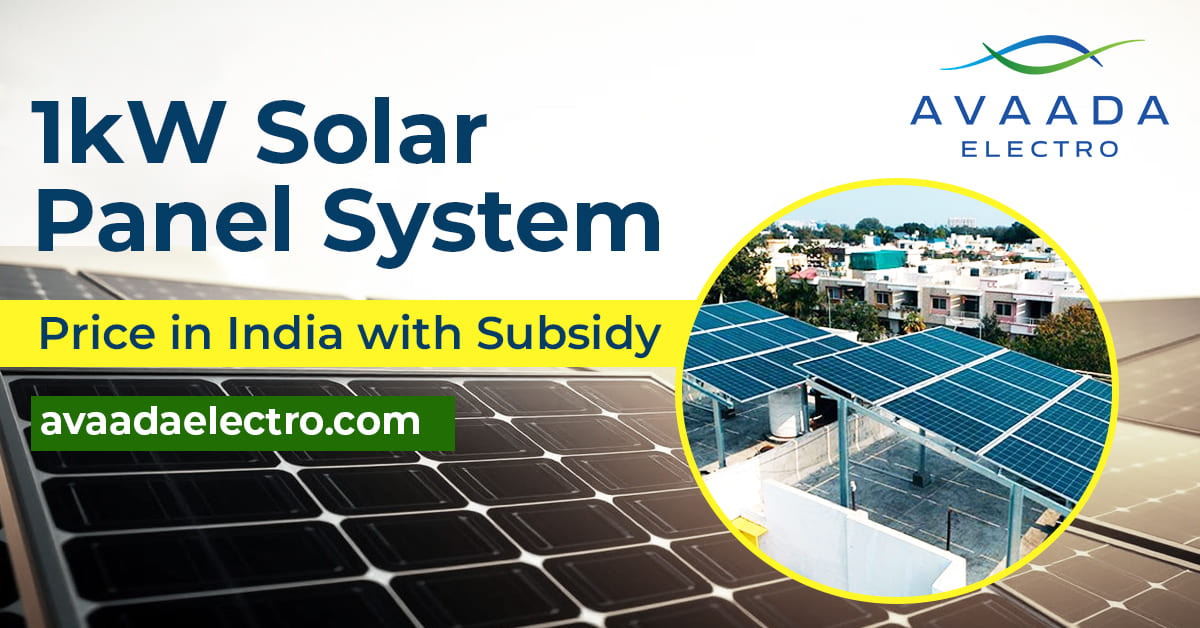
The rooftops in India are rapidly becoming clean energy centres, and the government’s PM Surya Ghar: Muft Bijli Yojana has enabled homeowners to go solar like never before. The 1kW solar panel system has become one of the most feasible, cost-efficient, and easy-to-maintain options for small houses.
With rising electricity bills and greater awareness, more families are discovering that even a small 1kW installation can save them a great deal of money every month, and in many cases, a 1kW setup can save them as much as 1000 Rupees per month. Even better, the subsidies in its centre and streamlined internet permissions have made the solar well affordable to middle-income homeowners.
This guide will describe how much a solar system with a power of 1kW will cost in 2026, what subsidies you can avail of, how electricity is produced, and how quickly it can break even. You will also learn a step-by-step procedure for claiming the subsidy and what to expect during installation.
At the end, you will have a clear view of whether a 1kW rooftop solar system is the right choice for your home and how to make the most of it.
What Is a 1kW Solar Panel System?
A 1kW solar system has the capacity to produce 1 kilowatt (kW) of power under ideal sunlight conditions. This capacity is the cumulative product of the solar panels as a sum, and not the number of panels.
Actually, the system of 1kW will give approximately 4-5 units (kWh) of electricity per day, which will vary depending on your location, weather conditions, and the type of panel. In one year, that is 1,500-1,800 units every year, which is enough to run the basic appliances of a small family.
Components of a 1kW Solar Setup
A standard home solar kit includes:
- Solar panels (typically 3–4 high-efficiency modules)
- Solar inverter (to convert DC to AC power)
- Mounting structures (for your rooftop)
- Cables and junction box
- Net meter (for on-grid connections)
- Battery (optional for hybrid or off-grid systems)
How much space is required for the installation?
A 1kW solar system typically needs around 100 square feet of unobstructed rooftop space with full sun exposure for at least 5–6 hours daily.
Compatibility of 1kW Solar Panel System
This size is perfect for –
- Small homes or apartments using up to 200 units/month
- Shops or small offices with moderate daytime usage
- Rural households with limited or intermittent grid supply
How Much Does a 1kW Solar System Cost in India in 2026?
By 2026, the average cost of a 1kW rooftop solar system in India would be between INR 55,000 and INR 1.2 lakh (depending on the type of system, panel technology, and what needs to be installed).
Due to India’s rapidly growing domestic solar manufacturing ecosystem, which, according to the most recent reports by MNRE and ICRA, has already reached and is projected to reach 109 GW by 2027, prices have remained competitive despite ongoing improvements in panel efficiency.
Cost Breakdown Table (2026 Estimates)
| System Type | Description | Approx. Cost (Before Subsidy) | Best Suited For |
| On-Grid System | Connected to the grid, no battery | ₹55,000–₹70,000 | Homes with a reliable grid supply |
| Hybrid System | Includes a limited battery backup | ₹75,000–₹95,000 | Homes with short power cuts |
| Off-Grid System | Standalone with full battery storage | ₹95,000–₹1.20 lakh | Homes in rural or no-grid areas |
These costs include panels, an inverter, a structure, and installation. The variation usually depends on panel efficiency, i.e., Poly, Mono-PERC, or TOPCon and inverter type.
Solar Subsidy on 1kW System – PM Surya Ghar Yojana in 2026
The government introduced the PM Surya Ghar: Muft Bijli Yojana, which is a scheme to provide solar energy to every Indian family, at the beginning of 2024. The program provides direct monetary subsidies to homeowners with rooftop solar systems with a capacity of no more than 3 kW.
With a central subsidy of 30,000 rupees per 1kW, you can actually save 30,000 rupees that will directly translate into a lesser investment. The amount is directly credited to your bank account after checking and validation of your installation by the local DISCOM.
In this scheme, the owners of the homes submit their applications through the online portal- pmsuryaghar.gov.in.
Select an empanelled solar vendor that is accepted by MNRE. There are also several other incentives or net-metering benefits offered by many states, such as Delhi, Gujarat and Goa, to boost your savings.
Updated Subsidy Table (FY2026)
| System Capacity | Central Subsidy (₹) | Net Cost After Subsidy (Approx.) |
| 1 kW | ₹30,000 | ₹25,000–₹40,000 |
| 2 kW | ₹60,000 | ₹60,000–₹80,000 |
| 3 kW | ₹78,000 (maximum) | ₹80,000–₹1,00,000 |
This subsidy model makes sure that even small systems, like a 1kW unit, deliver excellent returns.
For example, a ₹65,000 system effectively costs just ₹35,000 after subsidy. This can save ₹10,000–₹12,000 per year in electricity bills, paying back the investment in about 3.5 – 4 years.
What Can a 1kW Solar System Run?
Typical load capacity: 800–1000 watts continuous.
Appliances that a 1kW solar system can run include –
- 5-6 LED lights
- 2 fans
- 1 television
- 1 refrigerator (small size)
- Mobile/laptop charging
It cannot run AC or a water heater simultaneously without a battery or a larger setup.
Benefits of Installing a 1kW Solar Panel System
A 1kW solar panel system is not only a clean energy upgrade but a long-term investment which provides steady returns over a period of more than twenty years. Since small families are the intended customers, it is the right mix of affordability, practicality, and performance.
Let’s look at the key benefits:
Significant reduction of electricity expenses
A 1kW system has a range of 4-5 units per day, which will cost 700-1200 per month saved, at your usage rate of electricity. That is almost 12,000 a year, with over 3 lakh saved lifetime.
Shortcut payback and long-run benefits
Using the PM Surya Ghar subsidy, the home owners will normally recover their capital after 3.5 to 4.5 years. The system has worked effectively for 25 years, and it saves decades of free energy.
Environmental impact
A 1kW solar system mitigates an average of 1.2-1.5 tonnes of CO 2/year which is approximately the same amount of CO 2 as planting 50 trees in a year. Thus, each home going solar will help make the environment a better place.
Credible power, reduced dependence on grids
Solar is shielding you against power shortages and tariff increases. The hybrid or off-grid systems in unstable electricity areas guarantee that you will be able to keep your necessities going.
Boosts property value
Houses that possess a rooftop solar system tend to be priced higher because customers perceive that a reduction in utility and reliance on power is a significant incentive.
How to Install a 1kW Solar Panel System Under the PM Surya Ghar Subsidy?
The government has taken steps to streamline the process and subsidy to install the rooftop solar through PM Surya Ghar: Muft Bijli Yojana, where homeowners will be able to do all the steps online, including the application and subsidy disbursement.
Here’s a simple breakdown –
Step 1 – PM Surya Ghar portal application
Go to pmsuryaghar.gov.in and make an account with your state DISCOM name and electricity consumer number. After registering, you can just log in to follow up on the progress.
Step 2 – Select an empanelled vendor
Choose a vendor from the list of those approved by MNRE on the portal. The subsidy-eligible installations and coordination of installations with your DISCOM can only be conducted by your vendor, who has been empanelled.
Step 3 – Site review and application evaluation
The seller will also scan your roof, assess the access to sunlight, space and power consumption. They will then bring the system design and technical information to DISCOM to approve the same.
Step 4 – Installation and inspection
After being approved, the process of solar system installation takes 3-7 days. This will involve repair of the inverter, panels and safety. Quality and safety of the installation will then be examined by the DISCOM.
Step 5 – Net metering and synchronisation
The net meter is installed in your home, and whenever you have additional solar energy that you can export to the grid, you get credits on your bill after that time. When it is synchronised, your solar system is fully operational.
Step 6 – Subsidy disbursement
Upon successful inspection, you will have this subsidy directly sent to your bank account associated with the application; this makes it very transparent and fast.
It is the standardised digital procedure and thus has simplified the adoption of solar as never before.
ROI and Payback Period for a 1kW Solar System
The return on investment (ROI) from a 1kW solar system in 2026 is among the highest of any home improvement project.
Here’s what your numbers would look like –
| Parameter | Details (2026 Estimate) |
| System Cost (After Subsidy) | ₹35,000 – ₹45,000 |
| Average Monthly Savings | ₹900 – ₹1,200 |
| Annual Savings | ₹10,000 – ₹14,000 |
| Payback Period | 3.5 – 4.5 years |
| System Life | 25 years |
| Lifetime Savings | ₹3 lakh – ₹3.5 lakh |
After the payback period, your electricity is virtually free. It is except for minimal cleaning and occasional inverter servicing. It all comes with a 400–500% ROI over its lifetime, along with long-term energy security.
Major Factors Affecting the 1kW Solar Installation Cost
Although the fundamental cost of solar has continued to decrease, there are still a few forces that can affect the cost of your 1kW system, including:
Location and exposure to sunlight
In states such as Rajasthan, Gujarat, and Maharashtra, houses get additional sunlight per year, which enhances the output of the systems and ROI. Panels might have to be more efficient in shadier or hilly locations.
Panel Technology
Poly-crystalline panels – The cheapest, 16-17% efficiency.
Mono-PERC panels 19-21% efficiency with a slight premium.
N-type TOPCon panels (such as Avaada Electro) – 22-23% efficiency, high-end with higher yields in the long run.
Roof type & structure
Roofs with flat RCC are the simplest to install and the least costly roofs. Tilted frames or Tin sheds will need extra mounting hardware and will be a little more expensive.
Grid type
On-grid systems are the least expensive. Off-grid or hybrid configurations with battery cost 20-30% more because of the storage element.
Quality and warranties of the component
Positively rated panels and inverters, certified by MNRE using branded companies, can be more expensive initially but have a longer lifespan, a reduced level of degradation and subsidy eligibility.
Avaada Electro
Avaada Electro, a company within the Avaada Group, is an Indian solar panel manufacturer. Its modules are ALMM-listed and hence qualify for government subsidies under the PM Surya Ghar program.
| Feature | Avaada Electro |
| Core Business | Solar module manufacturing |
| Panel Technology | N-Type TOPCon (Up to 23%+ efficiency) |
| Manufacturing | AI-enabled,automated at Butibori plant |
| Certifications | ALMM, UL, BIS, IEC compliant |
| Warranty | 30-year linear performance warranty |
| Market Reach | Nationwide distribution |
Key Highlights
- Module Production – N-type TOPCon bifacial glass-to-glass modules (630–720 Wp).
- Subsidy Compliance – MNRE and ALMM certification ensure faster approvals.
- EPC & Rooftop Services – Turnkey projects with O&M support.
- AI-Enabled Manufacturing – Ensures consistency, reduced defects, and long-term performance.
ALMM-listed modules are eligible for applicable subsidy programs and can be used in residential rooftop systems
Final Takeaway
An example of the most intelligent and least expensive clean energy investments that a homeowner can make in 2026 is a 1kW solar panel system. As the panel prices have been dropping and the central subsidies are covering a greater proportion of the expenses, solar is now something that almost every Indian household can afford.
A small 1kW system can break even in a few years, and then proceed to give decades of free power. Other than saving money, it is a direct path towards a cleaner lifestyle, reduced emissions and a sustainable future.
Waiting to embark on a solar journey, now is the right moment to do it. A small system like 1kW can have a huge effect in the long run, both on your wallet and the planet.
Frequently Asked Questions
What is the amount of power produced by a 1kW solar system on a daily basis?
Average of 4-5 units every day or 1500-1800 units annually, according to place and weather.
What is the size of an area required to have a 1kW solar system?
About 100 sq. ft. of unshady roof area.
Can a 1kW solar system run an AC?
No. A 1kW system will be used for household non-essential items such as lights, fans, TV, and refrigerator. For ACs, consider 3–5 kW systems.
Is a subsidy on 1kW solar systems available?
Yes. Under the PM Surya Ghar Yojana, you will receive a subsidy of 30000 INR to your bank account upon installation and inspection.
What is the lifetime of a solar panel?
The majority of panels have a life span of more than 25 years and require minimal maintenance, and the panels retain approximately 80-85% of their efficiency even at the expiry of the panel.
Which solar installer do I select?
Choose a vendor of MNRE which is registered in the PM Surya Ghar portal. This makes it eligible for subsidies and installation of standard quality.