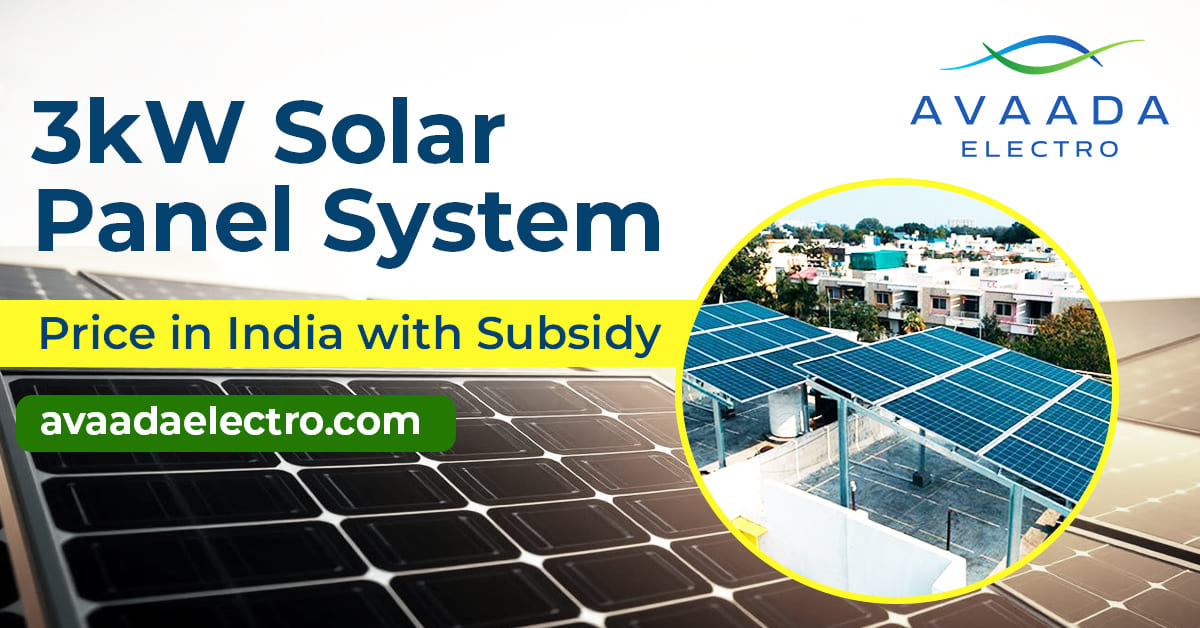
One of the most convenient and desired options for solar panel solutions in Indian houses in 2026 is a 3 kW solar panel system. It is strong enough to meet the demands of a small-to-medium family, running the daily necessities such as fans, night-lights, refrigerators and even one with 1.5 tons of air conditioning load working a few hours a day.
With increased electricity tariffs and subsidies under the PM Surya Ghar: Muft Bijli Yojana program, the number of homeowners installing mid-range systems, such as the 3 kW one, continues to increase to save on electricity bills and help achieve the Indian government’s clean energy targets.
In this guide, we shall cover all the information that you should know, such as the cost of a 3 kW solar system in 2026 (before and after subsidy), the amount of savings that you can receive each month, the payback period, and how the solar system would be installed.
What Is a 3 kW Solar System?
A 3 kW solar system is a solar system that can produce around 12-15 units of electricity per day, depending on the amount of sunlight and the efficiency of the panels. In a year, this is approximately 4,500 -5,400 units of clean power sufficiency to fulfil the energy requirements of most of a normal family.
How does it work?
The solar panels on your rooftop convert sunlight into electricity. The DC power produced is taken through an inverter and converted into usable AC power, which it sends directly to your home or sends the surplus power to the grid on credit by using net-metering.
How does a typical 3 kW setup look?
| Component | Specification |
| Solar Panels | 10–12 panels (depends on Wp rating, e.g. 630–720 Wp TOPCon or Mono PERC) |
| Space Required | Around 270–300 sq. ft. of shade-free rooftop |
| Daily Generation | 12–15 kWh |
| Ideal For | Homes using 400–500 units/month, small offices, shops, or independent villas |
A 3 kW system offers the sweet spot. Why? Because it is not too small like a 1 kW, yet not as expensive as a 5 kW setup. It is completely scalable, effective, and fits most urban and semi-urban households perfectly.
3 kW Solar System Price in India (2026)
In 2026, the average cost of a 3 kW rooftop solar system in India ranges between ₹1.6 lakh and ₹2.15 lakh, depending on technology, location, and type (on-grid, hybrid, or off-grid).
After accounting for the PM Surya Ghar subsidy, homeowners can expect to pay roughly ₹82,000 to ₹1.07 lakh net, nearly half the upfront price.
3 kW Solar System Price & Subsidy Table (2026)
| System Type | Approx. Cost (Before Subsidy) | Subsidy (₹) | Net Cost (After Subsidy) | Perfect for |
| On-Grid | ₹1.6 – ₹1.8 lakh | ₹78,000 (max limit) | ₹82,000 – ₹1.02 lakh | Homes with stable grid power |
| Hybrid (with Battery) | ₹2.1 – ₹2.3 lakh | ₹78,000 (for solar portion only) | ₹1.32 – ₹1.52 lakh | Homes are facing frequent power cuts |
| Off-Grid | ₹2.4 – ₹2.6 lakh | Not eligible for subsidy | ₹2.4 – ₹2.6 lakh | Remote/rural areas without grid access |
Important Note – Prices may vary by 5-10% depending on roof type, local labour, and module efficiency (N-Type TOPCon vs Mono-PERC).
This cost involves panels, an inverter, structure, wiring, protection devices, and installation charges.
What Can a 3 kW Solar System Run?
A 3 kW solar setup can easily power most of the appliances in a 2-3 BHK home. It is assumed that an average daily consumption pattern.
Appliance Capacity Example
| Appliance | Quantity |
| LED Lights (9–12W) | 8–10 |
| Ceiling Fans (60W) | 4–5 |
| Refrigerator | 1 |
| Television | 1 |
| Laptop or Wi-Fi Router | 2–3 |
| Washing Machine | 1 |
| 1.5 Ton AC | 1 (4–5 hrs/day) |
| Misc. Loads (mixers, chargers, etc.) | Multiple small loads |
An average 3 kW solar power system can produce an average of 400-450 units of power each and every month, which is sufficient to offset 60-80% of the family’s bill, depending on their usage and the amount of sunlight received.
In case of houses in sun-abundant areas such as Gujarat, Rajasthan or Andhra Pradesh, monthly savings of up to INR 2,000 to INR 3,000 will give solar a decisive advantage over grid power.
Subsidy & Policy Support Under PM Surya Ghar Yojana (2026)
The 2024 PM Surya Ghar, established by the Government of India, will still render rooftop solar affordable to access in 2026.
The subsidy rate is 40% of the benchmark cost in the case of a 3 kW residential solar system, considering a limit of INR 78,000. This value is directly charged to the homeowner’s bank account after being investigated and successfully synced to the grid.
How to Apply for a Subsidy?
- Register on pmsuryaghar.gov.in.
- Select a vendor panelled by MNRE.
- The vendor does system installation and submits details on the system.
- The net meter is verified by the Local DISCOM and installed.
- Subsidy is added to your bank account after inspection.
Thing to remember – Subsidy will only apply to the ALMM-listed panel and MNRE-approved vendors- this will guarantee the quality, accountability and sustainability.
Detailed Cost Breakdown (Component-Wise)
A 3 kW solar system includes more than just panels, and a number of key components decide both performance and price.
Here’s a breakdown of how your cost typically divides –
| Component | Estimated Cost Range (₹) | Description |
| Solar Panels (3 kW @ ₹25–28/Wp) | ₹75,000 – ₹84,000 | N-Type TOPCon or Mono-PERC panels; higher efficiency panels cost slightly more |
| Inverter (String / Hybrid) | ₹22,000 – ₹35,000 | Converts DC to AC; hybrid adds battery support |
| Mounting Structure & Accessories | ₹12,000 – ₹18,000 | Aluminium or galvanised structure with wind-load safety |
| Cables, DCDB, ACDB, SPD, Earthing | ₹8,000 – ₹12,000 | Electrical safety and interconnections |
| Installation & Labour | ₹10,000 – ₹15,000 | Includes design, wiring, and testing |
| Net Metering & Documentation | ₹3,000 – ₹5,000 | DISCOM fees and coordination charges |
So,
Total (Before Subsidy) – ₹1.6 – ₹2.15 lakh
Total (After Subsidy) – ₹82,000 – ₹1.07 lakh
Payback & ROI Analysis
A 3kW solar panel is not merely an environmental choice, but also a financial one. The system pays for itself within a few years and then produces free electricity for the next two decades.
How the Payback Works
Your solar system produces roughly 4,500 – 5,400 units/year. Taking the average electricity cost at ₹7per unit, that’s between a saving of ₹31,500 – ₹37,800 annually. At a post-subsidy cost of about ₹1 lakh, you can recoup the investment in about 4 years.
Then, all savings are a direct hit to your power bills. Solar energy panels have a life span of more than 25 years, so you save for another 20 years with no cost or very nominal maintenance.
Example ROI Table for a 3 kW Solar System
| Parameter | Value / Estimate |
| System Capacity | 3 kW |
| Average Cost (After Subsidy) | ₹1,00,000 (approx.) |
| Annual Generation | 4,800 units |
| Average Tariff | ₹7 per unit |
| Annual Savings | ₹33,600 |
| Payback Period | 3.5 – 4.5 years |
| Lifetime Savings (25 yrs) | ₹7-8 lakh |
| ROI (Internal Rate of Return) | 18 – 22 % |
Factors Affecting Solar Installation Cost in 2026
The cost of your 3kW solar panel installation will be different depending on where you are and which installer or manufacturer you choose. Knowing what things affect the cost can help you make more educated decisions and prevent overspending.
- Panel Type & Efficiency
N-Type TOPCon or bifacial glass-to-glass modules have more investment upfront, but yield is higher by 3-5% and will also last longer.
Mono-PERC modules are also economical, but not quite as efficient.
- Inverter Type
The on-grid string inverters are the cheapest.
Hybrid inverters are more expensive by 20–30%, but some have batteries and can be used during a blackout.
- Mounting Structure & Roof Type
Ballasted or rail-based mounts are typically employed with precast RCC roofs.
Tin or pitched roofs (special clamps or elevated frames are required) add approximately 5-10 % the costs.
- Regional Labour & Material Costs
Set-up and delivery fees vary by dealer. Metro cities and in hilly terrain may increase the cost up to 8–12% due to logistics and labour.
- Distance to Connection Point
Longer DC or AC cable runs between the panels and the inverter result in higher material cost.
- Net Metering & DISCOM Fees
Meter testing, inspection, and synchronisation are charged separately by the electricity board of each state.
- Government Benchmark Rates
The benchmark cost is adjusted annually by the MNRE. If your dealer gives you a price that’s significantly above these prices, ensure justification in terms of module quality, warranty, or additional features.
Step-by-Step Installation Process Under PM Surya Ghar Subsidy (2026)
The installation of a rooftop solar system under the PM Surya Ghar: Muft Bijli Yojana is now less difficult, transparent and even more digitalised. Here’s how it works:
Step 1 – Submit the application on the National Portal
Visit pmsuryaghar.gov.in and create an electric account with your DISCOM number and state. When you log in, you can see the entire process, from vendor approval to subsidy disbursal.
Step 2 – Select an empanelled vendor
Select a solar installer on the MNRE-approved vendor list in your state. These vendors are the only ones who can perform installations which are eligible for the central subsidy.
Step 3 – Technical feasibility and site visit
The vendor will go to your house to examine the roof tops, availability of sun and volume required. They subsequently post a system proposal to get approval from DISCOM.
Step 4 – Equipment installation and verification
After approval, installation normally requires 37 days. This will involve climbing on panels, wiring, inverters, and safety. The DISCOM subsequently does an inspection on the system and makes sure that the standards are met.
Step 5 – Net metering & synchronisation
Your net meter is connected in such a way that you can sell any surplus power to the power grid and get credits. Once the system has been validated, it becomes synchronised to the grid.
Step 6 – Subsidy transfer
Once you have successfully inspected, your subsidy (up to 3 kW – 78,000) gets directly deposited into your bank account. This model of direct transfer does not use middlemen and is fast to process.
To be on the safe side, you should also keep a copy of your installation report with the net-metering application and certificate of completion. They can be required in future service or warranty claims.
Avaada Electro
Avaada Electro is a solar module manufacturer within the Avaada Group that provides modules compliant with required certification standards.
| Feature | Avaada Electro Advantage |
| Core Business | Solar module manufacturing |
| Panel Technology | N-Type TOPCon (bifacial glass-to-glass, 23%+ efficiency) |
| Manufacturing Facility | AI-enabled, automated plant at Butibori, Maharashtra |
| Certifications | ALMM, BIS, UL, IEC — subsidy-compliant |
| Warranty | 30-year linear performance guarantee |
| Market Reach | Nationwide distribution |
Technical & Service Edge
- Higher Power Density – 630–720 Wp modules generate more energy per sq. ft.
- Subsidy Compliance – ALMM-listed modules ensure eligibility under PM Surya Ghar.
- Turnkey EPC Support –
End-to-end installation and O&M services. - Sustainability at Scale – Modules designed for 25+ years with minimal degradation.
For a 3 kW system, selecting certified, high-efficiency modules can support long-term performance depending on installation quality and site conditions.
Quick Comparison – 1 kW vs 3 kW vs 5 kW Solar Systems (2026)
To help you make the right choice, here is a simple comparison of the most common residential system sizes.
| System Capacity | Ideal For | Average Daily Generation | Monthly Savings (₹) | Net Cost (After Subsidy) | Payback Period | Roof Space Needed |
| 1 kW | Small home (1BHK) | 4–5 units | ₹800–₹1,200 | ₹35,000–₹45,000 | 3.5-4.5 years | 100 sq. ft. |
| 3 kW | Mid-size family (2–3 BHK) | 12–15 units | ₹2,000–₹3,000 | ₹82,000–₹1.07 lakh | 4-5 years | 270–300 sq. ft. |
| 5 kW | Large family or villa | 20–24 units | ₹3,500–₹4,500 | ₹1.4–₹1.6 lakh | 5-6 years | 450–500 sq. ft. |
What is the Key takeaway?
A 3 kW system brings out the perfect balance between cost and coverage. It can power nearly all household essentials and deliver significant savings. It does that without requiring extra rooftop space or heavy investment.
Conclusion
One of the best solutions that will make Indian homeowners energy independent in 2026 is the implementation of a 3 kW rooftop solar system. It is one of the smartest and most cost-effective methods to attain energy independence.
It is no longer an eco-choice, but an economic upgrade, with affordability and a quick 4-5-year payback, with subsidies of INR 2000-3000 a month and savings.
Frequently Asked Questions
How much would a 3 kW solar system cost in India in 2026?
An annual 3kW solar system will cost approximately INR 1.6-2.15 lakh with no subsidies. After the subsidy PM Surya Ghar (up to 78000), the actual cost is between INR 82000 and INR 107000.
What is the power output on a 3 kW system per day?
It yields an average of 12-15 units per day (4,500- 5,400 per year) based on sunlight and the type of panel.
What appliances can it power?
It has the capacity to operate all of the lights, fans, a refrigerator, a TV, a washing machine, and a 1.5-ton AC for several hours a day.
What is the area required for 3 kW solar panels?
About 270-300 sq. ft. of rooftop space.
Does it have a subsidy for 3 kW systems?
The PM Surya Ghar Yojana grants a direct benefit to the homeowners (up to INR 78,000).
What is the payback period of a 3kW solar panel system in India?
It takes between 4 and 5 years, after which the electricity becomes virtually free during the rest of the 20 or so years of system life.
Can I install this system by myself?
Depending on subsidies, the system should be commissioned by a vendor under MNRE.
What does it need in terms of maintenance?
Solar panels need to be cleaned monthly or every 2 months, and inverters need regular performance reviews. There are no fuel or high-maintenance expenses involved.
How long do solar panels last?
Good modules such as those of Avaada Electro, last over 25-30 years, and the efficiency can still be up to 85-90% even after 20 years.
Is it possible to grow my 3 kW system?
Yes. A power output of 5 kW or more can be scaled to most inverters and enable more efficient module setups in anticipation of future energy requirements.