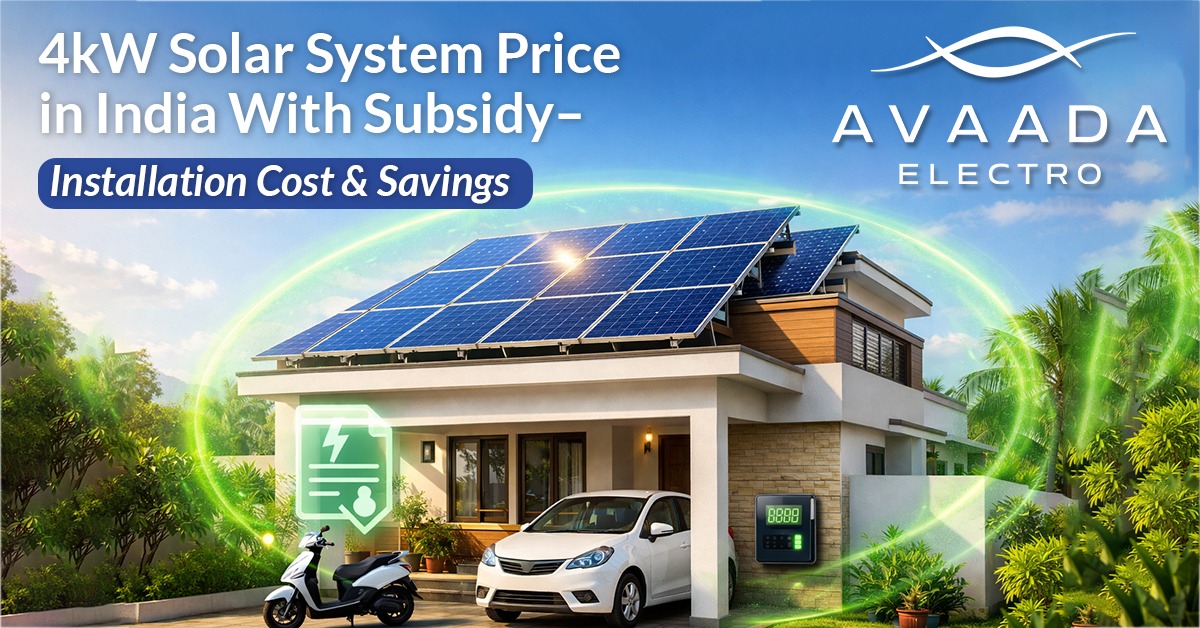
A 4kW rooftop solar system is one of the most practical and cost-efficient solar solutions for Indian households and small commercial users. With rising electricity tariffs and expanding government incentives, understanding the actual installation cost, available subsidies, and long-term savings is essential before making an investment decision.
This guide provides a clear, data-driven view of 4kW solar system prices in India in 2026, including cost before and after subsidy, realistic energy generation, and expected payback periods. It also explains how the PM Surya Ghar subsidy applies, what factors influence pricing, and how net metering affects your savings.
Use this guide to evaluate installer quotes, verify subsidy eligibility, and make a confident, financially sound solar investment based on real numbers, not assumptions.
What Does the Subsidy Look Like in 2026?
The central scheme PM-Surya Ghar: Muft Bijli Yojana provides central financial assistance to residential rooftop PV installations. For residential consumers, the published structure includes amounts per kW for the first capacities and a cap for larger systems.
For systems 3 kW and above, the effective cap is ₹78,000. The official scheme page and implementation guidelines detail the rates and application process.
Practical point: states and utilities may add top-up subsidies or apply different administrative rules. Always check both the central scheme and your state DISCOM site before finalising procurement.
Typical Market Prices for a 4kW system (2026)
Market quotes vary by product quality, inverter type, mounting, and installer overhead. Use the ranges below to benchmark quotes:
- Low-cost (economy): ₹40,000–₹50,000 per kW → ~₹1.6 lakh–₹2.0 lakh for 4kW. (Basic modules, simple string inverter, standard mounting).
- Mid-range (most common): ~₹2.8 lakh–₹3.2 lakh for 4kW (branded mono modules, reliable string or hybrid inverter, quality BOS, and workmanship).
- Premium: ₹3.5 lakh and above for 4kW (high-efficiency modules, hybrid/battery-ready inverter, premium mounting, extended warranties). Market advertisements and vendor pages show premium packages at this level.
Cost components (typical split)
- Modules: 35–45%
- Inverter: 12–18%
- Mounting & civil: 8–12%
- Electrical, wiring, protections: 6–10%
- Installation labour & commissioning: 8–12%
- GST and miscellaneous: remainder
Use the above percentages to check the reasonableness of your vendor’s bill of materials (BoM). Reliable vendors will provide a BoM with model numbers and warranty terms.
How the Subsidy Applies – Simple Worked Example
Assume a mid-range price quote – ₹2,80,000 for a 4kW system (pre-subsidy). Under PM-Surya Ghar, the central assistance for ≥3 kW is ₹78,000. Net price after central subsidy:
- Under PM Surya Ghar Muft Bijli Yojana, the scheme provides 60% subsidy on benchmark cost for the first 2kW and 40% on the next 1kW (up to 3kW total), capping central assistance at ₹78,000 for ≥3kW systems like 4kW. Net price after central subsidy: ₹2,80,000 – ₹78,000 = ₹2,02,000.
- State subsidies may add benefits – e.g., Maharashtra up to ₹60,000 top-up, Uttar Pradesh ₹15,000-₹30,000, but vary and require local DISCOM verification.
- Larger systems like 4kW emphasize electricity bill savings for faster ROI over subsidies alone.
- Net payable ≈ ₹2,02,000 (before any state top-up, additional discounts, or finance costs).
If a state DISCOM offers a top-up or a local incentive, that reduces the net payable further. Always require the vendor to show the subsidy paperwork and the final invoice that reflects the subsidy.
Expected Energy Generation from 4kW Solar System (Realistic Method)
To estimate annual generation use specific yield (kWh per kWp per year). In India, typical rooftop specific yield values commonly used for planning lie in the 1,200–1,600 kWh/kWp/year band, depending on location and tilt. Conservative planning often uses ~1,300–1,400 kWh/kWp/year for many populated regions.
Example (practical):
- Specific yield used: 1,400 kWh/kWp/year (midcase).
- Annual generation = 4kW × 1,400 = 5,600 kWh/year.
Use PVWatts or a professional PVsyst simulation to get location-specific monthly profiles and more accurate hourly estimates. NREL’s PVWatts is the standard public tool for quick, credible estimates.
Savings and simple payback: worked examples
Savings depend on your retail electricity tariff and export rules (net metering or net billing). Use the following steps:
- Choose a tariff to value self-consumed units and exported units.
- Multiply annual generation by the tariff to estimate gross annual savings.
- Subtract annual O&M and insurance to get net annual savings.
- Payback = (Net installed cost after subsidy) ÷ (Net annual savings).
Two worked examples
Example A – Conservative (urban, modest tariff)
- Net cost after central subsidy: ₹2,02,000 (from above).
- Annual generation: 5,600 kWh.
- Average value per unit (weighted self-use & export): ₹7.5/unit (depends on consumption and net-meter rules).
- Annual gross savings = 5,600 × ₹7.5 = ₹42,000.
- O&M & insurance approx = ₹3,000–₹6,000/year.
- Net annual savings ≈ ₹36,000–₹39,000.
- Simple payback ≈ 5.2–5.6 years.
Example B – High tariff / good net-metering (favourable state)
- Same net cost: ₹2,02,000.
- Annual generation: 5,600 kWh.
- Effective value per unit: ₹9.0/unit (higher export or higher retail rates).
- Annual gross savings = 5,600 × ₹9 = ₹50,400.
- Net annual savings ≈ ₹44,000–₹47,000 after O&M.
- Simple payback ≈ 4.3–4.6 years.
These examples illustrate why local tariffs and export policies materially affect payback. Always model using your exact tariff and expected self-consumption fraction.
Net Metering, Net Billing, and State Differences
Net metering remains the primary mechanism for residential rooftop schemes in many states. Some states have moved to net-billing or set export tariffs that determine the value of exported energy. These rules affect the effective price per unit you receive for surplus generation and, therefore, your payback.
Example: a recent state update increased export rates and clarified virtual/group net-metering rules; such changes improve economics for rooftop owners and apartment societies.
Check your state DISCOM portal and the RERC/State ERC notifications before finalising assumptions.
Financing the 4kW system and the Subsidy Application Process
Financing options
- Home/solar loans: many banks and NBFCs offer solar-specific loans with tenors up to 7–10 years.
- EMI & vendor finance: Some vendors provide zero-down or low-interest EMIs.
- Scheme loan aggregation: under PM-Surya Ghar, the implementing agencies may facilitate loan aggregation for beneficiaries. Check the scheme notes.
Subsidy Application – Practical Checklist
- Confirm eligibility and documentation requirements with your chosen installer.
- The installer typically registers the system in tender mode or the appropriate portal per scheme guidelines.
- Submission of identity, ownership proof, and site details; installation under the approved BoQ.
- After commissioning the appliance, subsidy claims are processed per implementing agency rules; the timeline varies by state and tender.
Vendors who understand the PM-Surya Ghar process manage registration and documentation; they are required to provide a step-by-step subsidy timeline in writing.
Component Choices that Materially Affect Cost and Performance
Selecting the right BoM is the most important procurement decision.
- Modules: Mono-crystalline branded modules are the usual choice for the balance of cost and efficiency. TOPCon/HJT modules increase energy yield but raise cost.
- Inverter: String inverters are cost-effective for uniform roof layouts. Hybrid or battery-ready inverters add flexibility for future storage but increase upfront cost.
- Mounting & civil: Roof condition, tilt, and type determine mounting costs. A roof repair or reinforcement increases overall project cost.
Request the full BoM with model numbers, datasheets, and test certificates. Verify inverter MPPT count and warranties; insist on manufacturer warranty statements in writing.
Installation Timeline & Common Delays
Typical schedule:
- Site survey & quote: 1–3 days
- Permits & DISCOM approvals: 7–30 days (varies by state)
- Procurement & delivery: 7–21 days (depends on stock)
- Installation & commissioning: 1–4 days on site for 4kW
- Metering & subsidy documentation: additional 7–30+ days depending on agency
Delays usually arise from roof repairs, permit backlogs, or long vendor lead times. Confirm a realistic timeline in the contract.
Warranties, Maintenance, and Lifetime Costs
- Module product warranty: typically 10–12 years.
- Performance warranty: many modules guarantee ~80–85% output at 25 years.
- Inverter warranty: typically 5–10 years; extended warranties available.
- O&M: routine cleaning once or twice per year; annual service checks recommended. Budget ₹3,000–₹6,000/year for basic O&M on a 4kW system.
Factor warranty terms and spare parts availability into vendor selection. A lower quoted price with a weak warranty or an unclear BoM is higher risk.
On-Grid Vs Hybrid Vs Off-Grid 4kW Solar System
- On-grid (most common): Lowest upfront cost; relies on grid for night use; eligible for central subsidy; best payback.
- Hybrid (battery-ready): Higher cost; provides backup during outages if sized with a battery; may reduce subsidy eligibility when batteries are included.
- Off-grid: Not suitable for most urban homes; requires a large battery bank; high cost and complex design.
For most homeowners seeking bill reduction and subsidy, an on-grid 4kW system with future battery-readiness is the pragmatic choice.
How To Validate Vendor Quotes – Quick Checklist
- Request BoM with model numbers, datasheets, and certificates.
- Ask for a PVWatts or installer simulation for your address showing annual kWh.
- Verify warranty transferability and claim process.
- Check installer references and past projects.
- Ensure the quote separates the subsidy, taxes, and final net payable.
These steps avoid overpriced equipment, hidden costs, and late surprises.
Practical Recommendations
- Obtain 3 competitive quotes and compare BoMs line-by-line.
- Require the installer to provide a PVWatts/PVsyst simulation for your exact address.
- Confirm subsidy eligibility and who will handle subsidy registration.
- Check state DISCOM export rules and recent tariffs; small differences materially affect payback.
Conclusion
A 4kW rooftop solar system remains one of the most effective ways for Indian households to reduce electricity bills and lock in lower energy costs. Use these steps:
- Benchmark quotes against the cost bands in this guide.
- Confirm central subsidy (PM-Surya Ghar) application and any state top-ups.
- Require a PVWatts or equivalent simulation for your exact location and a detailed BoM with datasheets.
A properly chosen 4kW system, purchased transparently and supported by a reliable installer, commonly repays its net cost in 4–6 years under current tariffs and net-metering regimes. Verify the numbers with location-specific modeling before signing any contract.
Frequently Asked Questions
What is the price of a 4kW solar system in India in 2026?
A 4kW rooftop solar system typically costs between ₹2.4 lakh and ₹3.2 lakh before subsidy. The final price depends on module quality, inverter type, and installation standards.
How much subsidy is available for a 4kW solar system?
Under the PM Surya Ghar scheme, systems of 3kW and above are eligible for a subsidy up to ₹78,000. The exact amount is credited after installation and approval.
What is the net cost of a 4kW solar system after subsidy?
After applying the central subsidy, the net cost usually ranges from ₹1.6 lakh to ₹2.8 lakh. State-level incentives, if available, can further reduce the cost.
How many units does a 4kW solar system generate per year?
A 4kW system typically generates 4,800 to 6,400 units annually. Actual generation depends on location, roof orientation, and sunlight availability.
Is a 4kW solar system enough for a household?
Yes, it is suitable for a medium-sized home with moderate electricity consumption. It can cover lighting, fans, appliances, and limited air-conditioning use.
How many solar panels are required for a 4kW system?
Usually, 8 to 12 panels are needed, depending on individual panel wattage. Higher-watt panels reduce the total number of panels required.
How much roof area is needed for a 4kW solar system?
Approximately 300 to 400 square feet of shadow-free roof area is required. The exact area depends on panel efficiency and layout.
What is the payback period for a 4kW solar system?
Most users recover their investment within 4 to 6 years after the subsidy. Payback depends on electricity tariffs, self-consumption, and net metering rules.
Is net metering available for a 4kW solar system?
In most states, net metering is available for residential rooftop solar systems. Export and billing rules vary by state and DISCOM.
Can I add batteries to a 4kW solar system later?
Yes, batteries can be added later if a hybrid or battery-ready inverter is used. This allows backup power during grid outages.
How long does installation and subsidy approval take?
Installation typically takes 1 to 3 days after approvals. Subsidy processing and credit may take several weeks, depending on the state.
Is a 4kW solar system worth installing in 2026?
Yes, with rising electricity tariffs and available subsidies, it offers strong long-term savings. It is one of the most cost-effective rooftop solar systems for homes in India.