
The average home requires 15 to 20 solar panels to power it. However, did you know that simply installing a certain number of solar panels on your roof isn’t enough?
Knowing your home’s solar needs helps you compare quotes and produce as much solar energy as you can. It also makes it easy for you to save money without having to make changes to your budget.
In this article, we provide detailed information on how many solar panels are needed to power a house, as well as other essential details that will save you both time and money.
What Are Solar Panels And How Do They Work?
Solar panels are devices that convert sunlight into electricity using many small solar cells. They are installed in small compartments, generate electricity in solar cells, and are manufactured from silicon. When light from the sun hits those cells, it creates an electric current. This process is known as the photovoltaic effect.
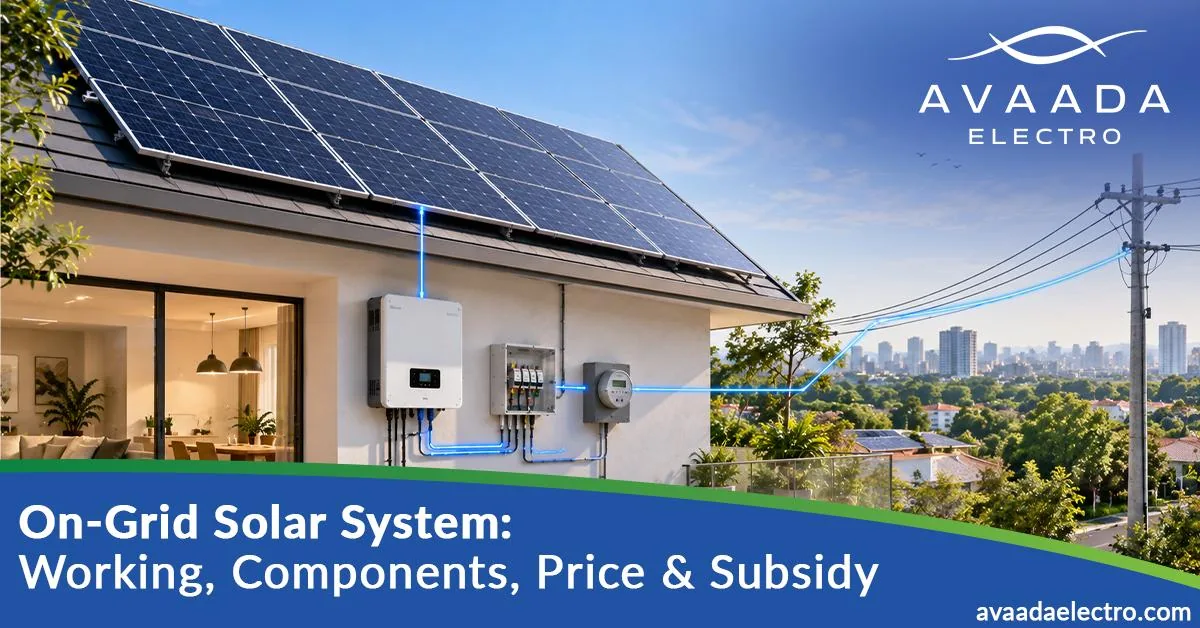
It is in the form of direct current (DC), which your home devices can’t directly use. It then runs through an inverter, converting it into alternating current (AC). AC is the type of electricity used in our homes.
A basic solar setup includes –
- Solar panels (to capture sunlight)
- Inverter (for type of DC to AC)
- Battery (optional, as a power bank for extra power)
- Net Meter (to record how much electricity has been drawn and how much has been exported)
Depending on their size, solar systems can power basic appliances like lights and fans, as well as high-consumption devices, including air conditioners and refrigerators.
How does it benefit?
Installing solar panels can reduce your electric bills, decrease your carbon footprint, and provide energy independence. They are also low-maintenance once installed, can run for 25 years or more, and are thus a great and smart investment for homes in India.
Key Factors Affecting Solar Panel Requirements
Now that you have gone through the basic concepts of solar panels, let us see the key factors affecting solar panel requirements –
a. Household energy consumption
One of the most important factors to consider when you’re calculating how many solar panels you need is how much electricity your home requires. In India, you can verify this by cross-checking the amount you pay monthly on your electricity bill. The total displayed in kilowatt-hours (kWh) is the amount you used in a month.
For instance, your tiny 1BHK flat might consume 100-150 units/month, and a 2-3 BHK house might consume 200-300 units/month, depending on fans, ACs, geysers, and kitchen appliances. Also, big homes or multiple AC homes can consume 400 units/month and above.
Understanding your usage makes installing the proper solar system easier, whether it’s a 3kW system or a 5kW system, because of the usage of homes. Also, remember there are seasonal differences, such as more AC is used in the summer. View your bills over a 6-12 month period, and it’s all clearer.
b. Solar irradiance and geographic location
The amount of sunlight your home receives depends heavily on its location. Solar irradiance, the strength of sunlight, changes across India. It depends on the geography, climate, and elevation.
For instance, a house in Rajasthan gets 6 to 7 peak sun hours of sunlight exposure, which is perfect for high solar power generation. On the other hand, a home in Himachal Pradesh might get just 4-5 peak sun hours, especially when there is fog or snow in the winter.
Solar panels in sunny areas need fewer panels to get the same amount of electricity as homes in less sunny areas.
Average monthly peak sun hours in different regions of India
Here is a region-wise table for India showing average monthly peak sun hours, based on solar light data collected from popular sources, such as NREL, etc. This is apt for predicting solar energy production strength.
| Region | Average Monthly Peak Sun Hours |
| North India [Delhi, Punjab, UP] | 135 – 165 hours |
| Western India [Rajasthan, Gujarat, Maharashtra] | 180 – 220 hours |
| Central India [Madhya Pradesh, Chhattisgarh] | 160 – 200 hours |
| South India [Tamil Nadu, Karnataka, Telangana, Andhra] | 170 – 210 hours |
| Eastern India [West Bengal, Odisha, Bihar] | 140 – 180 hours |
| Northeast India [Assam, Meghalaya, Nagaland] | 110 – 150 hours |
| Coastal Regions [Goa, Kerala, Maharashtra Coast] | 150 – 190 hours |
| Hilly Regions [J&K, Himachal, Uttarakhand] | 120 – 160 hours |
c. Roof size, orientation, and shade
In India, the best practice is to have a south-facing roof with a slope between 15 and 25 degrees for all the months of the year. If you have an East or West-facing roof, we can still install solar panels, and it will work well. You will simply require a few more panels to generate the same energy output. With smart design and placement, most Indian homes can generate adequate solar power, regardless of the direction their roofs face.
Shade from trees, walls, or water tanks can reduce solar output by 20–40%, so panels should be kept in open, shadow-free areas for top performance.
How to Calculate How Many Solar Panels Are Needed to Run a House?
Curious to know how many solar panels are needed to power a house in India? Here’s a step-by-step guide to help you know how much electricity you need and how to set up your solar system well.
Step 1 – Review your monthly electricity usage (in kWh)
Check your electricity bills from the last 6-12 months and the units (kWh) your home uses in a month.
Example – An average Indian home uses approximately. 400–500 kWh/month.
Step 2 – Understand how much power 1 kW of Solar can produce at your home
1 kW of solar panels in India, on average, generates 110 –130 kWh/month, depending on the season and location.
Example – It might be approximately around 120 kWh/month in Delhi or Gujarat. In Himachal or Kerala, it is probably lower i.e. 100 kWh/month.
Stage 3 – Calculate your required system size (kW)
Use this simple formula –
System Size (kW) = Monthly Usage (kWh) / Solar Production per kW/month
Example – 500 kWh ÷ 120 = 4.2 kW system required
Step 4 – Check how many panels you need
In India, the most popular panels are rated from 330W to 550W.
Assume you choose 330W panels.
Number of Panels = System Size (in Watts) ÷ Panel Wattage
4.2kW = 4,200W / 330W ≈ 13 panels
Step 5 – Adjust for real world efficiency losses (Approx. 20%)
Solar systems are never 100% efficient. Dust, wiring loss, shade, and temperature are some of the factors that contribute to the overall lower performance.
To be on the safe side, oversize your system a bit.
Adjusted System Size = System Size × 1.2
4.2 kW x 1.2 = 5 kW recommended system.
Read More – Solar Panel Installation For Home Cost
Common Residential System Sizes and What Power They Need
When considering a solar installation, knowing the difference between a 3kW and 5kW system will help you make an informed decision that takes into account your energy needs, budget, and rooftop size.
a. 3kW Solar Power System
3kW suits small families of 2–3 people. It is capable of producing approximately 12–15 units of electricity a day, depending on where you live and how much sunlight you can get per day.
It usually takes 300 sq. ft. of shadow-free rooftop space.
Its size is ideal for running lights, fans, TV, refrigerator, and the washing machine.
A 3kW system is well-suited for homes with low to moderate energy usage and minimal air conditioning requirements.
b. 5kW Solar Power System
A 5kW system is perfect for a medium-sized home or a home whose family has a medium to high electricity consumption. This plant generates some 20-25 units daily and requires about 450-500 sq. ft. of rooftop space.
It can run multiple fans, lights, ACs, a water pump, and kitchen appliances.
So, if you’re wondering how many panels are needed for a 5kW system, the average system installation is about 15-16 330W panels.
Solar Panel Types and Their Effectiveness
Choose a size as per your energy usage and operational needs.
When selecting solar panels for your home, it is essential to understand the types available, their performance differences, cost, and longevity. You should determine which one is best for your home.
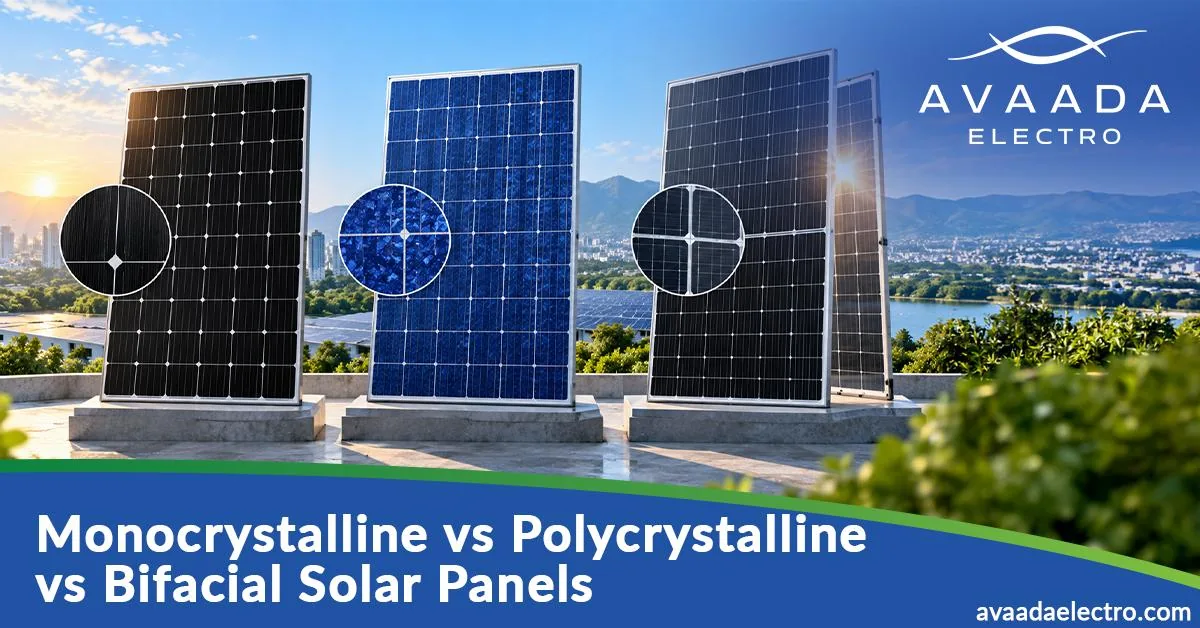
a. Topcon / PERC Monocrystalline Panels
These are high-efficiency panels, typically with an efficiency of about 23–26%. They perform great in a small roof space as they need fewer panels. And they tend to last longer and hold up better in hot weather, although they are pricier.
b. Polycrystalline Panels
These tend to be cheaper and are more popular in India. They have a slightly lower efficiency, ranging from about 18% to 19%, but they still perform well in homes with ample rooftop space. They offer a good balance between performance and cost-effectiveness, making them a popular and available choice.
c. Thin-Film Panels
These are light, flexible panels, most suitable for special applications such as curved roofs or temporary installations. However, they are less efficient (~16–19%) and not generally suitable for residential rooftops.
Panel-based Comparison
| Panel Type | Efficiency | Cost | Lifespan |
| Topcon / PERC Monocrystalline | High (23–26%) | High | 25+ years |
| Polycrystalline | Medium (18–19%) | Moderate | 25 years |
| Thin-Film CdTe | Low (16–19%) | Low | 25 years |
Solar Panel Maintenance Tips for Long-Term Efficiency
Your solar panels need to be monitored, and should be clear, and clean to operate at maximum effectiveness for many years to come. This is how you should clean your solar panels –
- Clean the panels every 2–3 months using soft water and a soft cloth to remove dust, bird droppings, and dirt.
- Do not use a solvent, acid, or harsh material to clean the product, as this will cause damage.
- Check for new sources of shade, such as growing trees, nearby structures, or gathering debris, that may block sunlight and reduce panel efficiency.
- Once a year, the wires and connectors should be inspected for signs of wear, loose ends, or damage caused by animals during the off-season.
- Keep an eye on the inverter output to ensure everything is functioning properly with your system.
- Arrange professional maintenance at least every 1-2 years to maintain ideal performance and health of the system.
- The maintenance of panels and systems requires minimal effort. Panels will continue to operate at top performance for more than 25 years.
Choosing the Right Solar Panel Installer & Brand
Choosing the right solar panel and the right installer is just as important as the panel itself.
Make sure that the solar brand you choose has an ALMM (Approved List of Models and Manufacturers) mark and the necessary BIS certification. This means it adheres to the quality and safety guidelines established by the government of India.
To make sure you get a durable device, settle for a trusted brand like Avaada Electro with high ratings and recommendations. Don’t go with the most inexpensive one, go with the most reliable one.
Also, it’s the installer that makes the most difference. A decent installer will also set the panels up right, hook the wires up safely, and put you in touch with the best sunlight. Low-cost installation can result in poor performance and extra repair expenses in the future.
We recommend that you get a site inspection before purchase. This can help you determine how many panels you need, where to put them, and how much your system will cost.
Read More – How Much Electricity Does A Solar Panel Produce
Conclusion
For India, the optimum choice would be a south facing inclined roof (between 15° and 25°) for all months of the year. If your roof is East or West facing, we can still fit solar panels, and they’ll perform, you just need a few more panels to achieve the same amount of electricity generation.
With intelligent design and placement, most homes in India can generate enough solar energy, no matter what your roof’s orientation is.
Frequently Asked Questions
How do I determine the number of solar panels I need for my home?
You can work it out by dividing the total electricity you use in your home each month (measured in kWh) by the average monthly output of a single one of your panels. The number also varies based on how powerful the panel is in watts, how efficient it is, i.e., how many sun hours you get, and where you live.
How many solar panels are needed to get an electric supply to an average Indian home?
An Indian household with a monthly electricity consumption of 250-300 units will require 8-10 solar panels of 400W each to power nearly everything in the house. The figure will change depending on how much energy the region consumes and how much sun it gets.
Can you run a house entirely on solar power?
Yes, it’s possible if your system is sized to match your total energy use or if you have a battery backup or net-metering agreement with your utility company. Proper planning and load planning are vital.
How many solar panels are required for a 3 BHK house?
A 3 BHK house, for example, may require approximately 10-12 panels of 400W to meet its daily power needs. This number will depend on your actual usage, appliances, and the hours of sunlight you receive.
How much solar panel do I need?
It will depend on factors such as the amount of electricity you use, the wattage of the panels on your roof, the available roof space, your location, and whether there’s shading. If you use more energy or the sun shines less where you are, you need more panels.
What is the maximum solar panel output per day?
In India, an average 400W solar panel gives around 1.6 to 2.2 electricity units (kWh) per day. The output is dependent on the length of daylight and the orientation of the panels.
Do solar panels work when it’s cloudy or raining?
Solar panels still work, but not as well when it’s not sunny. Typically, they will generate 10-25% of the power of a sunny day. You have a battery or a grid connection to rely on days like these.
Can I expand my solar panels later?
Yes, most systems are expandable. You can add additional panels later, provided your inverter is compatible, and you have adequate roof space. This allows you to scale your solar system as your energy needs increase.
What are the benefits of having a rooftop in a house for solar panels?
You need around 100–120 sq. ft. of unshaded roof space per kilowatt of solar system. A 3–5 kW system would have to supply an area of 300–600 sq. ft.