
In India, states such as Rajasthan (36 GW), Gujarat (24.8 GW), and Maharashtra (17.2 GW) lead in solar installations. Net-metering policies are implemented across more than 17 states, typically for rooftop systems up to 500 kW, subject to state regulations.
Net metering is a core billing mechanism that directly determines the financial viability of grid-connected rooftop solar systems. However, despite its significance, it remains poorly understood.
Net metering determines how surplus solar power is handled, how electricity bills are calculated, and how quickly a solar system achieves payback. Before installing any grid-connected solar system, it is important to understand how it works.
The guide describes what net metering is, how it operates, the various types of net meters in use today, and the practical advantages of using net metering in straightforward terms.
What Does Net Metering Mean?
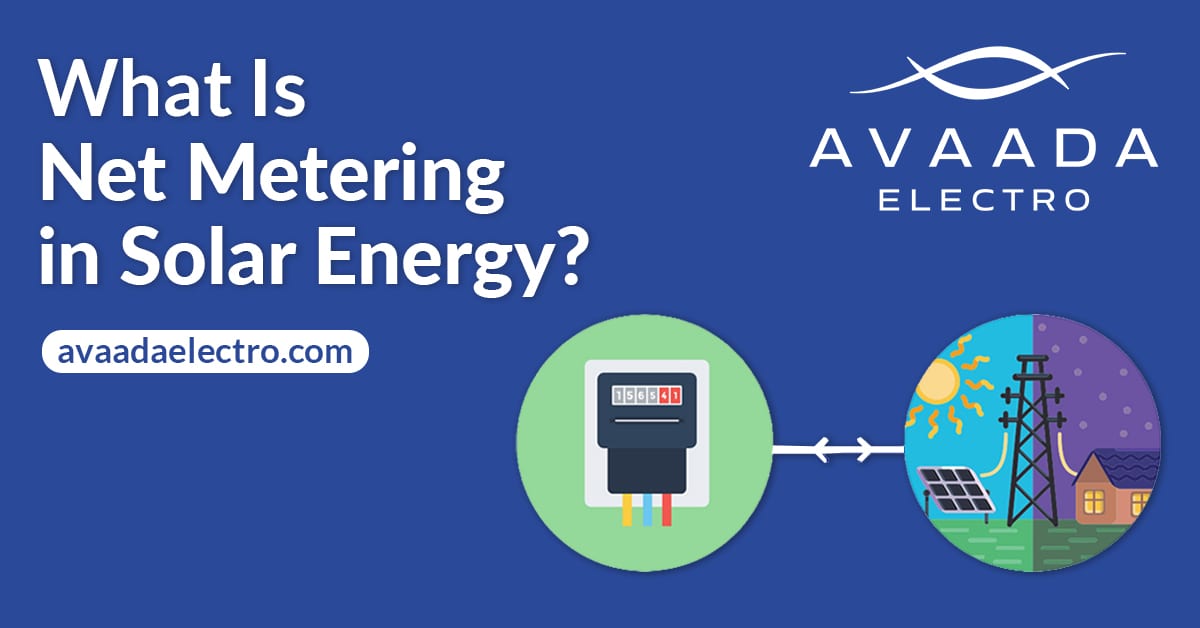
Net metering refers to a billing system applied to grid-connected solar systems. It measures the net difference between the electricity you draw from the grid and the electricity your solar system exports to the grid.
Consider the following example:
- In a day, your solar system produces 40 units of electricity.
- You use 25 units at home.
- The remaining 15 units are exported to the grid.
- These 15 units are recorded as energy credits on your meter.
Afterwards, at night or when there are clouds and your solar system is not generating enough power, you pull electricity from the grid. The already accumulated credits are applied to your electric bill.
Net metering ensures that excess solar energy is not wasted.
How Net Metering Works (Step-by-Step Guide)
The principles of net metering involve the use of a joint mechanism of solar panels, a grid-tied inverter, and a two-way electricity meter.
Step 1: Solar Generation Begins
Solar panels generate electricity during the day. This power supplies the connected building or facility.
Step 2: Self-Consumption
Your appliances are powered directly by solar generation. This reduces electricity drawn from the grid.
Step 3: Export of Excess Power
When your solar system generates more electricity than you use, it feeds into the utility grid.
Step 4: Meter Records Export
A bi-directional meter is used to record the number of units exported to and imported from the grid.
Step 5: Credit Adjustment on Bill
The utility determines the following at the end of the billing cycle:
- Units imported from the grid
- Units exported to the grid
You only pay for the net units consumed, or receive credits if exports exceed imports.
This mechanism ensures transparent billing and accurate energy accounting.
Net Metering vs Net Billing vs Gross Metering
Not all regions use the same system. The metering mechanism directly determines savings and payback.
| Feature | Net Metering | Net Billing | Gross Metering |
| Self-consumption | Yes | Yes | No |
| Exported energy value | Adjusted at the retail tariff | Paid at a fixed export tariff | Entire generation sold to the grid |
| Electricity bill | Based on net units | Separate import & export bills | Only consumption billed |
| Best for | Homes & rooftop users | Regions phasing out net metering | Large producers |
Among these models, net metering delivers the highest savings for most residential rooftop systems by valuing exported electricity at near-retail tariffs.
Types and Variants of Net Metering
1. Standard Net Metering
Applied to a single home or building that has a single electricity connection.
2. Group Net Metering
Enables the use of solar energy from a single system to serve multiple meters on the same premises, e.g., housing societies.
3. Virtual Net Metering (VNM)
The credits are also distributed to several users who need not be physically linked to the same solar system. This is typical of community solar designs.
4. Time-of-Day Net Metering
Credits and charges change with time, and electricity is used or exported, which promotes off-peak consumption.
Utilities apply different net-metering variants based on grid and regulatory requirements.
Why Net Metering Matters – Key Benefits
Net metering is a key policy mechanism driving rooftop solar adoption. It ensures that surplus solar generation is not wasted, so that consumers receive fair value for the electricity they generate.
These are the main advantages of net metering discussed below.
1. Major Reduction in Electricity Bills
The most immediate advantage of net metering is a substantial reduction in monthly electricity bills.
In practice, well-sized rooftop systems reduce electricity bills by 60–90%, depending on consumption patterns. These savings can amount to thousands of rupees over a year. As a result, rooftop solar becomes economically viable.
2. Faster Payback on Solar Investment
Directly, net metering enhances the financial performance of a rooftop solar system because each unit of surplus energy will be valued. Instead of losing excess power, users receive credits that minimize subsequent bills.
This shortens payback periods and improves long-term project returns. In the absence of net metering, the surplus energy would be wasted unless it was stored in batteries.
3. No Immediate Need for Batteries
One of the most costly elements of a solar energy move is battery storage.
Net metering eliminates the immediate need for batteries by allowing the grid to function as virtual energy storage, reducing upfront costs and system complexity.
In most grid-connected homes and buildings, net metering provides the advantages of energy storage without the physical and financial costs and complexity of physical batteries.
4. Encourages Clean Energy Adoption
Net metering is important for a faster transition to clean, renewable energy. It makes rooftop solar cost-effective, reducing the barrier to entry for households and small businesses that would otherwise be unwilling to participate due to cost.
As the number of consumers switching to solar increases, the use of electricity generated by fossil fuels decreases. This leads to reduced greenhouse gas emissions and air pollution, and advances towards national and global climate pathways.
Net metering makes solar energy an environmental option rather than a financial decision, thereby spurring its adoption.
5. Grid Support and Peak Load Reduction
Net metering provides significant grid-based system-level advantages. Rooftop solar systems are installed near the point of consumption, so there is less transmission loss and less burden on the centralized power plant.
During peak daytime periods, when air conditioners, equipment, and business loads are at their highest, distributed solar generation helps alleviate grid load. This increases grid stability, reduces the need for costly peak power plants, and improves overall energy reliability.
In essence, net metering aligns consumer savings with grid efficiency and environmental sustainability.
Net Metering Policies: Real-World Context
Net-metering policies evolve over time. The utilities periodically adjust export tariffs, caps, and eligibility regulations to achieve equilibrium in grid economics.
Several states and countries have –
- Reduced export tariffs.
- Replaced net metering with net billing.
- Introduced smaller system size eligibility limits.
These changes reinforce the need to verify local regulations before system installation.
Net metering is one of the most consumer-friendly policies in the solar industry worldwide, even as regulatory frameworks evolve.
Read More – On Grid Solar System
How to Apply for Net Metering (Step-by-Step)
Although each utility may have different procedures, the overall process is quite similar.
Step 1: Site Survey & System Design
A solar installer estimates the roof area, load profile, and system capacity.
Step 2: Application to Utility (DISCOM)
Documents typically include:
- Application form
- System design details
- Construction safety certificate
- Electrical drawings
Step 3: Approval & Installation
Upon approval, the solar system is installed in accordance with the guidelines.
Step 4: Meter Replacement & Commissioning
The utility also converts the currently in-use meter to a bi-directional net meter.
Step 5: Billing Activation
Credits gained through net metering will begin to reflect on the subsequent electricity bill.
Common Pitfalls and What to Watch For
As much as net metering can make the economics of rooftop solar much more feasible, many system owners are experiencing issues that can be avoided through proper planning or an understanding of utility regulations. Identifying these pitfalls before installation helps avoid delays, financial losses, and operational issues.
Export caps
These are among the most disregarded constraints. Various utilities limit the amount of electricity a solar system can be permitted to export to the grid, either as a percentage of the authorized load or as a hard capacity limit.
In the event of the system generating surplus energy relative to the export rate, the excess energy will be curtailed or credited at a significantly lower rate. This reduces anticipated savings and increases the payback period. Always verify the export limits set by your local utility and design the system accordingly.
Credit expiry
This is another significant consideration. In other areas, the net metering credits are not rolled over permanently. Unused credits can be reset at the end of a billing year or a financial year, when generation exceeds consumption.
Oversized systems reduce financial efficiency when export credits expire or are capped. A review of credit carry-forward policies would help ensure that the system size matches the actual consumption pattern.
Policy changes
These are long-term risks that many solar owners overlook. The policies of net metering, export, tariffs, and eligibility criteria may vary depending on grid conditions and utilities’ growing solar penetration. Although existing systems are often exempted under earlier rules, this is not guaranteed.
Conservative financial planning, which presupposes modest export values rather than aggressive incentives, helps secure returns in the event of policy changes.
Incorrect system sizing
This is the most common technical design error. When a system bigger than what is consumed during the day is installed, the exports will increase. Exported electricity is usually credited at a lower tariff than self-consumed energy.
Optimizing self-consumption is generally the most effective way to improve project economics. Before determining the final capacity, a proper load assessment should be conducted, including changes in consumption over the season and into the future.
Incomplete paperwork
Incomplete documentation delays approvals, commissioning, and billing activation. Lack of structural certificates, wiring schemes, or falsified application forms may cause delays of weeks or even months. In other instances, utilities can temporarily defer the net metering activation until corrections are made. The risk is reduced by using a skilled installer who is aware of utility procedures.
Read More – Rooftop Solar Subsidy
Conclusion
In conclusion, net metering is appropriate when it is technically designed, regulatory compliance is ensured, and documentation is professional.
Considerate system sizing, plausible financial assumptions, and careful attention to utility rules are the reasons why solar owners will receive the full benefits of net metering and avoid unexpected financial or regulatory outcomes in the future.
It remains one of the most effective mechanisms for improving rooftop solar project economics. Always check your local net metering rules and plan your solar installation accordingly.
When implemented correctly, net metering transforms rooftop solar into a financially viable investment.
Frequently Asked Questions
What is net metering?
Net metering is a billing mechanism that allows rooftop solar systems to export surplus electricity to the grid and receive bill credits against future consumption.
What is the effect of net metering on electricity bills?
Exported solar units are adjusted against imported grid units, lowering the total billable consumption. This directly reduces monthly electricity bills and improves overall project savings.
Is net metering better than net billing?
For most residential users, net metering provides higher savings because exported electricity offsets retail tariffs. Where net metering is unavailable, systems operate under net billing or gross metering based on local regulations.
Can net-metering policies change in the future?
Yes, utilities periodically revise tariffs, export limits, and eligibility criteria. Project economics should always be evaluated under the latest applicable regulations.
How are surplus energy credits settled?
Surplus electricity is exported to the grid and credited to your account for future billing cycles. Oversized systems may face credit caps or lower settlement rates depending on utility policy.
Can commercial and industrial consumers use net metering?
Yes, subject to defined capacity limits and utility-specific regulations. Many states allow net metering for C&I consumers within defined system-size and export thresholds.
Is net metering mandatory for all rooftop solar systems?
No. Net metering is optional and policy-driven. Where not available, systems operate under net billing or gross metering frameworks based on local regulations.
Does net metering reduce payback time?
Yes. By valuing surplus generation through bill credits, net metering improves cash flow and shortens system payback periods. It remains one of the most effective mechanisms for improving rooftop solar economics.
Is a battery required for net metering?
No. Net metering works with grid-connected systems without batteries by using the grid as virtual energy storage. Batteries are needed only if backup power during outages is a project requirement.
Is net metering available everywhere?
No. Net-metering availability, export limits, and settlement rules are defined by state regulations and local utility policies. Installers must verify eligibility and applicable tariffs before system installation.