
Key Takeaways
- TOPCon panels offer the best overall value in 2026.
- HJT and premium TOPCon modules are often preferred where roof space is constrained.
- Check efficiency, warranty, and degradation rates.
- Verify ALMM, BIS, and certification compliance.
- Choose trusted brands and quality installation.
Selecting solar panels in 2026 requires careful evaluation of technology, cost, warranties, and regulatory compliance. Panel selection depends on technology type, efficiency, pricing trends, and local manufacturing regulations.
This blog provides a step-by-step guide to evaluating panels based on efficiency, use, durability, warranty, pricing, and bankability. It also comes with a well-organized checklist to use whenever you receive quotes.
Quick Look: Best Picks by Need
- Limited roof space / highest output per m²: HJT or back-contact panels (highest cell efficiency).
- Best balance of value and performance: N-type TOPCon panels (high efficiency at improving cost points).
- Bifacial panels deliver incremental gains only on reflective or elevated mounting surfaces.
- Budget-focused installations: Quality mono-PERC from reputable Tier-1 brands (watch warranties and degradation).
What Changed In Solar Panels In 2026?
India generated 20,600 million units (20.6 billion kWh) of renewable electricity in November 2025, with solar contributing 13,186 million units (64% share) and growing 17.24% year-over-year. Cumulative solar capacity hit 132.85 GW by November 2025, including 23.16 GW of grid-connected rooftop, up from just 3 GW in 2014.
Now, there are two megatrends.
First, rapid advances in N-type cell technologies (TOPCon and HJT) are pushing solar cell efficiencies into the range usually found only in the laboratory or niche products.
Second, policy and supply-chain changes in India influence module pricing and availability.
- Certified solar cell efficiencies above 26% have been reported under controlled manufacturing and laboratory conditions, primarily in laboratory and pilot-scale environments.
- Bifacial modules are increasingly deployed, but real-world gains depend strongly on mounting height, albedo, and layout, since realistic gains are usually limited to small single-digit percentages and up to 10–20% in ideal configurations.
These developments expand technology choices but increase the importance of correct technology-to-site matching.
The 7 Decision Tests: How To Analyse Any Solar Panel
When comparing panels, make quick checks of each option.
1. Real-world efficiency (not just STC)
Evaluate real-world performance using PTC ratings or modeled yield rather than STC nameplate values. N-type TOPCon and HJT panels achieve higher real-world performance under heat and partial-shading conditions than older PERC modules.
2. Temperature coefficient
A better (lower-magnitude) temperature coefficient allows more energy to be retained. HJT and selected N-type modules deliver lower temperature losses and improved afternoon energy output.
3. Degradation rate & warranty
Compare the annual degradation guarantee and the 25-year performance warranty. Newer N-type panels typically promise a degradation rate of around 0.4-0.6%/yr (which is lower than older PERC panels). Top brands offer a 25-year performance guarantee for output at ≥80-85%.
4. Durability and testing
Request IEC, PID, salt-mist, mechanical load, and micro-crack (EL) test reports, third-party test reports (PVEL, Fraunhofer, DNV). Independent test results from PVEL, DNV, and Fraunhofer provide objective reliability benchmarks.
5. Bifacial suitability
Typical bifacial installations deliver 5–10% gains under reflective or elevated mounting conditions. If your roof is a dark flush-mount, you have minimal upside.
6. Manufacturer bankability & warranty service
Focus on manufacturers with long histories and strong balance sheets, and those offering local services. Tier-1 lists and recent production figures help assess supplier stability, e.g., in 2025-26, India produced DCR-compliant quantities in large numbers.
7. Total system economics
Compare the panel’s cost per watt and the expected energy per m² (kWh/m²/year). More efficient panels are more expensive and use fewer watts, but they reduce BOS (balance of system) costs and space requirements.
Technology Roundup – TOPCon vs HJT vs PERC vs Back-Contact
Technology | Typical 2026 cell/module efficiency | Real-world strength | Cost position |
HJT (heterojunction) | ~24–25%+ certified module efficiency records | Excellent temp performance, low degradation. Great for small roofs. | Premium |
TOPCon (n-type) | ~26% solar cell efficiency records reported under industrial production conditions | High efficiency, improving cost curve — balanced value | Mid-to-Premium |
Back-contact / IBC | comparable at high efficiency | Best for max efficiency, often more expensive | Premium |
Mono-PERC (p-type) | ~20–22% | Mature, lower cost, higher degradation vs n-type | Budget / Value |
These reported efficiencies represent upper-bound laboratory or pilot performance and do not reflect guaranteed rooftop output.
Notes: Industry labs and manufacturers reported industrial TOPCon cell efficiencies above 26% in 2025–26. HJT modules achieved certified module records near 25% in independent testing. These advances close the gap between lab and production yields.
Price Bands – What You Should Realistically Expect (2026)
These price ranges provide reference benchmarks for evaluating installer quotations.
- Economy (mono-PERC / basic inverter / no monitoring): Lowest upfront, lower efficiencies, and higher degradation. Suitable for budget-constrained installations.
- Standard (TOPCon mid-range modules / reliable inverter/monitoring): This offers the best value for typical homeowners.
- Premium (HJT/back-contact / advanced monitoring / long warranties): Highest upfront, best for space-constrained sites or owners maximizing production.
When evaluating, insist on a detailed BOM (bill of materials): module model with serial range, inverter make/model, mounting type, fuse/combiner details, and monitoring platform.
Read More – Top Solar Companies in India
Popular Solar Panel Manufacturers in 2026
Indian homebuyers choosing solar panels in 2026 should evaluate both global brands and Made-in-India manufacturers, especially for subsidy and ALMM eligibility.
- Avaada Electro – DCR/ALMM-compliant modules manufactured in India; suitable for PM Surya Ghar subsidy and government-backed residential installations.
- Maxeon / SunPower family – High efficiency and long-term track record; premium price point with strong temperature performance.
- REC / Q CELLS – Strong reliability and warranty coverage; mid-to-premium segment.
- LONGi / Jinko / Trina – High-volume TOPCon manufacturers with competitive pricing and wide availability in India.
Key rule for Indian homebuyers: Verify ALMM listing and DCR compliance before purchasing, as non-compliant modules disqualify homes from government subsidies.
Tip: Brand selection must be based on test performance, warranty enforceability, and local service capability.
Roof & Site Considerations That Change Your Panel Choice
Site conditions directly determine achievable output, degradation risk, and financial returns. The roof size, shading, weather conditions, and the structure’s condition are factors that determine the appropriate panel type. An early assessment of these factors supports higher energy productivity, longer system life, and stronger financial returns.
1. Available Roof Area and Orientation
The size of the available rooftop area and the orientation chosen have a direct impact on the potential solar power output. Small or constrained rooftops require high-efficiency modules to maximize installed capacity.
Roof orientation also directly affects energy yield; poorly oriented or tilted roofs require higher-efficiency panels to offset reduced sunlight exposure.
2. Shading and Low-Light Conditions
Trees, neighboring structures, water tanks, and parapet walls can block sunlight unless shading is properly assessed. Where partial shading cannot be avoided, panels should be matched with string inverters that have more than one MPPT or microinverters, which helps isolate the shaded area and minimize energy loss.
HJT panels deliver superior low-light performance and reduced temperature losses in shaded or diffused-light conditions.
3. Climate and Temperature Impact
The panel’s long-term performance varies with local weather conditions. Temperature in hot areas may decrease the amount of energy produced. Panels with a superior temperature coefficient, typical of HJT and some N modules, maintain efficiency at the highest temperatures.
Corrosion resistance is very important in a coastal or humid environment. Quality glass and solid-frame panels and proven salt-mist test certifications support long service life.
4. Roof Material and Structural Load Capacity
Various roofing materials, such as concrete, metal sheets, tiles, and industrial roofing, have different load-bearing capacities. Solar panels and mounting constructions introduce weight, and they should be firmly anchored.
A professional structural evaluation determines whether reinforcement is required and helps prevent problems such as roof damage, leakage, or even falling hazards. Older buildings are particularly prone to structural clearance.
5. Albedo Effect and Bifacial Panel Suitability
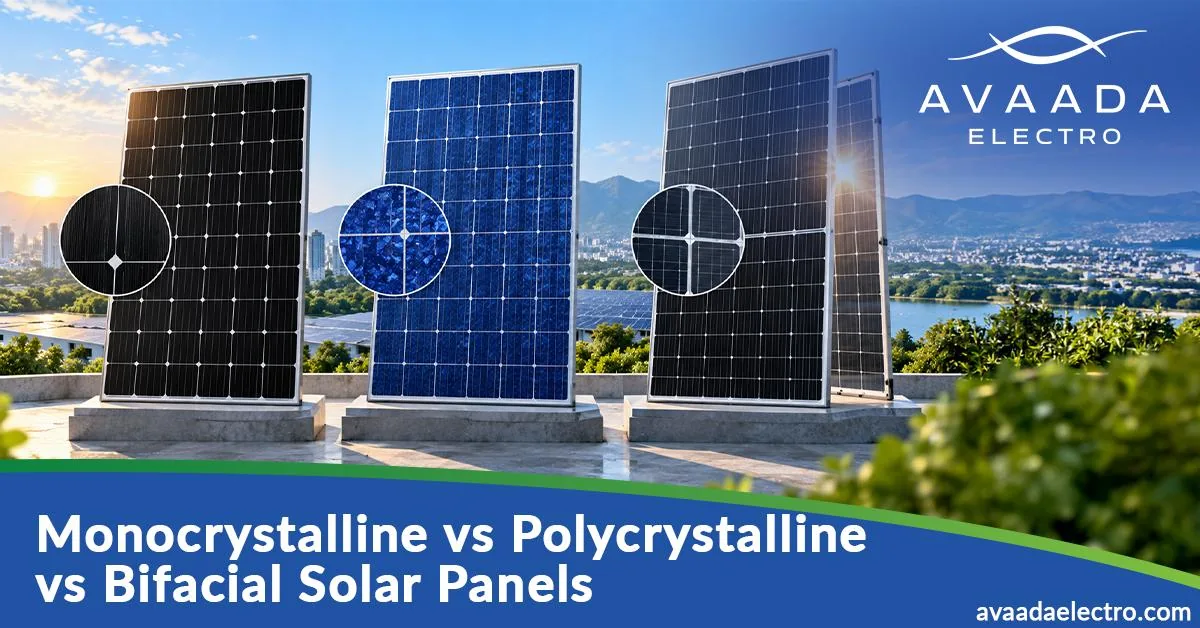
The bifacial solar panels generate power on both the front and back sides and are best placed on light or reflective surfaces, such as white roofs, concrete slabs, or gravel. Under these circumstances, the extra power gained may be worth the extra expense.
Dark roofs or tightly mounted rooftops impose restrictions on rear-side generation, and in this case, a monofacial panel offers a better overall performance.
Warranties and Certifications to Demand Before Buying Solar Panels in India
A risk-free solar purchase requires verification of three distinct warranty and certification layers:
- Product warranty – Covers manufacturing defects and workmanship faults; minimum 10–12 years for quality brands, 15 years for premium models.
- Performance warranty – Guarantees minimum annual output (typically ≥80–85% at 25 years). Verify the stated annual degradation rate and any step-down clauses in the contract.
- Third-party test certification – Request PVEL or UL test reports. Panels certified by PVEL’s PQP (Product Qualification Programme) carry independent reliability validation beyond manufacturer claims.
- ALMM / BIS / IEC compliance – For Indian homebuyers, ALMM listing and BIS certification are mandatory for PM Surya Ghar subsidy eligibility and grid approval.
Buying Checklist & Negotiation Tips
Before you sign:
- Obtain at least three itemized quotations for identical technical scope.
- Request module data sheets, serial lists (where feasible), inverter data sheets, and mounting schematics.
- Request long-term references from operating sites using the same module model.
- Specify performance acceptance testing and formal warranty handover in the contract.
- Negotiate the inclusion of monitoring, shipping, and installation insurance, rather than just the module price.
- In markets with DCR rules (e.g., India), verify ALMM/DCR compliance and insist on certification to avoid subsidy denial or project delays.
When Bifacial Panels Make Sense – And When They Don’t
Bifacial panels can deliver meaningful incremental energy when:
- Hanging higher than a reflective floor (white roof, concrete, sand).
- There is adequate rear-side irradiance (high albedo) and sufficient module clearance.
- The design does not involve dense or closely spaced module rows.
The dark, low, or space-tight roof characteristics will lead to small bifacial gains and an inferior payback of the premium. Field gains range from low single digits to above 15% only under optimized conditions.
Example decision flow (simple)
- Limited space? → Think of HJT or TOPCon.
- Need the best value? → TOPCon mid-range modules from a famous brand.
- Want backup? → Hybrid system: panel choice along with battery planning.
- Is the project subject to DCR requirements in India? → Favor DCR-compliant local modules or validated ALMM entries.
Read More – Top Advantages of Bifacial Solar Panels
Conclusion
Panel selection in 2026 requires disciplined evaluation of efficiency, durability, warranties, supplier credibility, and regulatory compliance. For the typical homeowner, a good TOPCon module from a reputable manufacturer, combined with a quality inverter and reliable monitoring, is the most desirable combination of value and performance. When space on the roof is limited, or you require the ultimate in efficiency, the HJT/back-contact modules are worth the high price. Always verify certification reports, degradation guarantees, and service capability before contract execution.
Next steps:
- Conduct a site survey that includes shading analysis and an IRR/ROI projection.
- Request three itemized quotes covering identical scope and warranties.
- Check DCR/ALMM (where necessary), test reports, and service SLAs using the checklist above.
Frequently Asked Questions
Which solar panel technology is best in 2026?
Technology choice depends on space constraints, budget, and performance targets. HJT and back-contact deliver maximum efficiency, TOPCon offers the best balance of cost and performance, and PERC remains a value option for budget-constrained installations.
Are bifacial panels worth installing on a home roof?
Bifacial panels deliver meaningful gains only on elevated or reflective mounting surfaces with sufficient rear irradiance. Flush-mounted or dark rooftops produce limited additional energy and rarely justify the premium.
How important is the warranty when selecting panels?
Warranty quality directly determines long-term system value. Buyers must evaluate both product warranty and annual degradation guarantees, as small differences compound significantly over a 25-year operating life.
Do I need to worry about DCR or local manufacturing rules?
Yes. In DCR-regulated markets, module origin directly affects subsidy eligibility and procurement approval. Non-compliant modules can delay commissioning or disqualify projects from incentives.
How can I verify a panel’s real-world performance?
Verify third-party test reports from PVEL, Fraunhofer, or DNV and request serial-level field references. Independent laboratory data provides the most reliable indicator of long-term performance.
Is higher efficiency always better for a home installation?
Higher efficiency improves output per square meter but increases upfront cost. The optimal choice balances roof constraints, BOS cost savings, and expected lifetime energy yield.
How do temperature coefficients affect panel performance?
Panels with lower temperature coefficients retain more energy during hot conditions and deliver higher afternoon output. This directly improves annual generation in high-temperature regions.
Should brand reputation be the primary selection factor?
No. Model-specific performance data, certification reports, warranty enforceability, and service capability are more important than brand name alone.
How long do modern solar panels typically last?
High-quality modules are designed for 25 years or more of operation with gradual degradation. Inverters typically require one replacement during the system lifecycle.
Can panel choice affect inverter and BOS costs?
Yes. Higher-efficiency modules reduce required panel count, cabling, mounting structures, and installation labor, lowering total balance-of-system costs.
Do different roof orientations affect panel selection?
Yes. East–west or partially shaded roofs require modules with stronger low-light performance and lower mismatch losses. Technology choice directly affects daily generation profile and lifetime yield under non-south-facing conditions.
Are certification standards important when selecting panels?
Yes. Panels must comply with IEC, BIS, and utility certification standards to ensure safety, durability, and grid approval. Non-certified modules increase commissioning risk and can invalidate warranties or subsidies.