
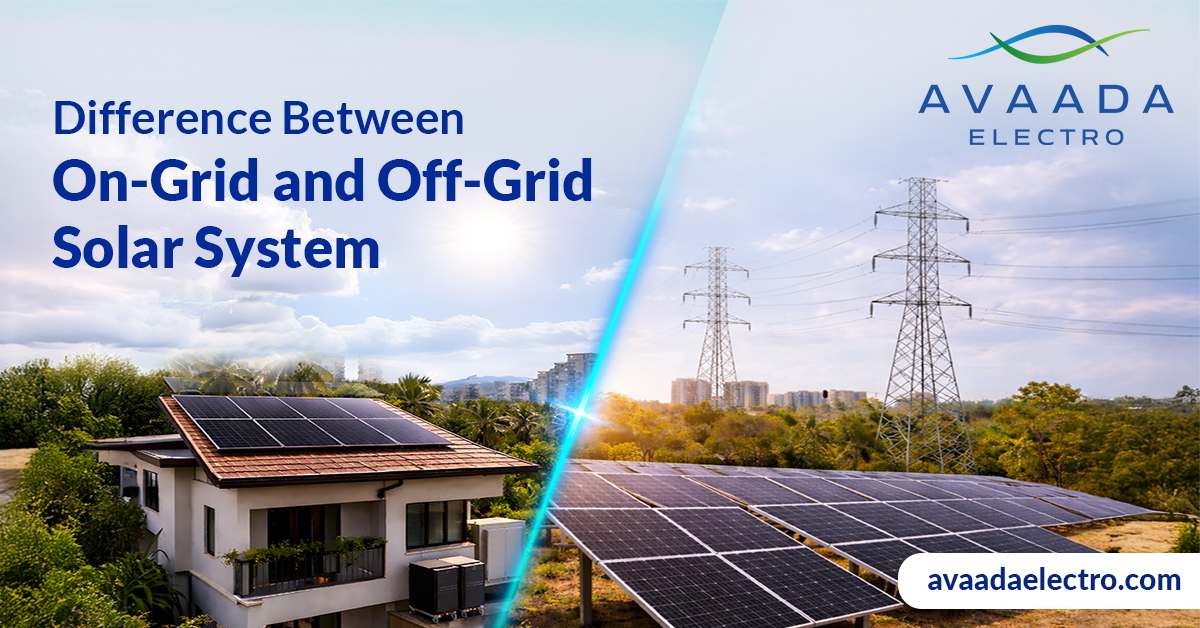
As electricity prices continue to rise and power reliability becomes a concern in most areas, more households and businesses are opting for solar energy. The decision between an off-grid and on-grid solar system, however, is one of the first and most confusing decisions people face.
On the surface, the two systems are similar. They use solar panels, an inverter, and sunlight to generate electricity. This can create the impression that the difference is minimal. In reality, the difference is fundamental and directly influences your cost, power reliability, maintenance, and long-term performance.
An on-grid solar system is connected to the power grid and aims to reduce the power bill. An off-grid solar system is designed to operate without a grid connection and is completely self-sufficient. Selecting an incorrect system would result in unwarranted costs, unstable power supply, or underutilised investment.
This guide outlines the differences between on-grid and off-grid solar systems in a non-technical manner.
On-grid solar is the best option for saving money when the grid power is stable, whereas off-grid solar is the best option in places with absolutely no grid power stability.
What Is an On-Grid Solar System?
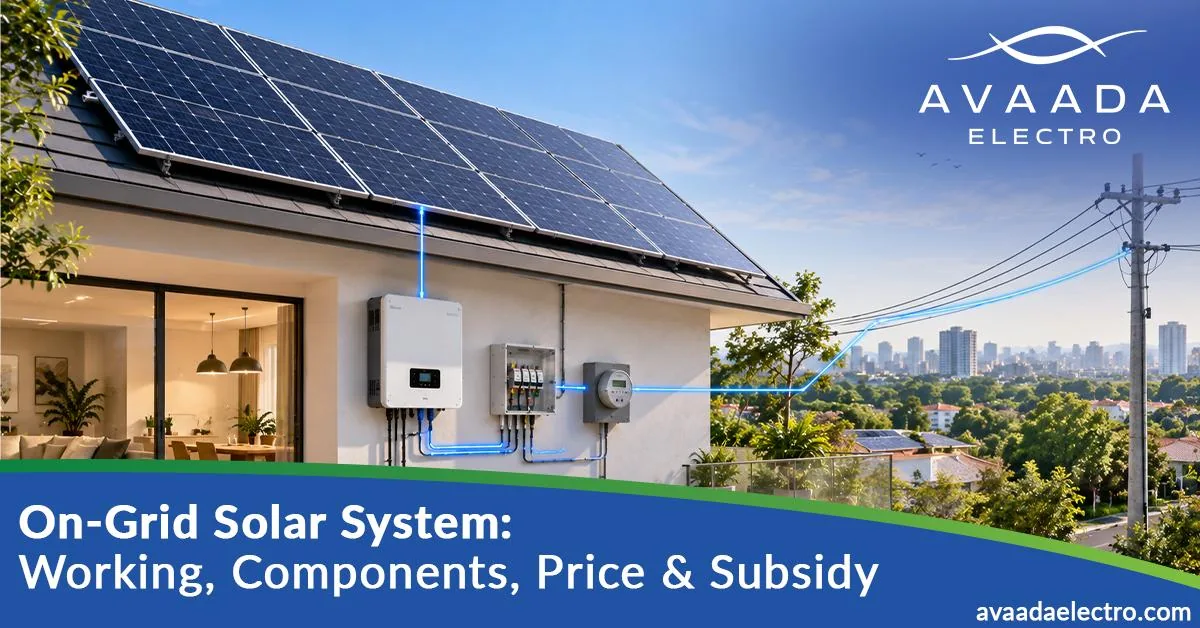
A grid-tied solar system, also known as an on-grid solar system, is directly connected to the local electricity grid. It is a solar-powered generator that uses solar panels to produce electricity and provides power to your home or business while still connected to the utility network.
Solar panels produce electricity during the day when the sunlight is available. The first thing you can use this power for is to operate your appliances. When the system generates more energy than required, the surplus is exported to the grid. At times of low solar production, such as at night or during cloudy periods, electricity is automatically sourced from the grid.
Net metering is a major characteristic of an on-grid system. In net metering, the amount of electricity that you export to the grid is counted, and you are then awarded credits that cover your electricity bill. This improves the system’s long-term financial returns.
Cases where on-grid solar systems are applied include:
- Urban and semi-urban homes
- Commercial buildings
- Industrial facilities
- Areas that have a consistent grid connection.
Their primary purpose is to reduce electricity bills rather than provide backup power.
What Is an Off-Grid Solar System?
An off-grid solar system is entirely independent of the electricity system. It produces, stores, and delivers electricity on its own without the assistance of any external power source.
Solar panels can be used in an off-grid system to generate power during the day. This energy is used to energise appliances and, at the same time, recharge a battery bank. The batteries store the energy, which is then utilised at night or when there is less sunlight. This is because there is no grid backup, so the system must be well-planned to meet energy requirements year-round.
The off-grid systems are always designed to include –
- Solar panels
- Charge controller
- Battery bank
- Off-grid inverter
Consequently, the off-grid systems will need to be properly sized and load evaluated to prevent instances of power shortages.
These systems are typically installed in:
- Remote villages
- Agricultural locations and farmhouses.
- Areas without grid access
- Regions where electricity is cut off regularly or often.
Off-grid systems are chosen primarily for energy reliability rather than cost optimisation.
Read More – Net Metering Benefits & Working
Core Differences Between On-Grid and Off-Grid Solar Systems
The actual disparity between on-grid and off-grid solar systems is in how they regulate the electricity supply, storage, and reliability.
Grid Dependency
An on-grid system relies on the utility grid as a backup power source. Off-grid systems are independent and use batteries as their energy source.
Battery Requirement
Batteries are not normally required in on-grid systems. Without them, off-grid systems cannot operate.
Power During Blackouts
Solar systems switch off when the grid is off. Off-grid systems do not stop as long as the batteries are charged.
Energy Management
On-grid systems export surplus power to the grid. Excess energy is stored in a battery in off-grid systems.
System Complexity
On-grid systems are simpler and easier to maintain. The battery management and load balancing make off-grid systems more complex.
These variations not only affect performance but also cost, maintenance, and ong-term lifespan.
Cost Comparison: On-Grid vs Off-Grid Solar Systems
One of the most important aspects in selecting a solar system is cost, and there is a considerable distinction between off-grid and on-grid systems.
Compared to off-grid solar systems, on-grid systems are cheaper to install. The key elements of the cost are solar panels, a grid-tied inverter, mounting structures, and installation. Net metering also enhances payback by minimising electricity bills.
Battery banks are the main reason why off-grid systems are more expensive. Batteries are an additional high initial expense and require replacement after several years. There are additional elements, such as charge controllers and higher capacity inverters, that are more expensive.
Other than installation, long-term costs, too, are different:
- On-grid systems are low-maintenance.
- Off-grid systems require battery monitoring, replacement, and upgrades from time to time.
Although off-grid systems are more expensive, they are valuable in places with poor or no grid power. Cost should be evaluated alongside reliability and usage requirements.
Net Metering vs Battery Storage: The Real Trade-Off
It is among the most misconceived issues of solar systems.
In an on-grid solar system, surplus power is fed into the grid via net metering. Bill credits are given instead of storing the energy. This renders the system efficient, cost-effective and reliant on grid availability.
With an off-grid solar system, excess power is packed in batteries. This is stored energy, which will maintain a power supply in the absence of sunlight. Nonetheless, batteries are costly and have limited capacity and lifespan, which affects the system’s performance and cost.
The trade-off is straightforward:
- Net metering is cost-effective.
- Storage of energy using batteries is secure.
Your choice depends on whether saving money or ensuring uninterrupted power is more important.
Power Reliability & Blackout Performance
The difference is most observable in power reliability.
On-grid systems are automatically switched off during power blackouts. They will not provide electricity unless the system has battery storage or hybrid capability, even during sunlight.
Off-grid systems are designed to operate without being connected to the grid. Power is supplied continuously so long as batteries are charged.
Off-grid systems provide energy security in areas where power outages are common or where power is highly required. Where the grid supply is reliable, the on-grid system is a viable option.
Maintenance, Lifespan & Operational Complexity
On-grid solar systems require minimal maintenance. They do not need much attention beyond cleaning panels and regular inspection of inverters.
Off-grid systems require further participation. Batteries need to be monitored, their performance checked, and they have to be replaced periodically. Poor maintenance may reduce efficiency and shorten the system’s lifespan.
In terms of lifespan –
- Both systems have solar panels that last 25+ years.
- Inverters last 8–12 years.
- Batteries can last 4–10 years, depending on the type and use.
Off-grid systems are more complex to operate because they require energy management.
When Should You Choose an On-Grid Solar System?
An on-grid solar system is the appropriate option in case –
- You have grid power you can depend on.
- You want to minimise the electricity bills.
- You want a reduced initial investment.
- You do not require power during blackouts.
It is suitable for houses, offices, factories, and commercial buildings located in the city.
When Should You Choose an Off-Grid Solar System?
When –
- There is no grid power or power reliability.
- You are residing in remote or rural localities.
- You believe in energy self-sufficiency rather than savings.
Farmhouses, villages, telecom towers and remote facilities are best suited to it.
On-Grid vs Off-Grid vs Hybrid Solar: Where Hybrid Fits In
Hybrid solar systems are grid-connected, but have battery storage. They combine the benefits of net metering with battery backup.
The hybrid systems lie between on-grid and off-grid. They are priced above the on-grid systems and below the off-grid systems.
Hybrid systems provide a middle ground for users who require savings and backup.
Installation & Approval Differences
On-grid and off-grid solar system installations differ primarily in their connection (or lack thereof) to the power grid.
An on-grid solar system will need coordination with the local electricity distribution company (DISCOM or utility provider). System capacity, inverter requirements, and net metering eligibility are required before installation.
Once installed, the system is then inspected and tested, and upon passing this test, it is formally linked to the grid and can be permitted to export power. This consent-based procedure is likely to prolong installation durations but ensure conformity and provide extended billing advantages.
An off-grid solar system, however, does not need any utility approvals since it is an independent system. Installation is all about proper system design, load estimation and battery size. Although not required, an off-grid system requires greater technical accuracy during installation to prevent battery damage or power shortages.
Concisely, on-grid installations are approval-based, whereas off-grid installations are design-based.
| Aspect | On-Grid Solar System | Off-Grid Solar System |
| Utility approval required | Yes | No |
| Net metering approval | Mandatory | Not applicable |
| Installation timeline | Longer (due to approvals) | Faster |
| Technical complexity | Moderate | High |
| System inspection | By the utility authority | Internal/installer-based |
| Best suited for | Grid-connected areas | Remote or no-grid areas |
Environmental & Practical Considerations
On-grid and off-grid solar systems are both environmentally friendly; however, their practical effects differ. On-grid solar systems also have a smaller environmental footprint because they typically operate without batteries, thereby eliminating the need for battery manufacturing, disposal, and recycling. They also occupy less physical space and fewer infrastructures.
Off-grid solar systems rely on batteries, which take up more space and pose long-term factors, such as battery replacement and environmentally responsible disposal. In practice, this requires off-grid systems to be well-sized, lest they run out of energy, whereas on-grid systems can rely on the grid for a buffer.
Making the correct choice of the system is a guarantee of environmental responsibility and efficient use in everyday life.
Read More – Off Grid Solar System Price
Final Verdict: Which Solar System Is Better for You?
There is no universal answer. The better system depends on:
- Location
- Grid reliability
- Budget
- Power requirements
An on-grid solar system is the most effective in terms of savings. Off-grid solar works well for being independent. Understanding this distinction is essential for long-term decision-making.
Knowing these differences will allow you to make a confident and informed choice, the choice that will be compatible with your location, use, and long-term energy objectives.
Frequently Asked Questions
What is the primary distinction between on and off-grid solar systems?
The primary difference is grid dependency. On-grid solar systems are connected to the electricity grid and utilise it for backup. In contrast, off-grid solar systems are entirely autonomous and use batteries to store energy and provide it when needed.
On-grid or off-grid: Which is the cheaper solar system?
Solar systems powered by the grid are usually less expensive because they do not require batteries. The off-grid system is more costly because of the battery banks, charge controllers, and the complexity of the installation, which adds cost in both the initial and long-term.
Can we use an on-grid solar system during a power outage?
No, regular on-grid solar systems shut down when power is interrupted for safety reasons. They cannot provide electricity during grid outages, even with solar panels, because they lack batteries or a hybrid inverter.
Why do off-grid solar systems require batteries?
Off-grid solar systems require batteries to supply power during nights and low-sunlight conditions. These batteries provide power at night or in low-light conditions, so the electricity supply is not interrupted, unlike on-grid solar systems.
Which solar system is more suitable in places that experience constant power outages?
Off-grid solar is more suitable in situations with frequent or prolonged power outages, as it provides constant power when battery storage is available. On-grid systems cannot support such locations except when they are combined with battery backup or hybrid technology.