Solar panels can seem complicated, but the science behind them is straightforward when explained step by step. At the most basic level, solar panels convert sunlight into electricity by applying known physical laws and the work of a new generation of engineers. It does not matter whether you are interested in solar for your house or business, or just want to know how clean energy works; understanding the fundamentals helps you make well-informed choices.
This blog discusses the mechanism behind solar panels, from sunlight generation to usable household electricity, in easy-to-understand, practical terms. By the end, you will clearly learn how sunlight is converted into electricity, the main elements involved, and why the system’s design is just as important as the panels.
How Solar Panels Work
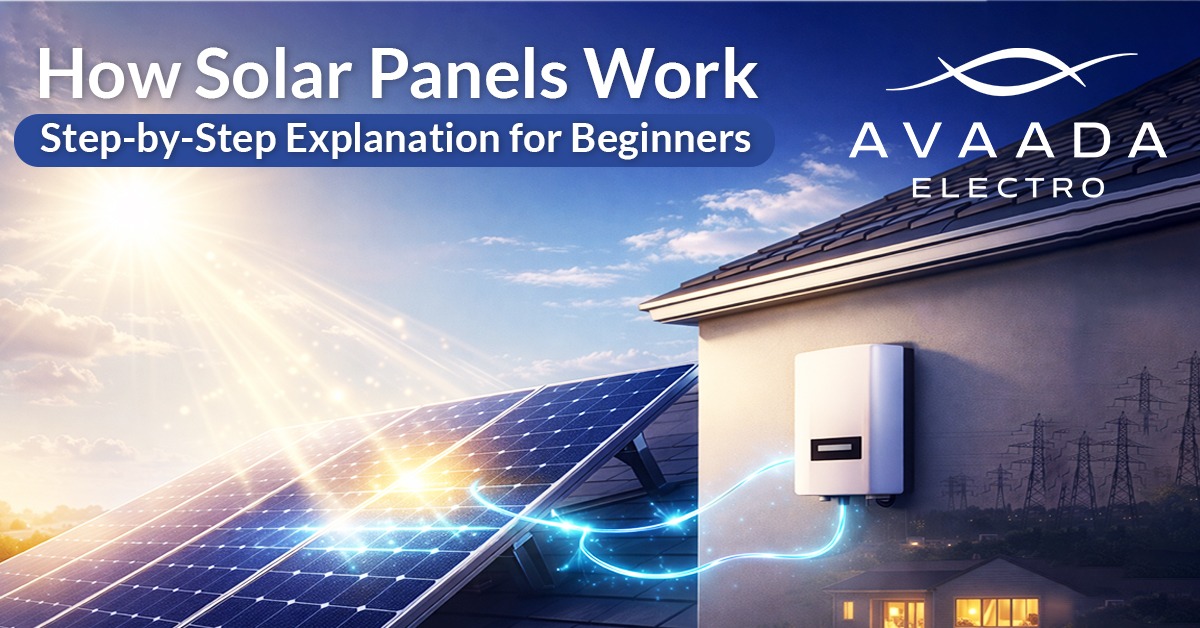
Photons from sunlight strike the photovoltaic (PV) cells, releasing electrons. This movement of electrons generates direct current (DC) electricity, which is then collected, converted to AC by an inverter, and either used on-site, stored, or exported to the grid.
Step 1 – Photons hit the cell: the photovoltaic effect
The PV cell is at the center of any solar panel. The residential and commercial modules mostly utilize crystalline silicon cells. This process occurs at a microscopic level as follows:
- Photons are the fundamental particles of sunlight. Upon hitting the silicon cell, photons can transfer their energy to electrons in the material.
- Silicon cells are produced with an inbuilt electric field through two layers, n-type (additional electrons) and p-type (additional holes where electrons are absent). This field at the p-n junction forces the freed electrons in one direction.
- Direct current (DC) electricity is the flow of electrons through an external circuit. The practical outcome is the conversion of sunlight into a DC electrical current.
Step 2 – Cells → Modules → Panels: wiring and power ratings
The solar cells used are small (usually 156 mm or more in wafer size). Their values are such that to obtain useful voltages and currents, they are:
- Wired in series to increase voltage.
- Wired in parallel in some configurations to increase current.
A panel (also called a module) is made of a group of cells laminated under glass. Modular ratings are determined in watts under laboratory conditions, e.g., the number displayed on the nameplate, such as 400 W. However, that rating is applied under Standard Test Conditions (STC), as explained below.
The bypass diodes and backsheet protections are also found in modules to limit the shading losses and to ensure that cells are not exposed to hot spots.
Step 3 – DC combiner, safety, and wiring
In larger or multi-string systems, module strings are connected to a combiner box, where several DC currents from several strings are fused and directed to the inverter. String fuses, surge arrestors, and occasionally monitoring combiner electronics are installed in the combiner box. Solar DC systems operate at high voltages that require proper DC wiring and protection; it poses hazards beyond those of household AC.
Step 4 – The inverter: DC → AC and why MPPT matters
The solar modules generate DC, while residential and grid systems operate on AC. The inverter’s task is to convert DC to AC and synchronize it with the grid. In modern inverters, another important optimization step is the Maximum Power Point Tracking (MPPT). MPPT algorithms continually adjust the electrical load presented to the panels to maximize power output under varying sunlight and temperature conditions.
There are three main inverter architectures to know:
- String inverters: One inverter for several strings, economical for uniform roofs.
- Microinverters: One inverter per panel, best when panels face multiple directions or have shading issues.
- Power optimizers + string inverter: Optimizers at each panel improve yield, feeding a centralized inverter.
Step 5 – Metering, consumption, storage, and the grid
Once the power is converted to AC, the power is used on the spot initially, lights, fridge, AC, and any excess comes to the grid (when the system is grid-tied). A bidirectional meter is used to record imports and exports; policies, such as net-metering, credit the exported energy. If you have battery storage, there will be an excess of energy that can be redirected to the batteries using a charge controller or a hybrid inverter.
Why Nameplate (STC) ≠ Real Life (PTC, NOCT, And Losses)
Power is quoted at Standard Test Conditions (STC): 1000 W/m² irradiance, 25°C cell temperature, AM1.5 spectrum, ensuring consistent comparisons across modules. Real roofs are not labs. Two realistic metrics commonly used in real-world performance assessment include:
PTC (PVUSA Test Conditions): a more conservative field-oriented rating, often 10-15% lower than STC; it takes into consideration more operating temperature and operational losses.
NOCT (Nominal Operating Cell Temperature), which estimates expected operating temperatures(temperature in the sun) to determine field output.
The other losses include wiring, inverter inefficiency, soil (dust), shade, panel mismatch, and degradation, all of which are reducing the actual energy. This is why installers model their PV systems (such as PVsyst or Aurora) to predict annual kWh, not just STC watts.
Real-World Performance Factors (And Where Energy Goes)
These are the key reasons why a 400 W panel could actually perform less on your roof than it did in the laboratory:
- Temperature coefficient: Panels lose voltage as they warm. Hot weather reduces production; more sophisticated cell types (n-type TOPCon, HJT) are more effective at higher temperatures.
- Soiling losses: Light is reduced by dust, pollen, and bird droppings.
- Shading & mismatch: This occurs because even partial shade can cause a partial break in the string output. Bypass diodes and module-level electronics help mitigate these losses.
- Inverter clipping: Inverter clipping occurs when an inverter is undersized relative to a PV array.
- System degradation: Performance degrades gradually over time. Field degradation is about 0.3-0.8 percent/year on average, and NREL and subsequent experiments indicate that many current modules degrade at an average of less than 0.5 percent/year in practice.
The Role Of Technology In Efficiency And Performance (2026 Snapshot)
Module technology has an impact on efficiency, temperature characteristics, and degradation:
- Mono-PERC (mature): Commercially mature technology with typical module efficiencies of 19–21%
- TOPCon (n-type passivated contact): better degradation properties and higher efficiency (usually in the range of 22-24% with high-end models rating even higher).
Although the laboratory efficiency records attract attention, the efficiencies of the mass production modules usually lag behind the lab values by several percentage points. The practical implication is straightforward: the more efficient, the higher the efficiency, enabling more power generation per square metre of roof area, which is useful when the roof area is limited.
Batteries, Hybrid Systems, And Energy Management
Battery integration requires additional wiring and control systems:
- AC-coupled systems store the AC of an inverter in batteries by use of a battery inverter – easier to retrofit.
- DC-coupled systems route DC power to a battery inverter/charger, which is slightly more efficient in some applications.
Among the critical battery metrics are round-trip efficiency(energy returned), usable capacity (kWh), depth of discharge, and cycle life. Batteries can store excess power for use during the evening/night; however, they are also expensive and require maintenance. Batteries are optional in many grid-connected homes with net metering and may be valuable for resilience or time-of-use arbitrage.
Safety, Standards, and Testing You Should Ask About
Quality and safety are non-negotiable. Ask for:
- Module certifications: IEC 61215 (performance/durability), IEC 61730 (safety), or UL 61730 (North America).
- Inverter certifications and anti-islanding tests.
- Factory Acceptance Tests (FAT) and site acceptance (IV curve tests, insulation resistance, earthing resistance).
- Third-party reliability tests are available (PVEL, Fraunhofer CalLab). These reduce vendor risk and validate manufacturer claims.
Simple Checklist: What To Request From Your Installer
It is important to evaluate more than just price when signing a solar contract. Requesting appropriate technical and documentation information is one way to know what you are really purchasing, and helps ensure the system performs as promised. The following checklist outlines what to request and the rationale for each item.
1. Module Datasheet and Performance Ratings
The datasheet of the solar module should always be requested, not only a brochure. The amount of watts the panel produces in the laboratory is the STC wattage, which should be clearly listed in this document, and the temperature coefficient, which is how much power the panel will lose as it heats up.
Request PTC or NOCT ratings; this will give a more realistic estimate of the performance in real life. Comparing the panels will help you make a fair assessment and prevent overestimating the generation. Reviewing these values will assist you.
2. Inverter Model, MPPT Count, and Efficiency
The inverter is a critical component of system performance, yet it is often neglected. Request to know the specific inverter manufacturer and model, the number of MPPT (Maximum Power Point Tracker) channels, and its efficiency ratings. The multiple MPPT systems are better in shading and mixed roof orientations. Inverter specifications are also useful for understanding how reliable, expandable, and maintainable the inverter will be in the future.
3. Expected Annual Energy Output and Assumptions
Ask to estimate the annual generation of energy (kWh) with reference to the Plane of Array (POA) irradiance. More to the point, enquire what was assumed in the computation, roof tilt, orientation, shading analysis, local solar irradiance information, and system losses. Clear modeling assumptions are signs of professional design and the avoidance of unrealistic projections of energy or savings.
4. Warranty Coverage and Protection Terms
Solar systems are long-term properties; hence, clarity in warranty is important. Request documentation on the module warranty of the product, module warranty of performance, and warranty of the inverter, duration of coverage, and claims. Know who clears warranty claims, the installer or manufacturer, and what the local support is. Firm warranty support minimizes long-term risk and guarantees your investment.
5. Commissioning and Acceptance Tests at Handover
Before final payment, ensure that you have agreed on the commissioning tests to be undertaken. These must comprise IV curve, insulation resistance testing, earthing resistance testing, and initial Performance Ratio (PR) testing. These tests ensure that the system is installed correctly and working according to the anticipated parameters on the first day.
Requesting such information holds installers responsible, and it makes the project transparent. What is more important is that it makes you assured that the solar system you get is the same solar system that you were assured of- one that is designed, installed, and commissioned to work for decades.
Emerging Tech & What Homeowners Should Expect Next
Studies are done at a frantic rate. Perovskite-silicon tandem and bifacial designs will achieve higher efficiencies, and manufacturers are working to reduce degradation and improve temperature tolerance.
Lab records still exist (such as OPCON breakthroughs), and overall, low-cost commercial usage normally falls behind lab news by several years. In 2026, the best options for most homeowners will be TOPCon or high-quality PERC modules, depending on available budget and roof space.
Conclusion
Solar panels are not magic boxes, but they are designed systems. The physics of photovoltaic cells is beautiful; however, to make it work properly, a good design is needed: the correct choice of panels, string sizing, inverter selection, proper mounting, and proper safety testing. For technical claims (efficiency, degradation, PTC), request the datasheets and third-party test reports mentioned above. It can make the difference between a good and a mediocre installation, and keep your anticipated savings within reasonable bounds.
Frequently Asked Questions
Why do solar panels produce DC and not AC?
The photovoltaic effect produces direct current (DC). This is due to the movement of electrons in one direction, where the solar cells receive sunlight. Since DC electricity is used, an inverter is needed to convert DC to AC so it can be used in homes and the power grid.
What is STC, and why is it different from real output?
Standard Test Conditions (STC) refer to laboratory testing conditions (STC) (1,000 W/m², 25°C), and the absence of shading or dust. The way panels work in the real world is in hotter, dustier, and less predictable environments, which is why real-world output is, more often than not, lower. Performance is more realistic when using such metrics as PTC ratings or modeled energy yields.
How much do panels degrade each year?
The majority of the current solar panels are deteriorating at a slow pace, which is about 0.3-0.8% per annum. Long-term studies and field data demonstrate that high-quality panels often perform much better than their warranties indicate, retaining 85% and even 90% of capacity after 25 years of service.
Should I get microinverters or a string inverter?
The panels that are positioned on dissimilar sides or partially shaded are convenient because microinverters can be used separately. String inverters are cheaper and function effectively on uniform, unshaded roofs. Power optimizers provide a compromise to this problem by enhancing panel-level operation, but retaining a central inverter.
Do solar panels work on cloudy or rainy days?
Yes. Solar panels do generate electricity even during cloudy or rainy days, but at a lower output. They are dependent on daylight, not on direct sunshine, and thus, diffused light can still be used to produce power. Over the year, these low-output days are offset by higher production on sunny days.
Can solar panels work during a power cut?
Normal grid-connected solar installations will shut down in the event of power outages to ensure the safety of utility workers. Assuming a power outage is critical, you will require a battery system or a hybrid inverter to enable you to supply a limited amount of power when you need it most.
How many panels do I need for my home?
The number of panels required will be determined by how much electricity you use, the amount of space you have in the roof, and the wattage of the panel. A house with higher power consumption or a small roof area may require panels with higher wattage. A site assessment would be used to identify the most effective layout.
Does panel orientation and tilt really matter?
Yes, orientation and tilt play a big role in energy generation. South-facing panels with an ideal tilt generally deliver optimal performance. Angles that are not optimal do not render solar unsustainable, but may decrease annual output by a few percent.
What happens to excess electricity produced during the day?
In case your system is on the grid and has net metering, then any surplus electricity is sent back and charged to your account. When there is no net metering or battery storage, excess energy may go to waste. You can store this additional power for later use with batteries.
Are higher-watt solar panels always better?
The panels with higher watts produce more power per panel, which is beneficial where there is a limited roof space. Nevertheless, the design and size of the entire system are of greater concern than the panel wattage. An effective system can be provided with an equally efficient and relatively low-wattage panel.
How long does it take for solar panels to pay for themselves?
The payback is determined depending on the electricity tariffs, system cost, availability of sunlight, and the usage patterns. Solar systems have been known to pay back in a few years in most residential applications, then save over the decades.
Do solar panels require a lot of maintenance?
Solar panels need less maintenance. Periodic cleaning to eliminate dust and debris, and periodic system reviews, are normally enough. There are no moving components, so long-term maintenance is also simple and cost-effective.