One of the best illustrations of sunlight’s ability to reach the highest level of heat without consuming any fuel is the solar furnace. Solar furnaces are now receiving renewed consideration in 2025, as industries seek alternative heating methods that are clean, cost-effective, and high-temperature, beyond fossil fuels.
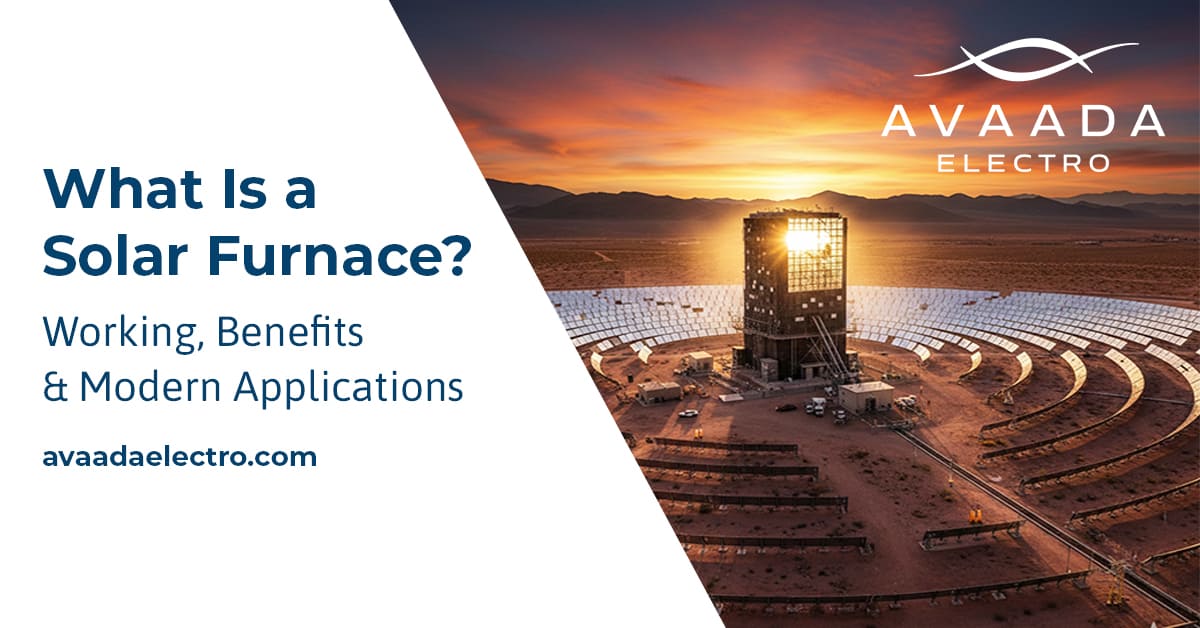
A solar furnace does not burn coal, gas, or electricity, but hundreds or thousands of mirrors are used to concentrate the sunlight to one energy point. This concentrated energy may range from 1,500 °C to 3,000 °C and applies to scientific research, testing materials, metal processing, and renewable fuel production.
This manual simplifies the concept of solar furnaces in simple language, explaining how solar furnaces are used, why they are used, and how this is applied in the real world to make the clean-energy transition.
What Is a Solar Furnace?
A solar furnace is a device that focuses sunlight with mirrors or lenses to generate extremely high temperatures. A solar furnace (in contrast with solar panels, which convert sunlight into electricity) converts sunlight into heat on a scale many times larger than that of conventional solar heaters.
An average solar furnace will consist of:
- An array of mirrors (referred to as heliostats)
- A large curved reflector
- A point at which the heat is concentrated.
The focus is a room, stuff, or pieces of equipment that are situated there.
Since only sunlight produces the heat, a solar furnace is clean, renewable, and can reach very high temperatures that conventional electric heaters cannot.
How Does a Solar Furnace Work? (Step-by-Step)
The following is a simple working principle that can be easily understood:
Step 1: Sunlight Collection
Several mirrors mounted on the wall follow the sun around all day and channel the sunlight to a large reflector. These are called heliostats because they are solar-tracking mirrors.
Step 2: Concentration of Light
The redirected sunlight is focused onto a very tiny point by the central reflector (which is usually a large parabolic plate), which is the focal point.
Step 3: Generation of Extreme Heat.
Whenever such a large amount of light is concentrated, the intensity is increased. Focus temperature can be more than 1,500 °C, and in sophisticated systems, it can be up to 3,000 °C.
Step 4: Heat Utilization
The excessive heat is employed in:
- Melting or testing of materials.
- Manufacturing of Hydrogen through thermochemical reactions.
- Experiments demanding extremely high temperatures are used in the sciences.
- Industrial heat processes
There is no combustion of fuel, there is no emission of gas, and the heat is obtained directly through the energy of the sun.
Types of Solar Furnaces
Let us now look at the different types of solar furnaces in detail.
1. Parabolic Dish Solar Furnaces
Focus sun rays using one large parabolic dish.
- Best suited to experiments of high temperature.
- Easy construction and must have precision tracking.
2. Heliostat Field + Tower Systems
Heliostats are thousands of computers that are controlled by sunlight and are focused on a receiver that is on the tower.
- Applied in large-scale industries
- It is able to produce multi-megawatt of heat energy.
3. Fresnel Lens Solar Furnaces
Concentrate sunlight using large lenses as opposed to mirrors.
- Lesser cost, smaller in size, reduced maintenance.
- Appropriate for small-scale research units (e.g., education).
4. Laboratory-Scale Solar Furnaces
Small ones are used in universities or research and development centers.
- Temperatures usually range from 800 to 1,500°C
- Very cheap and suitable for controlled tests.
This categorization aids the reader in comprehending that there are small academic solar furnaces all the way to large industrial heat plants.
Key Benefits of Using Solar Furnaces
Solar furnaces are now gaining popularity in research laboratories, industry, and clean energy innovation centres since they provide extremely high temperatures without coal, gas, or electricity. They are much more efficient than traditional heating systems in most specialised applications due to their unique ability to focus sunlight beams into a powerful thermal beam. The key advantages are described below in a very clear and simplistic manner.
Zero Fuel Cost
The benefit of solar furnaces is that they do not require any fuel. A conventional furnace uses gas, oil, or electricity, and these all have recurrent costs whose expenses are updated annually. The solar furnace involves the use of mirrors to focus the sunlight, implying the fuel is free and inexhaustible.
After installing the system, the industries will be able to save a lot of operating costs in the long term. These savings are very high in the case of facilities that are engaged in repeated high-temperature experiments or thermal processes. Solar furnaces are more useful to developing countries or remote locations where fuel supply is sporadic or costly.
High Temperatures Advanced Research
Solar furnaces may get up to a high of 2,000 -3,500 °C, which is many times higher than most electric or gas furnaces could go. These super-high temperatures are suitable for:
- Alloy development and metallurgy.
- Testing of ceramic material and refractory material.
- Aerospace components research.
- Experiments in solar-thermal propulsion.
- The research on the high-temperature degradation of materials.
The nature of the heating being direct, precise, and highly focused enables scientists to replicate conditions that are highly challenging to recreate in a traditional furnace.
Zero Carbon Emissions
Because no fossil fuels are burnt, nothing is emitted in the form of CO 2, NOx, SO 2, or particulate emissions. This renders them among the cleanest technologies of high temperatures that are present in contemporary times.
Solar furnaces are a very sustainable alternative to industries that are aimed at achieving net-zero or ESG compliance and green manufacturing certification. They are already finding applications in a number of solar research parks around the world as an alternative to the carbon-intensive thermal systems.
Low Operation and Maintenance
Solar furnaces do not need much maintenance other than cleaning of the mirrors/lenses and putting them in the right position. It does not have any fuel storage problems, burner maintenance problems, or combustion-related failures. This drastically reduces:
- Operating labour
- Maintenance downtime
- Fuel handling safety hazards.
These cost savings may be very substantial over the lifetime of a system.
Extraordinary Accuracy in Scientific and Industrial Tests.
Solar furnaces provide a predictable, controllable, and constant source of heat, which is of great importance in laboratories. Beam intensity, direction, and temperature can be manipulated with great accuracy by the researcher.
This accuracy is important to:
- Material strength tests
- Thermal shock research
- Invention of thermal-resistant materials.
- Experiments on chemical reactions in hot conditions.
Since the energy is optically focused as opposed to flame-based, cleaner and more consistent results are obtained in experiments.
Modern Applications of Solar Furnaces
The development of solar furnace started as a futuristic curiosity and has grown to be an enormous instrument in clean-tech. Today, they are used in:
Material Testing and Space Research.
Solar furnaces are used in space research to test materials capable of withstanding very high temperatures during the launch of the rocket and during re-entry in the atmosphere.
Industrial Manufacturing
They facilitate such operations as metal smelting, high-temperature ceramics, sintering, and chemical reactions, which require intense heat that is controlled but does not require burning coal or gas.
Solar Hydrogen Production
Another area where energy in the form of solar heat is employed to separate water, or to power thermo-chemical processes. Solar furnaces are becoming interesting as an emission-free source of heat, with India’s intensive push to go in the green direction of hydrogen.
Clean Cooking & Rural Use
In villages, small solar furnaces are being used to do smokeless cooking. The NGOs are popularizing these systems even in remote areas to curb the reliance on kerosene and firewood.
Education & Research Labs
Mini solar furnaces are used in schools, universities and renewable labs, to teach optic and heat conception and physics of solar power.
What are the Weaknesses of a Solar Furnace?
Solar furnaces are not flawless in their own way, and there are several limitations to this renewable solution:
Weather Dependence
They require clear skies so that they can perform optimally. When it is cloudy or rains heavily, the production is cut drastically.
High Initial Setup Cost
Huge industrial furnaces and heliostat fields demand great engineering and high initial investment.
Requires Land / Open Space
A solar tower furnace requires a large area of land, which has no shadows.
Safety Concerns
Since the focal point may get very hot, very high safety requirements will have to be observed.
The Future of Solar Furnaces in India
The renewable industry in India is growing very fast, and solar furnaces are becoming popular among high-heat industries.
Solar furnaces can be deployed in the high-temperature thermo-chemical reactions as India drives green hydrogen.
The large-scale systems of concentrators are being experimented with in Indian institutes such as IISc, IITs, and solar research labs.
The cost of reflectors, sensors, and tracking systems is on the downward slope and is therefore becoming more commercially viable.
As decarbonisation policies are implemented, industries may begin substituting fossil-fuel furnaces with sustainable solar-thermal furnaces.
Solar furnaces will probably transition to mainstream industrial implements in the next decade after expanding into a niche application.
Conclusion
The power of harnessing concentrated sunlight into useful and high-temperature energy without combusting any fuel is best illustrated by a solar furnace. A solar furnace demonstrates the progress made in clean energy technology, as it can be used to melt metals for industrial research and even to support future space missions.
Their ability to produce almost endless thermal output without emitting pollutants and to deliver high performance at low operating costs is making them an integral part of renewable energy systems in the contemporary world. With governments urging manufacturers to produce cleaner products and industries seeking other electrification options, solar furnaces will make a larger contribution to the world’s energy mix.
For students, homeowners, or industries seeking to learn new solar technologies, solar furnaces can provide insight into the future when the sun is the planet’s heat engine.
Frequently Asked Questions
What is a solar furnace?
A solar furnace is a system where the sun is focused on with the help of mirrors or lenses to create extremely high temperatures, even to more than 3,000 °C. It finds application in scientific experiments, industrial heating, and testing on materials.
How does a solar furnace work?
It will utilize various mirrors (heliostats), which follow the sun and redirect the sun’s rays to a focal point or center known as the receiver. The concentrated solar energy produces high temperatures.
What are the temperatures that solar furnaces can attain?
Small experimental furnaces get up to 500 – 1,000°C, and larger research furnaces such as the Odeillo Solar Furnace in France can get much higher than that, to over 3,000 °C.
Are a solar furnace and a solar cooker the same?
No. A solar cooker is created to cook food at low temperatures (100-250 °C). A solar furnace is far more potent, and it is applied in industrial-scale warming and investigations.
In what places are solar furnaces applied nowadays?
They serve in metallurgy, testing of aerospace materials, hydrogen production, solar fuel material development, and development of high-temperature thermal storage.
Is it possible that solar furnaces can operate at night?
Not directly. Nonetheless, they can be used to provide heat at night, when combined with thermal storage (molten salts, ceramics).
Are solar furnaces safe?
Well, with shields, track controls, and safety measures in place. The focused beam is very powerful and has to be operated under control.
Is it possible to have a solar furnace in the house?
Not realistically. A parabolic cooker of a small size can be installed at home, whereas an industrial-quality solar furnace needs large spaces, tracking systems, and accurate engineering.
Is it possible toAre solar furnaces expensive to construct? have a solar furnace in the house?
Initial construction is expensive with the mirror field and tracking system, but the operating costs are very low since the sun is free.
What are the most significant benefits of a solar furnace?
No fuel cost, no emissions, extremely high temperatures, extended life, and research and high-tech industrial applications.
Are solar furnaces operational during cloudy seasons?
During cloudy or hazy weather, efficiency reduces tremendously as they need direct sunshine.
What is the future of solar furnace technology?
Solar furnaces are being utilized in growing amounts in green hydrogen, solar metallurgy, hyper-efficient thermal storage systems, and space-based solar power research as a constituent component of the future renewable ecosystem.