An off-grid solar system is a self-sufficient power solution designed to operate independently from the public electricity grid. Unlike grid-connected solar systems, it generates, stores, and supplies electricity entirely on its own. This makes it a critical energy solution for locations where grid access is unavailable, unreliable, or economically impractical.
Interest in off-grid solar systems has grown steadily due to frequent power outages, rising electricity costs, and the need for reliable energy in remote or infrastructure-limited areas. However, off-grid systems are not simply “solar panels without a grid connection.” They require careful design, correct component sizing, and disciplined energy management to perform reliably.
This guide explains what an off-grid solar system is, how it works step by step, its key components, advantages and limitations, and how to decide whether it is the right solution for your needs.
What Is an Off-Grid Solar System?
An off-grid solar system is a standalone power system that generates electricity from solar panels and stores it in batteries for use at any time. It is not connected to the utility grid and does not rely on external power sources for daily operation.
The defining feature of an off-grid system is energy storage. Because there is no grid to draw electricity from when solar generation is low, batteries play a central role in ensuring a continuous power supply.
Off-grid solar systems are commonly used in:
- Remote homes and villages
- Agricultural farms and irrigation sites
- Telecom towers and monitoring stations
- Resorts, lodges, and cabins
- Areas with frequent or prolonged grid outages
In these scenarios, energy reliability is often more important than upfront cost, making off-grid solar a strategic investment rather than a purely financial one.
How Does an Off-Grid Solar System Work? (Step-by-Step)
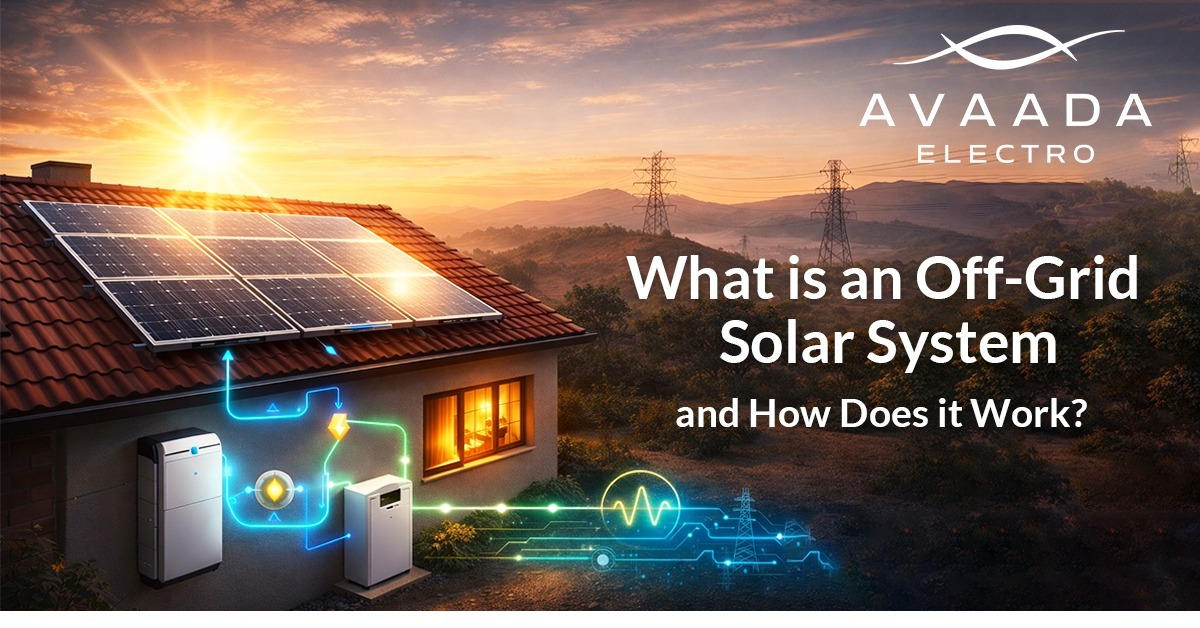
An off-grid solar system follows a clear and logical energy flow. Understanding this flow is essential to appreciating why proper sizing and design matter.
Step 1: Solar Panels Generate Electricity
Solar panels capture sunlight and convert it into direct current (DC) electricity. The amount of electricity produced depends on panel capacity, sunlight availability, orientation, and weather conditions.
Step 2: Charge Controller Regulates Power
The electricity generated by the panels flows into a charge controller. This device regulates voltage and current to protect the batteries from overcharging or deep discharging, both of which can shorten battery life.
Step 3: Batteries Store Energy
Excess electricity generated during the day is stored in a battery bank. This stored energy is used at night, during cloudy weather, or when energy demand exceeds real-time solar production.
Step 4: Inverter Converts DC to AC
Most household appliances run on alternating current (AC). The inverter converts DC electricity from the batteries into usable AC power.
Step 5: Loads Consume Power
Electricity flows from the inverter to connected appliances and equipment. In well-designed systems, energy consumption is balanced with generation and storage capacity.
Step 6: Backup Support (Optional but Common)
Many off-grid systems include a diesel or gas generator as a backup. This ensures reliability during extended low-sun periods or unexpected spikes in energy demand.
Key Components of an Off-Grid Solar System
Each component plays a specific role, and system performance depends on how well they work together.
Solar Panels
Solar panels are the primary energy source. Off-grid systems typically use high-efficiency monocrystalline panels to maximise output from limited roof or ground space. Durability and long-term performance are more important than marginal cost savings.
Charge Controller
Charge controllers protect batteries and improve system efficiency. MPPT (Maximum Power Point Tracking) controllers are widely preferred because they extract more energy from panels, especially in variable sunlight conditions.
Battery Bank
Batteries are the heart of an off-grid system. Common battery types include lead-acid and lithium-ion. Lithium batteries offer longer lifespan, higher usable capacity, and lower maintenance, making them increasingly popular despite higher upfront cost.
Off-Grid Inverter
Off-grid inverters are designed to operate independently and handle varying loads. Surge capacity is critical, as many appliances draw high power when starting.
Backup Generator
A generator provides redundancy. While not always used, it ensures energy security during prolonged cloudy periods or unexpected demand spikes.
Types of Off-Grid Solar Systems
Off-grid systems can be configured in different ways depending on usage requirements.
- Basic DC Off-Grid Systems
These systems power DC appliances such as lights and fans. They are simple and cost-effective but limited in application.
- AC Off-Grid Systems
AC off-grid systems power standard household appliances. They are commonly used in homes, offices, and farms.
- Hybrid Off-Grid Systems
These systems combine solar, batteries, and generators. They offer the highest reliability and are often chosen for critical applications.
How Much Power Can an Off-Grid Solar System Produce?
Power production depends on:
- Installed solar capacity
- Sunlight availability
- System efficiency
- Battery storage size
It is important to distinguish between generation capacity and usable energy. A system may generate large amounts of power during the day but still be limited by battery storage at night.
Effective off-grid design focuses on meeting daily energy demand and ensuring adequate storage capacity, not just peak solar generation.
Off-Grid Solar System Sizing: How Capacity Is Decided
Sizing an off-grid system involves several steps:
- Calculate daily energy consumption in kilowatt-hours
- Identify peak power demand
- Decide battery backup duration (one day, two days, or more)
- Account for seasonal sunlight variation
- Include safety margins for future growth
Unlike grid-connected systems, off-grid systems are often oversized intentionally to ensure reliability.
Advantages of an Off-Grid Solar System
Off-grid solar systems offer distinct benefits in the right use cases.
- Complete Energy Independence
Users are not affected by grid failures, tariff increases, or supply interruptions, but system performance depends on proper sizing and sunlight availability.
- Reliable Power in Remote Areas
Off-grid solar provides dependable electricity where grid infrastructure is absent or unreliable.
- Long-Term Cost Control
Once installed, operating costs are predictable and largely insulated from fuel price volatility.
- Environmental Benefits
Off-grid solar reduces reliance on fossil fuels and lowers carbon emissions.
Limitations and Challenges of Off-Grid Solar Systems
Off-grid systems also have important limitations that must be understood.
- Higher Initial Cost
Batteries and backup systems significantly increase upfront investment compared to grid-tied solar.
- Battery Replacement
Batteries have a finite lifespan and must be replaced periodically, adding to long-term costs.
- Energy Discipline Required
Users must manage consumption carefully to avoid overloading the system.
- Limited Scalability
Expanding an off-grid system later can be complex and costly if not planned in advance.
Off-Grid vs On-Grid vs Hybrid Solar Systems
| Feature | Off-Grid | On-Grid | Hybrid |
| Grid connection | No | Yes | Yes |
| Batteries | Required | Not required | Required |
| Initial cost | High | Low | Medium |
| Reliability | Very high | Grid-dependent | High |
| Power during outages | Yes | No | Yes |
| Ideal use case | Remote areas | Urban homes | Reliability-focused users |
This comparison helps clarify why off-grid solar is a specialised solution rather than a universal replacement for grid-tied systems.
Cost of an Off-Grid Solar System
The cost of an off-grid system depends on:
- Solar panel capacity
- Battery size and type
- Inverter quality
- Installation complexity
- Backup systems
Because requirements vary widely, off-grid systems must be priced based on site-specific assessments rather than generic estimates.
Maintenance Requirements of Off-Grid Solar Systems
Off-grid systems require regular attention to ensure reliability.
- Panels should be cleaned periodically
- Batteries must be monitored for health and charge cycles
- Inverter logs should be reviewed regularly
- Generators require scheduled servicing
Proper maintenance extends system life and prevents unexpected downtime.
Common Mistakes to Avoid When Choosing Off-Grid Solar
Choosing an off-grid solar system requires careful technical and financial planning. Many system failures and performance issues are not caused by solar technology itself, but by avoidable decision-making errors during system design and installation.
Undersizing batteries is one of the most common and costly mistakes. In off-grid systems, batteries are the primary source of power when sunlight is unavailable. If storage capacity is insufficient, users experience frequent power shortages, deep battery discharge, and reduced battery lifespan. Proper sizing must account for daily usage and desired backup duration.
Ignoring seasonal sunlight variation leads to unreliable performance. Solar generation fluctuates across seasons, with lower output during monsoon or winter months. Systems designed only for peak sunlight conditions may struggle during low-generation periods unless additional capacity or backup is included.
Selecting low-quality inverters compromises system reliability. Off-grid inverters must handle variable loads and high starting currents. Inferior inverters can fail prematurely or cause frequent shutdowns, disrupting the power supply.
Skipping backup planning increases risk. Even well-sized systems benefit from a generator or secondary energy source to handle extended low-sun conditions or unexpected demand spikes.
Choosing inexperienced installers often results in poor system integration and long-term maintenance issues. Off-grid systems demand specialised expertise.
These mistakes often lead to system underperformance, frequent breakdowns, and user dissatisfaction.
Conclusion
An off-grid solar system is a powerful solution for locations and users that require reliable, independent electricity. While it involves higher upfront investment and disciplined planning, it delivers unmatched energy security when engineered correctly. Off-grid solar is not about cutting costs alone; it is about control, reliability, and long-term resilience. For the right use case, it remains one of the most effective renewable energy solutions available today.
Frequently Asked Questions
What is an off-grid solar system?
An off-grid solar system is a standalone power system that operates independently of the utility grid. It generates electricity from solar panels and stores it in batteries for continuous use.
How does an off-grid solar system work?
Solar panels generate electricity during the day, which is stored in batteries through a charge controller. An inverter then converts stored energy into usable power for appliances.
What are the main components of an off-grid solar system?
An off-grid system includes solar panels, a charge controller, a battery bank, and an off-grid inverter. Many systems also include a backup generator for added reliability.
Can an off-grid solar system run household appliances?
Yes, an off-grid solar system can run household appliances if it is properly sized. High-power appliances require sufficient battery and inverter capacity.
What happens when there is no sunlight?
Stored energy in the batteries supplies power during nighttime or cloudy conditions. A backup generator may be used if battery levels drop too low.
How long do batteries last in an off-grid solar system?
Battery lifespan depends on type and usage patterns. Lithium batteries typically last longer than lead-acid batteries under similar conditions.
Is an off-grid solar system expensive?
Off-grid systems have higher upfront costs due to batteries and backup components. However, they provide reliable power where grid access is unavailable or unreliable.
Can an off-grid solar system be expanded later?
Yes, expansion is possible, but it should be planned during initial design. Adding panels or batteries later may require compatible components.
Is an off-grid solar system suitable for urban homes?
Off-grid systems are generally not ideal for urban areas with reliable grid power. On-grid or hybrid systems are usually more cost-effective in such cases.
Does an off-grid solar system require regular maintenance?
Yes, routine maintenance such as panel cleaning and battery monitoring is necessary. Proper maintenance ensures long-term reliability and consistent performance.