What will be your response if you find out that solar panels can do more than just save electricity?
Of course, you would be astonished.
As the world is moving towards clean and green energy, solar power is becoming more popular. However, remember that it is not just about being green in all aspects but also about being local. It is exactly where DCR solar panels come to the scene. These panels are manufactured using Indian-made cells and modules, generating significant profits for the country.
The latest survey concluded that the global market for distributed solar power is on a strong growth path, estimated to reach $193.93 billion by 2029. With a CAGR of 6.4%, the rising demand indicates the growing importance of localized solar solutions like DCR panels.
In this quick and comprehensive guide, you will learn about DCR solar panels and why the Government of India is supporting them. If you are looking for solar options, then this guide is a smart place to start.
What Does the Domestic Content Requirement (DCR) Mean in Solar Energy?
DCR, i.e., Domestic Content Requirement, is a policy that necessitates the use of solar cells and modules made in India, particularly in government-backed projects. This policy was introduced under the national solar mission of India, which has the goal of reducing import dependency and developing a strong local manufacturing base.
DCR assists in creating jobs in the country while also supporting the ‘Make in India’ vision. It also helps and protects the solar energy sector from global supply chain risks.
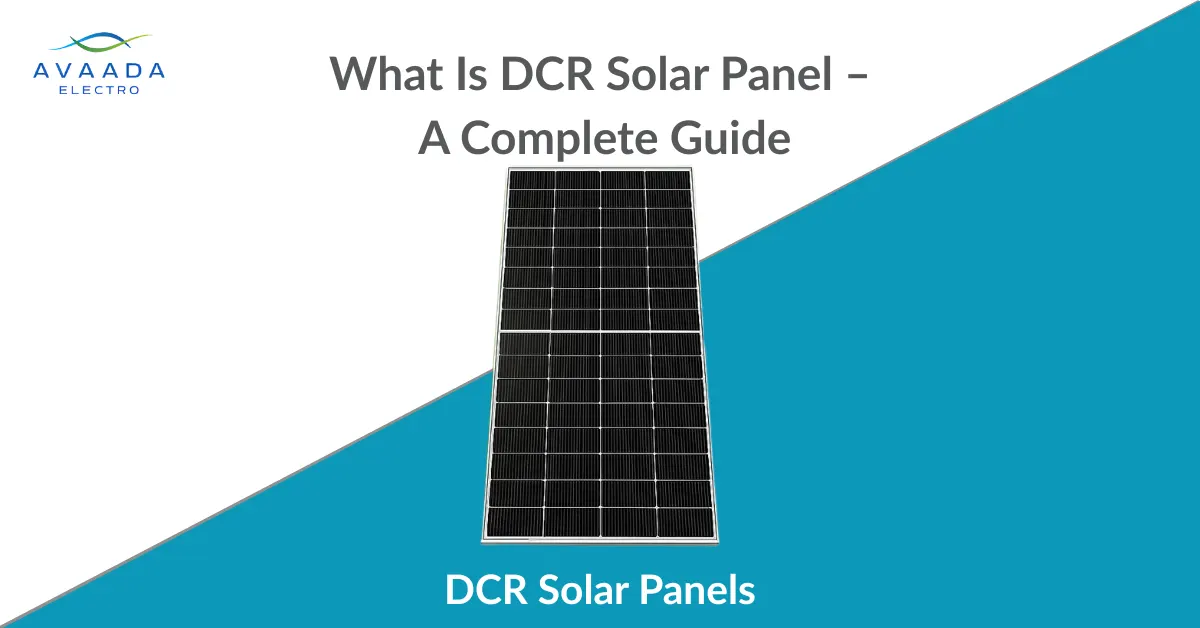
What is a DCR Solar Panel?

DCR, as mentioned, stands for the domestic content requirement that directs a particular percentage of components in solar panels to be manufactured on a domestic level. It is a brilliant initiative to promote local manufacturing industries that reduce dependency on imports and ensure that domestically grown industries are performing well in the competitive global market.
The DCR policy was introduced in 2010 as a part of the National Solar Mission of India. Its primary objective was to boost the domestic solar manufacturing space and reduce dependency on imports, specifically from countries popular for low-cost solar panel production.
The most significant aspect of this policy was to provide a robust platform for local manufacturers while also supporting job creation and the country’s economic growth.
What are the Key Components of a DCR Solar Panel?

A DCR solar panel leverages components made or assembled in India. This makes sure that it offers local economic support along with tighter control over performance as well as quality. Here is a quick look at each of its significant components.
Solar Cells
Solar cells are the powerhouse and one of the most critical parts of the panel. It is responsible for converting sunlight into electricity. In terms of DCR panels, solar cells are manufactured using domestically sourced silicon and are largely fabricated in Indian manufacturing companies, ensuring continuous performance quality as well as alignment with Indian environmental standards.
Glass Sheet
A tempered glass sheet is the front layer of the solar panel. This sheet helps protect the solar cells from wind, rain, dust, and hail. In DCR panels, the toughened glass is produced locally and is designed to handle the changing weather of India, right from summer to winter conditions.
Aluminium frame
This frame helps in giving the panel the right shape and offers structural power. These frames are made in India and are completely lightweight, durable, and have huge resistance to corrosion. This makes them suitable for rooftop as well as ground-mounted DCR solar panel installations.
EVA & Backsheet
Ethylene vinyl acetate, which is EVA, is mainly used to cover the solar cells. On the other hand, the back sheet works as a protective layer at the rear surface. These materials help in avoiding moisture damage as well as the degradation of ultraviolet. Indian manufacturers are now producing both components that are improving local sourcing parallelly.
Connectors and Junction Box
These components help in managing the electrical output and then connect the panel to the remaining parts of the system. A number of DCR complaint panels use junction boxes and connectors that are manufactured on a domestic level and that meet international safety standards.
Why are DCR Panels most chosen?
Non-DCR panels depend on imported materials, and DCR panels are manufactured locally. These panels are manufactured under stringent quality control systems, including BIS certification, that ensure long-term performance as well as reliability in Indian climatic conditions.
What are the Key Benefits of DCR Solar Panels?

DCR solar panels are highly beneficial in varied terms. Let us closely look at their benefits.
Economical benefits
For DCR, i.e., Domestic Content Requirement, solar panels do not just produce clean energy; they also give a striking turn to the Indian economy. In implementing Indian-made solar modules and cells, the policy builds upon our emerging manufacturing ecosystem. It has taken off over the past few years. Indeed, by 2026, India is expected to have around 74 GW of module capacity and roughly 25 GW of solar cells, which is a massive leap encouraged by measures such as DCR.
This expansion has meant more jobs on the ground, from factories to field installations. It is estimated that with each 1 MW of solar added, between 25-30 %of new direct or indirect jobs are added and distributed in different positions.
It will also help erase our dependency on imports, particularly from China. Solar imports in 2024-25 were down by more than 40%, resulting in a significant amount of foreign exchange savings. The whole point of DCR panels is not only that we manufacture power, but we also manufacture industries, support families, and keep more value here at home.
Environmental benefits
One of the major wins with DCR solar panels is the reduced carbon footprint. And because the panels are manufactured closer to where they are installed, we save big on emissions from shipping globally and long supply chains. This can cut lifecycle carbon impact by as much as 20 % against imported solar panels.
Most of these Indian manufacturers are increasingly adopting eco-friendly methods of product recycling, conserving water, and reducing industrial waste. These initiatives also go well with India’s vision of a cleaner and greener solar industry.
On a larger scale, DCR panels help India move closer to its climate targets, such as achieving 500 GW of non-fossil energy by 2030 and achieving net zero by 2070. So, by choosing DCR, we’re also not only getting benefits of local commerce but also making a sustainable choice that is a part of the global clean energy revolution of India.
Did you know?
Every 1 kW of solar energy installed offsets approximately 1.5 tons of CO₂ annually, equivalent to planting over 50 trees.
Operational benefits
There’s also a practical reason to select DCR solar panels. Many of the types made in India are tailored to local conditions, which include heat, dust, and humidity. This clearly indicates that they’re also less likely to fail on the ground.
DCR Solar panels are governed by Indian standards, including BIS certification, and the quality control is more stringent. It clearly indicates that the product is made for where it is used and that is supported by people who are also present there.
DCR Solar Panels vs. Other Solar Panel Types
For a better understanding of DCR solar panels, let us compare them with other solar panels in detail.
a. DCR vs. Non-DCR Solar Panels
Domestic Content Requirement (DCR) panels are made with raw materials that are locally procured in India, and non-DCR panels often rely on imports. The upfront cost of DCR panels is usually higher due to limited domestic manufacturing capacity, but pricing becomes cost-neutral over the lifetime if government subsidies or policy-linked tenders are available.
Non-DCR panels, on the other hand, benefit from international competition and mass production and usually achieve higher efficiency at a lower initial cost. These panels are typically used in the private sector, where cost and quality considerations often take precedence over domestic sourcing.
What are the key considerations?
- Quality – Non-DCR panels normally achieve better global benchmarking.
- Consistency – DCR quality has been improving, but some variance can still be found between different manufacturers.
- Policy Requirements – Programs such as CPSU, KUSUM, and Residential Rooftop Yojana in India require DCR fulfillment to avail incentives.
b. DCR vs. Thin-Film Solar Panels
DCR panels are based on crystalline Silicon (mono or poly), so they are harder and heavier. In contrast, thin-film solar panels contain acceptors such as cadmium telluride (CdTe) or copper-indium-gallium-selenide (CIGS). They are lighter, less rigid, and have properties more suitable for unusual surfaces.
Although DCR modules generally have superior efficiency (15 – 20%), thin-film modules may perform better in low-light conditions, cloudy weather, or at higher temperatures. But thin-film modules typically produce less energy per square meter.
DCR Solar Panels
Pros
- DCR Panels
- Higher efficiency
- Government support
Cons
- Heavier, rigid design
Thin-Film Panels
Pros
- Lightweight and flexible
- Performs well in diffused light
Cons
- Lower efficiency
- Limited availability in India
What are the applications?
DCR panels are better choices where rooftops and spaces are limited. On the other hand, thin-film panels are suitable for broad, open spaces and special applications, such as curved surfaces.
c. DCR vs. Bifacial Solar Panels
Bifacial solar panels can produce electricity from both the front and rear sides, leading to an energy yield gain of 10–30%, depending on the site ratio. Since DCR panels are monofacial, this extra energy gain is already lost for them.
Application Suitability
Bifacial – Best for open fields or solar farms with reflecting materials such as white gravel or sand.
DCR – Best for rooftops or where local sourcing is mandatory (under government tenders).
Cost-Benefit Comparison
Bifacial panels are more expensive at the outset, but the return on investment is better over time, especially in large commercial installations.
If supported by incentives and mandates, DCRs can still pencil out economically, so they remain attractive for small-scale or government-supported utilization.
Government Initiatives and Policies that Support DCR in India
The Government of India is consistently promoting the application of domestically manufactured solar panels with the help of different government policies and initiatives.
Let us look at the top government initiatives and schemes that aid DCR in India.
PM Surya Ghar Muft Bijali Yojana
This initiative is specifically created to provide free electricity to homes via subsidized rooftop solar panels. Here, DCR solar panels will be the most crucial component.
Did you know?
Over 2 million homes are expected to benefit under the PM Surya Ghar Muft Bijli Yojana by 2026!
M-SIPS
This scheme offers subsidies to boost investments in IT hardware and electronic manufacturing sectors, including solar panel production in India.
PLI Scheme (Production Linked Incentive)
It aims to improve the manufacturing capabilities of India with the help of financial incentives to companies. This will help in setting up high-efficiency solar PV model manufacturing units in India.
BCD ( Basic Customs Duty)
The Government of India has imposed basic customs duty on imported solar PVC cells as well as modules. It is specifically imposed to benefit local manufacturing to a greater extent.
Priority to ‘Make in India’
The government gives preference to domestically manufactured goods. These goods include DCR solar panels in the public procurement processes that fall within the renewable energy sector of the country.
What are the key policy aspects of government initiatives?
The major key policy aspects of these initiatives include –
- MNRE Guidelines
The Ministry of New and Renewable Energy provides stringent guidelines and standards for DCR compliance. It includes requirements for solar cell modules as well as other necessary components.
- Waste management
The government of India has made some rules to ensure that the proper management and disposal of solar PV waste are managed properly. It will further help in promoting a healthy economy in the solar industry.
- Safety and quality standards
DCR solar panels must stick to relevant quality as well as safety standards, including those standards conducted for grid synchronization, anti-islanding protection, and fire safety.
Finally, all these initiatives, as well as key policies, are made to strengthen the solar manufacturing ecosystem of India and speed up clean energy adoption in the country.
Common Myths & Misconceptions About DCR Panels
Let us look at the most popular myths about DCR panels in detail.
Myth – DCR panels have low quality
The Reality Part – The reality is that DCR panels are analyzed or examined by the quality standards a particular manufacturer follows, along with the technology capabilities. A lot of Indian manufacturers are experts in producing high-quality DCR panels that are leveraging advanced technology and passing International standards, which is a good sign.
What is the conclusion of this myth?
You just need to focus on the reputation of the manufacturer as well as the technology they are employing, irrespective of the type of panel that is DCR or non-DCR.
Myth – DCR panels are costly
The Reality Part – the price difference between DCR and non-DCR panels is quite negligible, especially when we consider long-term benefits, including domestic manufacturing support and reduced import costs in the future.
What is the conclusion of this myth?
You should evaluate the complete cost-effectiveness, looking for long-term benefits as well as higher government incentives for a DCR panel.
Myth – DCR panels are only made for large-scale projects
The Reality Part – DCR panels are efficient for both large and small-scale projects, including residential or commercial installations. Domestic manufacturing of DCR panels offers more sustainability as well as resilience in the energy sector in the longer term.
What is the conclusion of this myth?
You should choose DCR or non-DCR panels based on different factors like budget, long-term goals, or project size. But remember, DCR panels offer different options for all requirements.
When Should You Select DCR Solar Panels?
You might be thinking about the scenarios for choosing DCR panels. Don’t worry. We have caught you right and have shared a few significant cases when you can select DCR solar panels.
Let’s have a look!
To qualify for Government subsidies
A number of government subsidy programs specifically have a goal to promote local manufacturing in the solar industry. These programs usually need DCR complaint panels to reduce installation costs via official incentives.
To aid local manufacturing
You can choose DCR solar panels to support the domestic manufacturing sector of India. These panels are manufactured using solar cells and modules and accurately align with the Make in India initiative. This way, you can easily contribute to job creation and the overall development of the country’s solar industry sector.
To satisfy local support
DCR panels usually offer advanced local service as well as support networks. As these panels are manufactured in India, the maintenance, replacements, and after-sales service are faster and more trustworthy than the imported options.
To stick to regulatory requirements
Particular residential rooftop projects need DCR solar panels to meet particular quality or safety regulations, as per the Indian government. These panels make sure that the national standards are met, which reduces the risk of technical as well as legal issues occurring during the operation and installation.
Meet Avaada Electro – India’s Rising Star in DCR Solar Manufacturing
Avaada Electro has been the leader in the DCR solar panel sector in India, blending best-in-class R&D state-of-the-art automation, along with a strong emphasis on quality assurance.
Supported by Avaada Group’s clean energy vision, this company already has a quickly ramping domestic manufacturing capacity with integrated cell and module production. Our panels are made for Indian conditions and designed for optimum performance with sustainability in mind.
Avaada Electro isn’t just fulfilling DCR requirements; it’s exceeding them with new standards for innovation, reliability, and environmental stewardship as it fully embraces India’s renewable energy objectives and the Make in India mission.
Wrapping Up
DCR solar panels are more than just local sourcing; they are the top and smart step towards developing self-dependent and resilient energy systems. If you invest in the domestic supply chain, then India is not just reducing its dependency on importing but is also creating jobs and improving innovation levels. It is finally a win-win situation which gives cleaner power and improves the local economy of India.
Are you all set to go solar? Discover DCR-certified panels that are appropriate for both the clean future of India and the energy requirements of the country. Get connected with the most trusted manufacturers like Avaada Electro for best-in-class guidance. Also, stay updated on government policy as well as subsidies so that your choice to switch to solar will be more regarding.