Electricity charges in India have been on the rise in recent years. A monthly power bill of 4,000 to 7,000 has become a reality for many households, particularly where air conditioning, water motors, washing machines, and all kitchen appliances are in daily operation. Consequently, the number of homeowners migrating into rooftop solar has increased to curb monthly bills and be free of the inability to rely on changes in tariffs.
Out of all the sizes of the systems, a 5 kW rooftop solar system has become the most popular among Indian homes since:
It produces power that is enough to operate a full 3 BHK house, which has an AC, fridge, washing machine, lights, fan, and daily appliances.
It saves INR 4,500-6,500 in electricity costs every month.
Under the PM Surya Ghar subsidy, the net price will be brought down to a considerably lower level, which will make solar much more affordable in 2026.
The electricity produced by a 5 kW system is 20-24 units per day, which amounts to INR 7,500-8,500 units annually. The average payback period of most homeowners is 3.5-5.5 years, and the system would last 20 or more years, free of charge.
In this guide, you will learn –
- The cost of a 5 kW solar system in 2026 with and without a subsidy.
- New subsidy slab PM Surya Ghar Yojana.
- Savings and ROI calculation
- CO2 privacy and tree-ecological equivalent.
- Components that make up a complete installation.
- Installation process in the national subsidy portal step-by-step.
- The reason why the appropriate installer (ALMM + subsidy support) is important.
Our goal is simple –
To help you know whether a 5 kW rooftop solar system is the correct investment that you can make in your home in 2026, and how much you will be able to save.
What is a 5 kW Solar System?
5 kW indicates the power capacity of the solar system. It means that this is the amount of power that the system is capable of producing at any time when there is sunlight available. This is not defined in terms of the number of panels as it is different for each module.
What is the power that it produces?
Daily production is about 2024 units (kWh).
Generation per annum: about 7,300 to 8,500 units (kWh)/annum.
Real generation is also different as per the geography and the quality of installation.
How many solar panels are needed?
| Panel Technology | Panel wattage (approx.) | Panels required for 5 kW |
| Mono-PERC | 450–550 Wp | 9–11 panels |
| N-Type TOPCon (high-efficiency, e.g., Avaada Electro 630–720 Wp) | 630–720 Wp | 7–8 panels |
And with increased WP modules, the panel count is reduced, i.e.,
- Less roof space
- Better aesthetics
- Improved performance even in low light
Components Included in a Complete 5 kW Solar Setup
It is not merely a solar panel system of 5 kW rooftop. It is a combination of various components that collaborate in the production of electricity in a safe and efficient manner. The following are the components of a complete solar setup –
Solar panels
Solar panels are used to convert sunlight to electricity.
Inverter
The panels are then converted into DC power by an inverter that is utilised to produce usable AC power. It is then used to power your appliances. A grid-tied inverter is suitable for homes with stable electricity.
In cases of power outages in homes, supporting future batteries can be achieved with the help of hybrid inverters.
Mounting structure
This frame secures the panels in the rooftop at the right angle and makes them secure in the presence of strong winds or rain.
Cables
Cables are categorised into three types: hard-woven, foil, and polypropylene.
These make the system remain safe even in conditions of voltage change or lightning strike.
Solar installation is made up of panels, an inverter, a structure, wiring and protection. When properly done, it has a lifespan of 25+ years.
What Can a 5 kW Solar System Run?
A 5 kW system can power –
- 1-2 AC units (1.5 ton)
- Refrigerator
- Washing machine
- Lights, fans, and laptop charging
- Kitchen appliances like a microwave, mixer, and water purifier
A typical 3-4 BHK Indian household fits into this range.
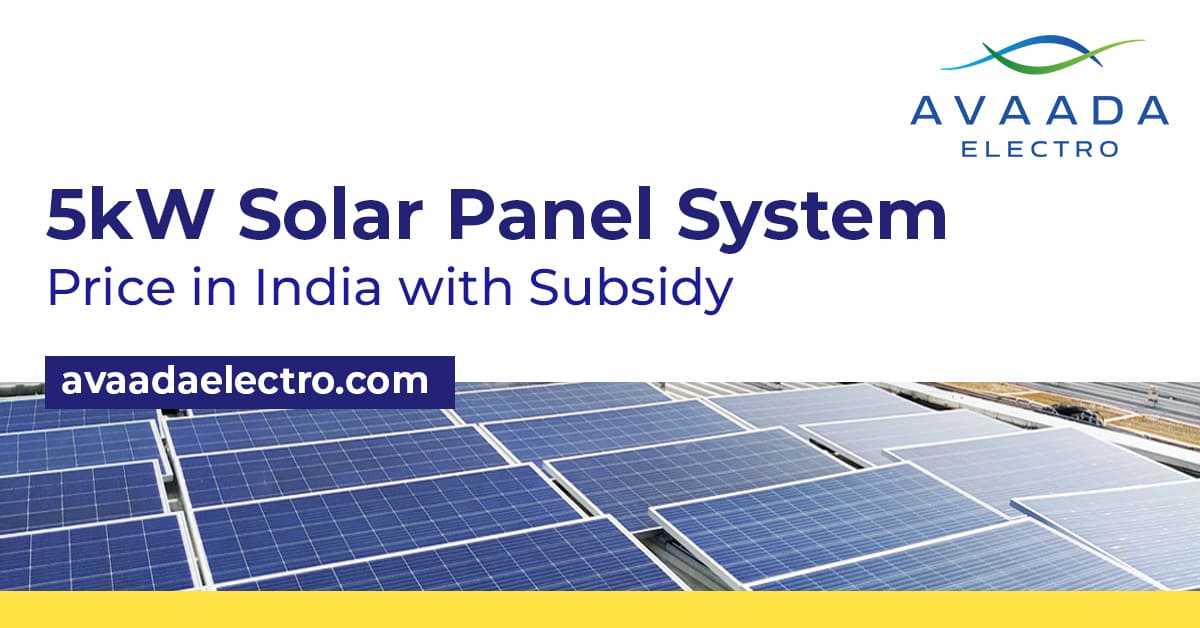
5 kW Solar System Price in India (2026)
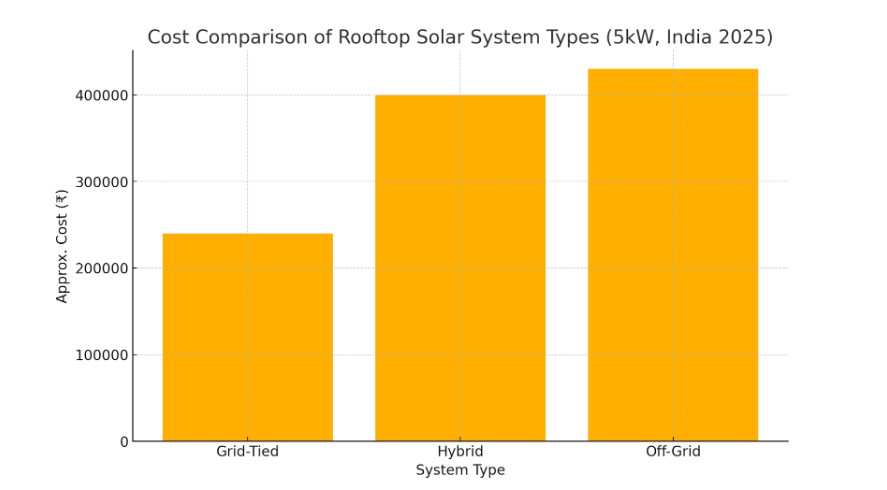
| System Type | Who can get the best outputs? | Approx. Price (Before Subsidy) | Approx. Price (After Subsidy) |
| Grid-Tied (rooftop without battery) | Homes with a stable grid | ₹2.2–₹2.6 lakh | ₹1.4–₹1.7 lakh (with subsidy) |
| Hybrid (solar + battery backup) | Homes needing backup | ₹3.5–₹4.5 lakh | No subsidy on battery |
| Off-Grid (battery only, no net-metering) | Remote areas without a grid | ₹3.8–₹4.8 lakh | No subsidy |
Pricing changes as per the –
- Panel technology (Mono-PERC vs N-Type TOPCon)
- State rooftop subsidy (if any)
- Quality of inverters and mounting structures
Choosing the right type of solar setup affects cost and functionality. Here’s a quick cost comparison of Grid-tied vs Hybrid vs Off-grid systems:
Subsidy Structure Under PM Surya Ghar Yojana (2026)
Central Government subsidy (for homeowners only) –
| System Size | Subsidy Amount |
| Up to 2 kW | ₹30,000 per kW |
| 2 kW – 3 kW | ₹18,000 per kW |
| Above 3 kW | Fixed at ₹78,000 |
ROI & Payback Period of 5kW Solar Panel System in India
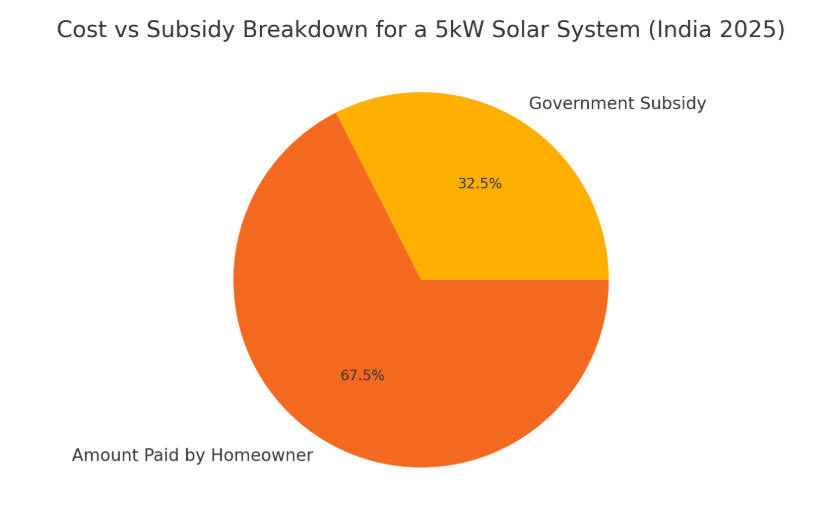
The subsidy reduces your upfront investment, which directly improves ROI:
- Monthly bill savings: ₹3,500–₹7,500
- Annual savings: ₹45,000–₹90,000
- With subsidy: payback in 3.5–5.5 years
- System life: 25+ years
- ROI: 18–22% per year, better than FD, SIP, or real estate
Solar is an investment, not an expense.
Benefits of Installing a 5 kW Solar Panel System
The most popular type of solar system that is used in medium-sized homes is the 5 kW rooftop solar system since the system is very well balanced in terms of cost, production and savings.
Major benefits include:
- Radical cutback of electricity bills
A 5 kW solar system produces approximately 7500+ units in a year, which saves you 45000-90000 per year on electricity bills, according to your tariff.
- Better ROI and compensation
Most homeowners break even in 3.5 -5.5 years using subsidy assistance and high production with electricity being virtually free after it.
- Increased property value
Homes which are solar-ready are usually sold at higher prices because the purchaser considers the low operating expense and energy autonomy.
- Guarantee against increasing power tariffs.
The annual electricity rates in India rise by 6-8 %. The solar assists in securing long-term energy prices and lessening the reliance on DISCOM price changes.
- Environmental benefit
Direct conversion to solar power will cut down carbon emissions.
A 5 kW system =
6-7 tons of CO₂ avoided every year
The same as planting about 250 trees per year.
5kW Solar Panel Step-by-Step Installation Process (Subsidy Compliant)
The PM Surya Ghar subsidy scheme has made the installation of rooftop solar easy. Here’s how the process works:
- Create an account on the national portal
Go to pmsuryaghar.gov.in, create an account with your mobile number and electricity bill.
- Select an empanelled vendor
The subsidy is open to vendors who are endorsed by MNRE. Select one of them at the portal dashboard.
- DISCOM feasibility approval
The vendor comes to your premises, where they upload technical information and request that your electricity provider approve them.
- System installation
The installation commences once it has been approved. Inverter, wiring and safety equipment are installed and tested.
- Approach and commissioning of the Net meter
DISCOM installs a net meter, performs a check-up and final commissioning.
- Credited to your bank account as a subsidy
Once this inspection is successfully passed, the subsidy is deposited in your bank account.
It is organised, totally digital, and transparent.
What Challenges Do Homeowners May Face?
Here are a few challenges that homeowners may face –
Delays in net-metering and approval
There are instances of homeowners having delays in the net-metering approval due to the state-wise verification processes by the DISCOMs.
When selecting a vendor who has been empanelled to work with your state DISCOM, you are sure to find him or her to do all the paperwork and follow-ups, hence saving time in waiting.
Space and shading problems of the roof
The lack of roof space or shade provided by the surrounding buildings reduces energy production.
Panels with higher efficiency, such as N-type TOPCon, can support better energy generation in limited roof space, subject to site conditions.
Selecting the appropriate type of system
The reason is that many customers do not know what systems they should choose: grid-tied, hybrid, or off-grid.
A load assessment performed by the installer is a simple task to determine the necessity of savings (grid-tied) or backup (hybrid/off-grid).
Selection of an ALMM-Approved vendor
The government subsidy is only applicable to ALMM-listed panels. Make sure that the installer certifies the module to prevent rejection of the subsidy.
How to Fix and Repair Your 5kW Solar Panel System
Correct maintenance will ensure your solar investment performs properly throughout its 25+ years of life. The following are some of the main tips and typical problems that should be observed:
Panel Cleaning
Dust, dirt, and droppings of birds may decrease power output. Wipe down the clean panel using water and a soft cloth after every couple of months- more frequently in dusty places. No harsh chemicals or tough materials are to be used.
Shade Management
Make it a habit to ensure that there are no new obstructions (trees, buildings) that are shading your panels, because shading is a sure way to cut down production of energy by a substantial margin.
Measure Performance
Inverter displays or monitoring applications can monitor energy generation. Sudden drops may be an indication of panel, wiring or inverter issues.
Wiring Inspection
Connection of the wires can be loose or corroded which results in faults and dangers. Have electrical connections inspected by a skilled electrician on an annual basis.
Inverter Maintenance
Clean, well-ventilated and has no fault codes. Most inverter errors have certain fault indicators.
Battery (hybrid systems) Maintenance
Check the health of batteries, keep electrolyte levels (where applicable) and prevent deep discharges to increase the lifespan of the battery.
Resolving Faults in Time
In case you observe flickering lights, system shutdowns, alarms, etc, call your installer or official service to avoid damage.
Adhering to these maintenance procedures would help you save on money as well as maintain a running system that would save you years of reliability in power supply.
Avaada Electro
Avaada Electro manufactures its own solar panels and manages its production processes internally.
- Offers N-type TOPCon high-efficiency panels (630-720 Wp), producing more power in the same area of the roof.
- The company’s panels are manufactured using AI-automated production systems.
- Each of the modules is subsidy-compliant, ALMM-listed, and BIS/IEC certified.
- Provides up to a 30-year performance warranty, meaning the panels can provide energy for several years.
- The company provides site surveys, installation services, and assistance with net-metering and subsidy documentation.
Under Avaada, homeowners receive a long-term, dependable solution, not just a simple installation.
Final Takeaway
A 5 kW rooftop solar system is one of the best choices that a homeowner can get in 2026.
The government subsidy and the increase in electricity tariffs have meant a payback period of only 3.55 years, after which it is virtually free to produce the electricity you need.
Solar will make your house self-sufficient in terms of energy, reduce your monthly bill and enhance your house’s value.
When it is installed with a reliable installer and energy-efficient panels, it ends up as a long-term investment that does not require maintenance.
This is the appropriate moment to switch to rooftop solar if you are considering it.