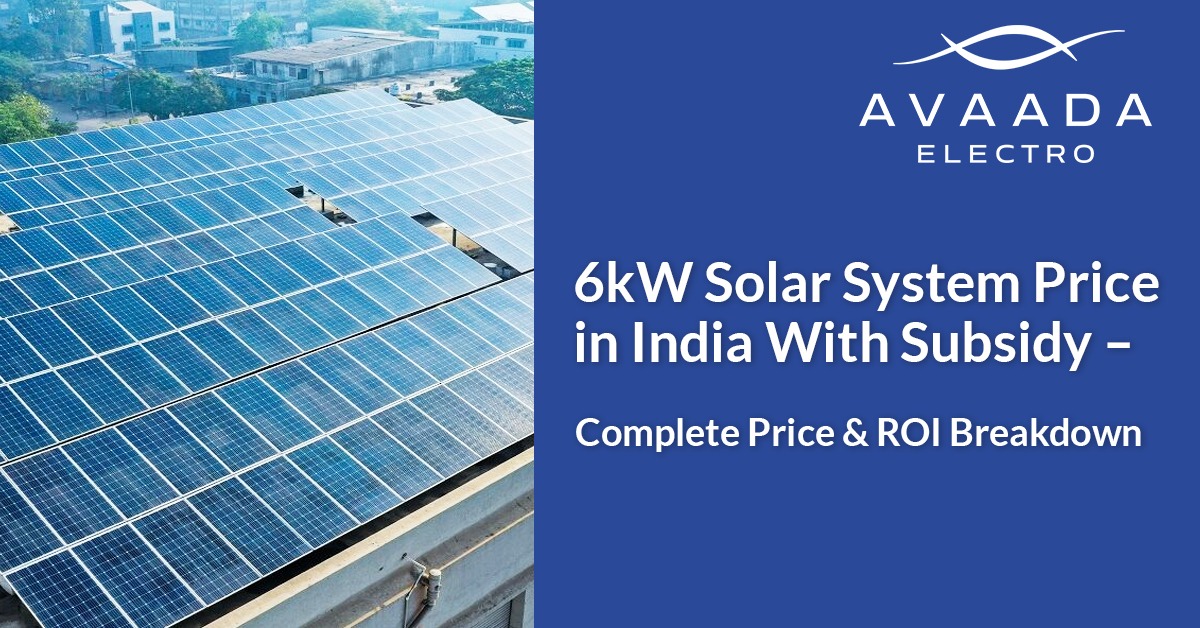
A 6kW rooftop solar system is a practical, future-ready solution for Indian households with high electricity consumption. It is commonly chosen by large families, independent homes, villas, and small commercial establishments where monthly power bills are significant. In 2026, with rising electricity tariffs and government-backed incentives, understanding the actual price after subsidy, expected savings, and return on investment (ROI) is essential before making a purchase decision.
This guide provides a clear and factual explanation of 6kW solar system pricing in India, how the central subsidy applies, what affects installation cost, how much energy the system generates, and how long it typically takes to recover the investment. This guide helps buyers evaluate installer quotations, verify subsidy eligibility, and assess financial returns.
Why Choose a 6kW Solar System?
A 6kW system is ideal for properties with:
- Monthly electricity consumption of 700–1,000 units
- Multiple air conditioners
- High daytime energy usage
- Roof area of approximately 450–600 sq. ft.
This system size offers a strong balance between upfront investment and long-term savings. It is large enough to significantly reduce electricity bills while still remaining eligible for residential rooftop solar subsidies.
6kW Solar System Price in India (2026)
Pre-Subsidy Price Range
The cost of a 6kW solar system varies based on component quality, inverter type, and installer standards. Typical market ranges in 2026 are:
- Economy systems: ₹3.2–₹3.6 lakh
(Basic mono panels, standard string inverter, minimal accessories) - Mid-range systems (most common): ₹3.8–₹4.4 lakh
(Branded mono panels, quality inverter, robust mounting, better protection) - Premium systems: ₹4.6–₹4.8 lakh or higher
(High-efficiency panels, hybrid or battery-ready inverter, premium mounting)
These prices generally include design, supply, installation, commissioning, and standard warranties.
Government Subsidy for 6kW Solar System (2026)
Under the PM Surya Ghar: Muft Bijli Yojana, residential rooftop solar systems are eligible for central financial assistance. For systems of 3kW and above, the subsidy is capped at ₹78,000, regardless of system size.
What This Means for a 6kW System
Even partial shading from nearby buildings… reduces system output if not accounted for in design. Therefore:
- The same ₹78,000 subsidy applies to both 3kW and 6kW systems.
- State subsidies vary, e.g., Maharashtra adds up to ₹25,000-₹60,000 top-up, Karnataka offers ₹10,000 extra per kW up to 3kW, Uttar Pradesh provides ₹15,000-₹30,000 based on capacity, Gujarat offers up to ₹20,000 additional per system, which must be checked locally via DISCOMs.
- Larger systems rely more on electricity savings than subsidies for ROI; some states provide additional incentives or benefits through DISCOMs, but these vary widely.
Net Cost After Subsidy – Worked Examples
Example 1: Mid-Range System
- Pre-subsidy price: ₹4,20,000
- Central subsidy: ₹78,000
- Net payable: ₹3,42,000
Example 2: Economy System
- Pre-subsidy price: ₹3,40,000
- Central subsidy: ₹78,000
- Net payable: ₹2,62,000
Example 3: Premium System
- Pre-subsidy price: ₹4,80,000
- Central subsidy: ₹78,000
- Net payable: ₹4,02,000
These examples highlight why component selection and installer pricing significantly influence the final investment.
Component Cost Breakdown (Typical)
A 6kW system cost is usually distributed as follows:
- Solar panels: 35–45%
- Inverter: 12–18%
- Mounting structures & civil work: 8–12%
- Electricals, wiring, protections: 6–10%
- Installation & commissioning: 8–12%
- Taxes and miscellaneous: balance
Always request a detailed bill of materials (BOM) with model numbers and warranty terms.
Expected Energy Generation From a 6kW Solar System
Solar generation is estimated using specific yield, measured in kWh per kWp per year. In India, typical rooftop systems deliver:
- Low sunlight regions: ~1,200 kWh/kWp/year
- Moderate regions: ~1,400 kWh/kWp/year
- High sunlight regions: ~1,600 kWh/kWp/year
Annual Generation Estimates
- Low case: 6 × 1,200 = 7,200 units/year
- Medium case: 6 × 1,400 = 8,400 units/year
- High case: 6 × 1,600 = 9,600 units/year
Monthly averages range from 600 to 800 units, with higher output in summer and lower output during monsoon or winter months.
Step-by-Step Method to Calculate Savings and Payback
The following steps explain how to calculate savings and payback:
- Estimate annual generation
Begin by calculating the system’s expected annual energy output using location-specific sunlight data and system size.
Professional installers use simulation tools to account for tilt, orientation, shading, and system losses.
Annual generation, rather than daily output, should be used as the basis for financial calculations.
- Apply the effective electricity tariff
Next, assign a realistic value to each unit generated.
The value should reflect the blended tariff based on self-consumed units and exported units under net metering or net billing rules.
Using the highest slab tariff without considering export limits can overstate savings.
- Subtract annual maintenance costs
Annual operation and maintenance expenses should be deducted to arrive at net savings.
These costs typically include panel cleaning, system inspection, and basic servicing, and remain modest compared to overall savings.
- Divide the net system cost by the annual savings
Finally, divide the net installed cost (after subsidy) by net annual savings.
The result is the simple payback period, expressed in years.
The method provides a clear, conservative view of how quickly the investment recovers its cost.
Example – Moderate Tariff Scenario
- Net cost after subsidy: ₹3,40,000
- Annual generation: 8,400 units
- Effective tariff: ₹8 per unit
- Annual gross savings: ₹67,200
- Annual maintenance: ₹4,000
- Net savings: ₹63,200
- Payback period: ~5.4 years
High Tariff Scenario
- Tariff: ₹10 per unit
- Net annual savings: ~₹80,000
- Payback period: ~4.2 years
Higher tariffs and better self-consumption significantly shorten payback time.
Role of Net Metering in Savings
Net metering plays a central role in determining how much financial value a rooftop solar system delivers over its lifetime. It directly affects how surplus electricity is accounted for and how quickly the system pays for itself.
How Net Metering Works
Under net metering, any electricity generated by the solar system that is not consumed immediately is exported to the utility grid. These exported units are recorded and later adjusted against electricity imported from the grid, typically during nighttime or low-sunlight hours. The consumer is billed only for the net difference, which significantly reduces monthly electricity charges.
Why Net Metering Improves Savings
Net metering ensures that no generated energy is wasted. Without it, surplus daytime power would go unused unless batteries are installed. By allowing excess units to offset future consumption, net metering maximises the utilisation of every unit produced. This directly increases annual savings and shortens the return on investment.
Impact on ROI and Payback Period
By crediting exported units at retail or near-retail rates, net metering improves the effective value of solar-generated electricity. Systems with net metering typically achieve faster payback compared to systems without export compensation, especially for households with higher daytime generation.
State-Level Variations and Export Limits
Some states follow net billing or impose export caps, where exported units are valued at lower tariffs. These policies slightly reduce savings, making it essential to confirm local DISCOM rules before finalising financial projections.
Financing Options for 6kW Solar Systems
Buyers can choose from:
- Solar-specific bank loans
- Home improvement loans
- Vendor-provided EMI plans
- Scheme-linked loans under PM Surya Ghar
Financing spreads the upfront cost while electricity savings help offset EMIs.
Installation Timeline of a 6 kW Solar System in India
Typical project timeline:
- Site survey & design: 2–4 days
- Approvals & documentation: 7–30 days
- Material procurement: 1–3 weeks
- Installation & commissioning: 2–4 days
Delays usually occur due to DISCOM approvals or roof readiness issues.
Maintenance and Warranties of a 6kW Solar System
The following outlines typical maintenance requirements and warranty coverage:
| Component | Coverage | What It Means for the Buyer |
| Panel product warranty | 10–12 years | Covers manufacturing defects, material failure, and workmanship issues under normal use. |
| Panel performance warranty | 25 years | Ensures long-term output, usually guaranteeing 80–85% of rated capacity after 25 years. |
| Inverter warranty | 5–10 years | Covers electronic failure; extended warranties are recommended for long-term users. |
| Annual O&M cost | ₹3,000–₹6,000 | Includes cleaning, inspection, and basic system health checks. |
Why this matters
Warranties protect against early component failure, while routine maintenance ensures that generation estimates used in ROI calculations remain accurate over time. Buyers should always verify warranty documents and local service availability before finalising a vendor.
Common Mistakes Buyers Should Avoid
Installing a 6kW solar system is a long-term investment, and most post-installation problems arise from decisions made at the quotation stage. Awareness of these common mistakes helps buyers protect both system performance and financial returns.
- Choosing the cheapest quote without BOM clarity is one of the most common errors. Low-priced quotes often hide inferior modules, undersized inverters, or missing electrical protections. Buyers should always ask for a detailed bill of materials with brand names, model numbers, and warranty terms. Transparent documentation is a stronger indicator of quality than headline price.
- Ignoring roof shading and orientation can significantly reduce energy generation. Even partial shading from nearby buildings, water tanks, or trees can lower output if not accounted for in system design. A proper site survey and generation simulation are essential before finalising capacity.
- Overestimating export income leads to unrealistic ROI expectations. Net metering and export tariffs vary by state, and some utilities impose limits on export. Savings should be calculated conservatively, focusing on self-consumption first.
- Not checking warranty and service support exposes buyers to future repair costs. Always verify inverter and panel warranties and confirm local service availability.
- Assuming the subsidy is automatic is another risk. Subsidy eligibility depends on documentation, installer registration, and compliance with scheme rules.
Careful planning and verification at each step prevent most post-installation issues and ensure reliable long-term performance.
Conclusion
A 6kW rooftop solar system is a strong long-term investment for Indian homes with higher electricity consumption. In 2026, despite a capped subsidy, falling equipment costs, and rising tariffs, this system size is financially attractive. Buyers should focus on quality components, accurate generation estimates, and clear subsidy processes rather than only the upfront price. With proper planning, a 6kW solar system delivers reliable savings and energy security for over two decades.
Frequently Asked Questions
How much does a 6kW solar system cost in India in 2026?
The typical price ranges from ₹3.2 lakh to ₹4.8 lakh before subsidy. Final cost depends on components and installation quality.
How much subsidy is available for a 6kW system?
The central subsidy is capped at ₹78,000 for systems above 3kW. State-level incentives may apply additionally.
What is the net cost after subsidy?
Net cost usually falls between ₹2.4 lakh and ₹4.0 lakh. Exact figures depend on pre-subsidy pricing.
How many units does a 6kW system generate annually?
Between 7,200 and 9,600 units per year. Location and sunlight availability influence output.
Is 6kW enough for a large home?
Yes, it suits homes with high electricity usage and ACs. It can offset most household consumption.
How much roof area is required?
Around 450–600 sq. ft. of shadow-free area. Panel wattage affects the exact requirement.
What is the payback period for a 6kW system?
Typically, 4 to 6 years after subsidy. Higher tariffs shorten payback.
Can batteries be added later?
Yes, with a hybrid or battery-ready inverter. This allows future backup without reinvestment.
Does net metering apply to 6kW systems?
Yes, in most states for residential users. Rules vary by DISCOM.
How long does installation take?
Physical installation takes 2–4 days. Approvals may extend the overall timeline.