

Key Takeaways:
- Solar panels carry 25–30 year performance warranties but can keep producing at 80–87% efficiency for 30–40+ years.
- N-Type TOPCon panels degrade slowest (0.2–0.4%/year), retaining 88-92% output after 25 years versus 75-80% for polycrystalline.
- Inverters typically fail before panels- string inverters last 10-12 years while panels often outlast the entire system’s other components.
- Regular cleaning, inspection, and monitoring (via PR, IR thermography, or apps) help panels exceed warranty life and maximize savings.
The solar panels are built to be durable, which is one of the main reasons people have confidence in them to save energy in the long run. Be it a home, a factory roof, or one of the huge utility projects, modern solar panels are designed to deliver clean power that can be counted on to run for decades. The majority of homeowners are aware that solar saves on electricity bills, but few are aware of the lifespan of the panels or what happens when the system becomes old.
With advances in cell technology (such as N-type TOPCon), materials, and stringent international certification, current-generation solar modules have greater durability and a lower depreciation rate than previous-generation panels in 2026. Knowledge of lifespan, warranties, degradation rates, and durability helps make informed investment decisions and select the right manufacturer.
This blog simplifies all this down in such a way that you are well aware of what to expect from your solar system throughout its life span of 25-30+ years.
What Is the Lifespan of Solar Panels?
Most high-quality solar panels come with a 25–30-year performance warranty, but their actual lifespan is often longer.
Typical lifespan –
- 25–30 years – Guaranteed performance period
- 30–40+ years – Panels may continue producing power, but at lower efficiency
Panels don’t ‘die’ after 25 years; they simply generate slightly less electricity each year due to natural wear. A high-quality module can still perform at 80–87% efficiency even after 25 years if manufactured with advanced technologies such as N-Type TOPCon.
This is why choosing a premium manufacturer matters, as lifespan depends heavily on panel quality, materials, and reliability.
What Is Solar Panel Degradation?
The process of degradation of solar panels can be defined as the progressive decrease in the capacity of the panel to transform sunlight into electricity. Each panel deteriorates by a small share of its output each year due to environmental conditions (UV rays, heat, dust, and microcracks).
Average Degradation Rates in the Industry
- Mono-PERC panels: 0.5% – 0.7% per year
- N-Type TOPCon panels: 0.2% – 0.4% per year
- Premium bifacial glass-to-glass modules: as low as 0.25 percent per year.
What does this mean in real life?
Even at a panel degradation rate of 0.25 per year, a panel will continue to be 93-94 percent efficient after 25 years, compared to older panels, which reduce to 80% or less.
This is one of the key arguments why the industry is moving towards the N-Type TOPCon technology, which provides:
- Lower degradation
- Higher long-term stability
- Higher performance in high temperatures.
How Degradation Impacts Energy Production Over Time
Degradation doesn’t drastically reduce your savings; it happens gradually and predictably.
Example: A 2 kW or 5 kW rooftop system
Let us assume:
- A system produces 100% output in Year 1
- Degradation rate: 0.25% per year (TOPCon module)
Output over time –
- Year 10: ‾Around 95% of original output
- Year 20: ‾‾Around 91%
- Year 25: ‾Around 95%
Even after 25 years, your solar panel still generates most of what it did on day one.
This predictable performance is exactly why manufacturers provide long-term linear warranties; you know what you’re getting, year after year.
How Long Each Component of a Solar System Lasts
A solar system is more than just panels. Different parts age at different speeds:
Solar Panels
25–30 years (often continue to work beyond 35 years)
Inverters
- String inverters: 10–12 years
- Microinverters: 20–25 years
- Hybrid/Off-grid inverters: 8–10 years
Inverters usually need at least one replacement during the system’s lifetime.
Mounting Structures
25–30 years, provided they are galvanised and installed with anti-corrosion protection.
Batteries (If Installed)
- Lithium-ion: 8–12 years
- Lead-acid: 3–5 years
Wiring & Safety Devices
15–25 years, depending on exposure and installation quality.
This clear breakup helps homeowners plan maintenance and understand long-term costs realistically.
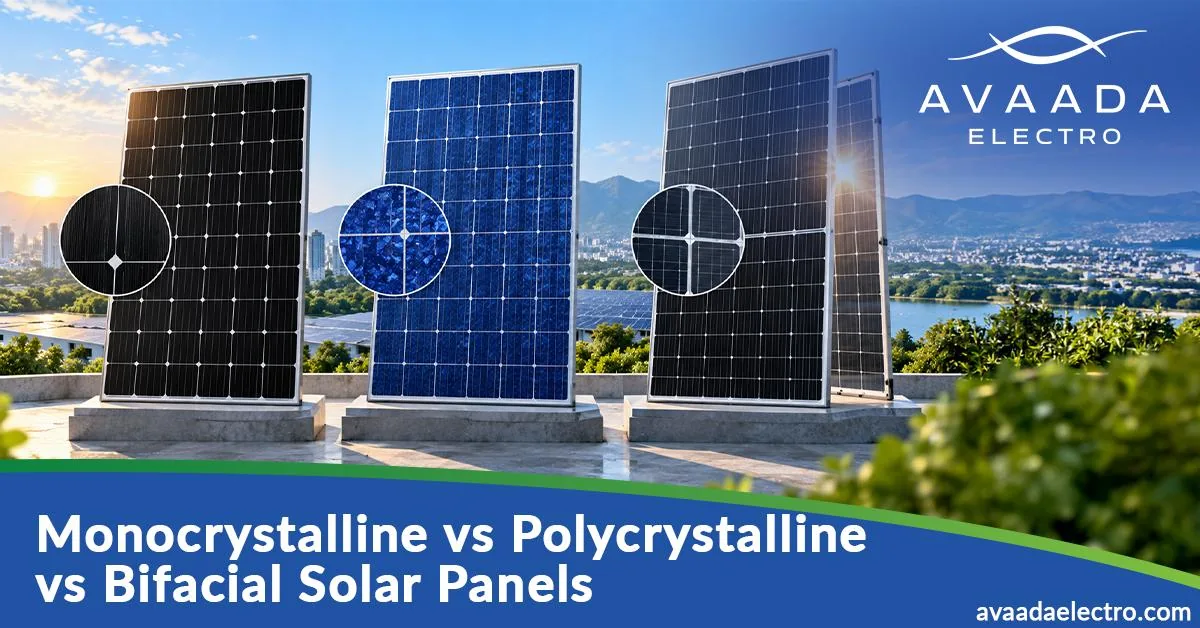
Monofacial vs. Bifacial vs. N-Type – Which Lasts the Longest?
N-Type TOPCon panels typically offer the best value over a 25-year lifecycle, since they retain more of their original output than Mono-PERC or polycrystalline panels across the same warranty period. Avaada Electro’s N-Type TOPCon modules are built specifically for this long-term efficiency retention.
Monofacial Poly/Mono Panels
- Traditional technology
- Reliable but degrades faster
- Average lifespan: 20–25 years
Bifacial Panels (Glass-to-Glass)
- Capture sunlight from both front and back
- Far better protection from moisture and cracks
- Degradation: ‾0.3% per year
- Lifespan: 30+ years
N-Type TOPCon Panels (Advanced Gen-3 Technology)
- Lowest degradation in the industry
- High efficiency, strong low-light performance
- Degradation: ‾0.22% in the first year, followed by approximately 0.4% per year thereafter
- Lifespan: 30 years
This is why premium manufacturers and leading global module makers are increasingly shifting to N-Type.
Degradation Rates of Different Solar Technologies
Not all solar panels age the same way. Their material and cell technology play a big role in how long they keep performing. Here’s how major panel types compare:
Polycrystalline Panels
- Older technology
- Average degradation: 0.7–0.8% per year
- After 25 years: roughly 75–80% performance
- Lower upfront cost, but lower long-term efficiency
Mono-PERC Panels
- Most commonly used for home rooftop systems
- Degradation: 0.5–0.6% per year
- After 25 years: 83–87% performance
- Good balance of price vs. output
N-Type TOPCon Panels
- Latest high-efficiency technology
- Degradation: 0.25–0.4% per year
- After 25 years: 88–92% performance
- Significantly lower Light Induced Degradation (LID)
- Ideal for long-term residential & commercial savings
This is why premium manufacturers are rapidly moving toward N-Type TOPCon, as it delivers higher efficiency and longer lifespan.
Solar Warranty Types & What They Actually Cover
Solar warranties are, in many cases, being misconceived, yet they have one of the clearest indications of the duration one should expect the panel to survive. There are usually 2 types of warranties issued by manufacturers that protect you against different forms of risk.
Product or Manufacturing Warranty (10-15 years)
This includes flaws in the material or workmanship, such as faulty junction boxes, lamination problems, yellowing (non-natural), glass breakage (non-natural), and frame corrosion.
A warranty on the product is like a guarantee on the safety: in case anything goes wrong due to a lack of proper manufacturing of the panel, it will be replaced or fixed by the manufacturer.
The good brands nowadays sell 12-15 years, though the advanced manufacturers (particularly the fully-automated line) are able to sell up to 15 years.
Performance Warranty (25-30 years)
This guarantees that your panels will continue to produce a minimum percentage of the original rated output after some years- normally 90-92 percent in the 10th year and 80-85 percent in the 25th year.
Other more recent technologies, such as N-type TOPCon panels, tend to ensure 88-89% output even at the age of 25, due to slower degradation.
A performance warranty involves a warranty curve- a downward-sloping curve that indicates the degradation expected every year. The smoother the curve, the greater the projected longevity.
A warranty is not the compulsion of a panel to perform for 25-30 years; rather, it is an indication of the confidence of the manufacturer in its material, tests, and field performance.
Brands that have higher quality control, like AI smart manufacturing and superior encapsulants, tend to have extended coverage.
Read More – How To Clean Photovoltaic Panels
Factors That Reduce or Extend the Lifespan of Solar Panels
The life of a solar panel is not predetermined; it depends on the materials, quality of construction, installation of the system, and its maintenance conditions. The largest contributors are as follows:
Module Quality and Cell Technology
N-Type TOPCon or high-quality mono-PERC cells are used to construct panels that degrade more gradually than other types of panels since they are resistant to LID and thermal stress. Polycrystalline panels or cheap imports have a lower degradation rate.
Manufacturing Control
Automated production lines provide accurate lamination, solder bonding, and encapsulation, which is imperative to durability. Improper lamination may lead to moisture ingress, delamination, and premature failure.
Environmental Stress
Solar panels are exposed to heat cycles, dust, humidity, salt spray (in coastal areas), and hail.
Hot climates enhance thermal fatigue.
Humid/coastal regions require panels of a more robust backsheet and frames that are non-corrosive.
Areas with heavy wind require mounted buildings that are strengthened.
Installation Quality
Wrong torque values, bad cabling, improper grounding, and misaligned mounting rails may reduce the life of a system. Some of the major proportions of field failures are installation failures rather than panel failures.
Soiling & Maintenance
Hot spots can be created by dust accumulation in Rajasthan, air pollution in Delhi, or sea salt in the coastal areas, and output can be reduced. Periodic cleaning and frequent inspections will avert criminals in the long run.
System-Level Issues
At other times, it is not the panel that is the weakest; there is the inverter, which normally has a life span of 8-12 years. Stress on panels may be enhanced by mismatch losses, string imbalance, or loose connectors.
With appropriate engineering and maintenance of panels (twice a year), the life of panels may be much longer than the warranty (25 years).
How to Test and Monitor Degradation?
The only method of determining whether the solar panels are degenerating at the standard rate is by observing their performance and recording the difference over the years.
Energy Production Comparison of the Annuals
The simplest approach: put the amount of energy generated this year and last year into comparison.
An average system ought to lose 0.5-0.8 percent every year. A decline of more than 2-3 per cent can point towards shading, soiling, or a partial problem.
Performance Ratio (PR)
Installers compare actual output with expected output using PR.
PR less than 70- 75% means that there is something wrong with the system.
IV Curve Testing
In this test, current-voltage characteristics are tested to detect:
- Micro-cracks
- Shading
- Connection failures
- Cell-level defects
It is done once every few years by experts.
Infrared (IR) Thermography
A thermal camera can detect hot points, diode problems, and wiring faults. It is the quickest method of diagnosing the latent problems.
Electroluminescence (EL) Imaging
EL scans indicate the presence of microcracks within cells, particularly during heavy storms or hail.
When to Call a Professional?
In case the output decreases unexpectedly, or the monitoring applications indicate unusual behavior, an installer is to check the system. Failure is avoided in large versions through early detection.
Maintenance & Best Practices to Maximise Life of Solar Panels
Although solar panels require minimal maintenance, there are several easy habits that can help extend their lifespan.
Cleaning
- Clean dusty or polluted panels after a duration of 2-3 months.
- Every four to six months is sufficient in the coastal/rainy areas.
- Make sure to use soft water and do not use any sharp tools.
Periodic Inspection
Visually check once or twice a year:
- Setting up constructions of rust.
- Cables for wear
- Junction boxes for moisture
- Surge protection and earthing.
Minimal repairs are saving major repairs in the future.
Measure Performance Periodically
The majority of the contemporary inverters are provided with mobile applications. In case the output is suddenly low, inspect the new shade, debris, and inverter alarms.
Protect From Animals & Debris
Wiring can be damaged by bird nests, or the cables can be chewed by rodents. Conduit protection and mesh guards are beneficial.
Software & Firmware Updates
To remain efficient and safe, smart inverters should be updated on a regular basis.
Regular maintenance maintains the degradation rates at a minimum, and also provides a longer, healthier life span of the panels.
When Should You Replace Panels?
Solar panels do not usually break down in a flash; rather, they wear out. Only when the system becomes financially or technically inefficient would you need a replacement.
Indications that it is time to replace panels
- Continuous underrated power of less than 75-80 percent.
- Existence of visible cracks, delamination, or yellowing.
- Severe hotspot formation
- Damage to the junction box or backsheet.
However, occasionally it is not the panel’s problem.
Inverters tend to fail faster than panels in most households. Changing the inverter usually results in improved performance.
Economic Decision-Making
When the yield of your system is so small that it is not worth repairing – or when the cost of electricity has soared high, a panel change can prove to be a cost-saving measure.
Recycling
India is also formulating solar recycling standards since the solar waste will surpass 11 million tonnes by 2047 (CEEW study).
Glass, silicon, silver, and aluminium can be reused as panels, and this saves the environment.
New Technologies & Longer Life of Solar Panels
Advancements in solar technology are increasing rapidly, and new modules are being created to have longer lifespans and slower degradation.
N-Type TOPCon
These modules are low LID and improved temperature modules. Most TOPCon manufacturers currently guarantee 88-89% output at year 25, indicating a long useful life.
Bifacial Panels
They produce power on both sides, eliminating the stress on individual cells and enhancing long-term output.
Advanced Encapsulants
Recent EVA/POE blends minimise the intrusion of moisture and avoid delamination – a significant contributor to premature panel failure.
Thick Frames and Improved Backsheets.
The newly designed frames are more resistant to wind and snow, whereas the backsheets are more resistant to UV and humidity.
Robotics & AI Manufacturing
Improved quality management in the factories translates to improved soldering, lamination, and cell placement – each of which leads to increased panel life.
These innovations imply that the panels that are installed now are likely to serve a long period of over 30 years and maybe 35-40 years with the right maintenance.
Read More – Solar Panel Efficiency
Conclusion
The majority of homeowners suppose that solar panels can be used for 25 years, but the reality is much better. The new panels, particularly N-Type, bifacial, and glass-glass panels, are designed to last 30 years or beyond and be predictable in their performance. Panels typically continue generating power even after their warranty has expired, albeit at a relatively low efficiency.
Properly installed with good modules, well-wired up, and cleaned every 20 years, the system can retain 85-90 percent of its efficiency. The failures are actually minimal, and in most cases, they are associated with bad installation, harsh weather conditions, or bad parts.
The takeaway is simple –
One of the most durable and low-maintenance technologies that one can set up in the home is solar panels. The degradation now is as low as 0.2-0.5 percent per year, and homeowners are now guaranteed of stable operation, long-term energy savings, and the ability to outlast its payback period by 20 plus years very easily.
With N-type TOPCon modules from ALMM-listed manufacturers such as Avaada Electro, long-term performance can be further improved, making solar a reliable and future-ready investment for Indian households.
Frequently Asked Questions
What is the lifespan of the solar panels in India?
Will solar panels cease to operate in 25 years?
No. The warranty period is just 25 years. This does not kill power production, only at a lower efficiency (usually 80-90 percent of original capacity).
What is the average degradation rate?
Technology depends on the modern panel degradation rate of 0.2- 0.5 per year. The polycrystalline panels became less efficient (0.7-1 percent) as they got older.
What is the reason why panels would degrade?
UV exposure, heat cycle, humidity, micro-cracks, and material fatigue. The effects are minimized by high-quality encapsulation and glass-glass construction.
What is the lifespan of N-type TOPCon panels?
The N-type TOPCon modules are less susceptible to degradation of about 0.2-0.3 per cent per year, thus contributing to a life span of more than 30 years.
Are Indian weather conditions a consequence of shortening life?
Not materially, in case the panels are quality-certified. The cleaning or inspection may need to be done more often, especially in dusty or humid areas, and their lifespan worldwide is similar.
Which one will fail the most, the panel or the inverter?
Inverters fail earlier. The lifespan of string inverters is 10-12 years, and the lifespan of microinverters is 20-25 years. The life span of panels is generally much longer than that of other components of the system.
What should I do to know whether my solar panels are degrading or not?
Track annual production, use inverter applications, or receive regular performance audit. Sudden drops are normally a case of shading or wiring, as opposed to wear.