
Whenever individuals shop for solar panels, one factor usually dominates the discussion: efficiency. Installers draw attention to it, manufacturers compete over it, and buyers naturally expect that a more efficient solar system will perform better. The truth is that solar panel efficiency does matter, but only when you understand what it measures, how it performs in the real world, and when it is truly relevant.
This guide explains solar panel efficiency in clear, straightforward terms. You will learn how efficiency is computed, how it differs from real-world output, typical efficiency levels in 2026, and how to use efficiency effectively when purchasing solar panels without overpaying or compromising performance.
What Is Solar Panel Efficiency?
Solar panel efficiency is the ratio of incoming sunlight that a panel converts into electricity.
Efficiency is calculated using this basic idea:
Electrical power output ÷ solar energy input (per unit area)
Efficiency tells you how effectively a panel converts sunlight relative to its size.
This distinction is crucial. Two homes can install identical panels yet achieve very different energy outputs due to the roof’s size, the amount of solar irradiance on the roof, the roof’s orientation, and the amount of shade it receives.
How Solar Panel Efficiency Is Measured: STC vs Real Life
Standard Test Conditions (STC)
Most efficiency numbers you see are measured under Standard Test Conditions (STC). These are laboratory conditions designed for fair comparison:
- Sunlight intensity: 1,000 W/m²
- Cell temperature: 25°C (77°F)
- No shading, dust, and airflow limitations
STC helps manufacturers compare panels on a consistent basis.
Why STC Numbers Can Be Misleading
Actual rooftops are hotter, dustier, and less optimized than laboratory environments. During hot afternoons, panel temperatures can exceed 60°C (140°F), which reduces production.
As a result, similar STC efficiencies do not guarantee the same performance after installation.
PTC, NOCT, and Real-World Metrics
Some manufacturers provide PTC or NOCT ratings that are more realistic and conservative indicators of actual performance. Such metrics account for higher temperatures and more realistic operating conditions.
Although STC remains the industry standard, more sophisticated purchasers go beyond it.
Why Solar Panel Efficiency Matters
Efficiency is not just a marketing figure; it also affects a range of real-world outcomes.
1. Roof Space Utilization
When usable roof space is limited, efficiency becomes a critical selection factor. More efficient panels produce the same power in a smaller area; therefore, you can install a larger system without increasing the roof area covered.
- A 20% efficient panel (~400 W) requires ~2.0 m² but delivers ~15–20% less power per square metre
- A 23% efficient panel (~460–480 W) covers the same area but delivers significantly more output
For a 6 kW rooftop system, 23% efficient panels . For compact rooftops, TOPCon and HJT modules (22–23%+) from Avaada Electro deliver the highest watt-peak output per square metre.
2. Balance-of-System Cost Impact
Higher-efficiency panels can reduce:
- Number of mounting structures
- DC wiring length
- Installation labor
Although higher-efficiency panels cost more, the system price can work in favor of space-constrained installations.
3. Performance in Heat
Real-world output is strongly affected by the temperature coefficient, which determines how much power drops as the panel heats up.
4. Long-Term Energy Yield
Efficiency influences the amount of electricity generated per system over decades, particularly when combined with low degradation rates.
Minor efficiency improvements compound over 25 years, resulting in meaningful energy differences.
Read More – Understanding PERC Technology
Solar Panel Efficiency in 2026: Technology Snapshot
TOPCon and HJT are among the highest-efficiency solar technologies currently available for residential applications. Avaada Electro’s premium range includes modules in this tier. Under India’s MNRE framework, draft norms propose raising the minimum c-Si module efficiency from 19.5% to 20.5% in 2027 and 21% in 2028, with 48,337 MW of PLI-backed manufacturing capacity accelerating TOPCon and HJT adoption.
Current efficiency levels can be summarized as follows:
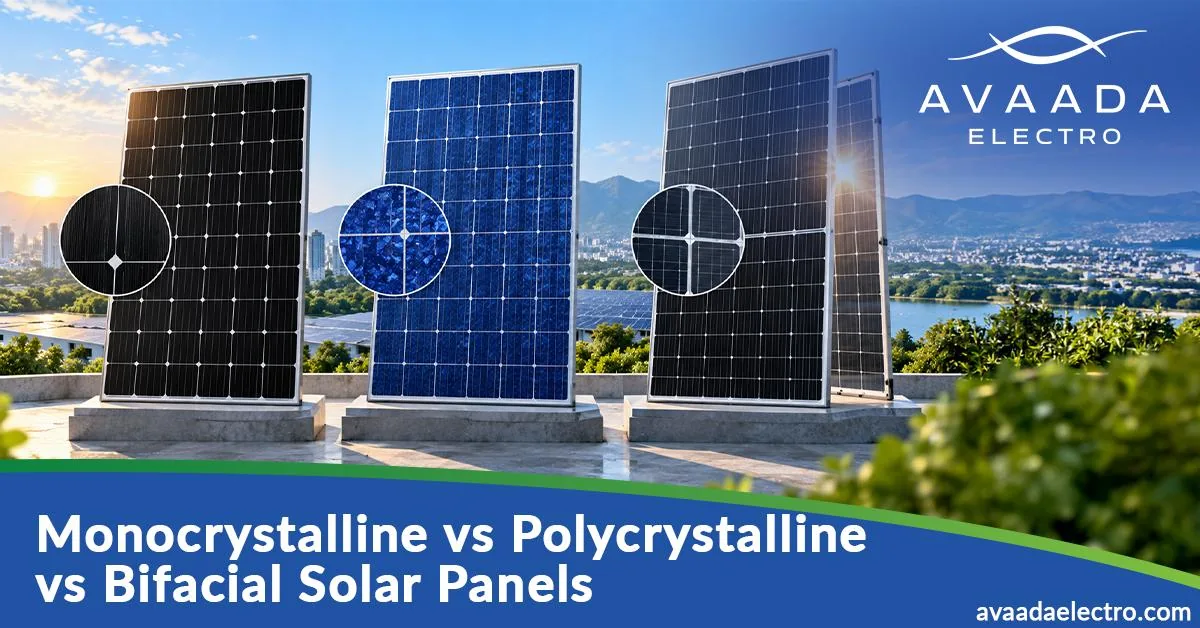
Mono-PERC (Legacy Technology)
- Typical efficiency: ~19–21%
- Mature and affordable.
- Higher degradation compared to newer technologies.
TOPCon (N-Type Technology)
- Typical efficiency: ~22% and above (premium models).
- Better temperature performance and lower degradation.
- Strong balance between cost and efficiency.
HJT (Heterojunction Technology)
- Typical efficiency: between ~21% to 23%
- Excellent low-light and high-temperature performance.
- Premium pricing, but top-tier output.
Back-Contact / IBC Panels
- High efficiency with advanced cell layouts.
- Often used in premium residential markets.
Bifacial Panels
- Bifacial panels generate power from both the front and rear sides.
- The Efficiency gain depends heavily on reflective surfaces and mounting height.
Laboratory efficiency records continue to improve, though mass-market residential modules remain within the ranges listed above.
Real-World Yield: Efficiency Is Only One Factor
The most efficient panel may perform poorly under bad site conditions.
Key Real-World Influencers
- Temperature: An increase in temperature decreases voltage and power.
- Shading: Partial shading will result in disproportionate losses.
- Soiling: Dust and pollution decrease the light absorption.
- Orientation and tilt: Suboptimal angles will reduce annual energy yield.
- Inverter design: String sizing, clipping, and MPPT quality matter.
- Degradation: The output degrades gradually each year.
This is why system design quality is as significant as panel efficiency.
Efficiency vs Cost: When Is Higher Efficiency Worth It?
Scenario 1: Limited Roof Space
When a roof can accommodate a given number of panels, increasing efficiency can be the sole way to achieve your intended system size. When this happens, it makes sense to pay a premium price to choose higher-efficiency panels.
Scenario 2: Plenty of Roof Space
In cases where the roof area is abundant, a slight reduction in panel efficiency can provide the same-sized system at a lower price. In this case, efficiency is not as important as reliability, warranty, and price per watt.
Scenario 3: Hot or Coastal Locations
A panel with a superior temperature coefficient can outperform alternatives in hot or coastal locations, but long-term performance depends on material quality and corrosion resistance.
Efficiency must be evaluated in the context of site conditions.
Emerging Technologies: What’s Coming Next?
Perovskite-Silicon Tandems
While these technologies promise high efficiency, large-scale commercial deployment, and long-term reliability validation are still under development.
Improved Bifacial Utilization
More practical bifacial gains are being achieved through improved mounting designs and reflective surfaces, most commonly in ground-mounted systems.
Manufacturing Optimization
Progress in cell design and passivation is reducing the disparity between the lab and real-world module efficiencies.
TopCon will remain the most viable option for homeowners in 2026.
How to Use Efficiency When Choosing Solar Panels
The first specification buyers notice is solar panel efficiency, and using this number alone can lead to poor choices. Efficiency can be used smartly as input to a broader assessment rather than as the sole determinant.
1. Assess Usable Roof Area, Not Total Roof Size
The size of your roof will not necessarily determine the number of square feet available for solar panels. Water tanks, chimneys, skylights, and shadow areas are obstructions that decrease the available space.
In the event of limited usable space, higher-efficiency panels can be used to produce more power within that constraint. With plenty of space, even less-efficient panels can be cost-effective for meeting your energy requirements.
2. Ask for the Temperature Coefficient, Not Just Efficiency
The temperature coefficient indicates how much a solar panel’s power output declines as operating temperatures rise above standard test conditions. In hot climates, such as much of India, panels with lower temperature coefficients deliver higher real-world energy yields because they lose less efficiency during peak afternoon heat.
For rooftops exposed to high ambient temperatures, selecting modules with strong thermal performance is as important as choosing high nameplate efficiency.
3. Compare Degradation Rates Over 25 Years
It is not just initial efficiency that matters. The output of solar panels gradually declines over time, a process called degradation. Comparisons of degradation rates allow you to know how much energy a panel will give out not only in the first year but also after twenty-five years.
The lower-degradation panels might perform better over their lifetimes than higher-efficiency panels, even if their initial efficiency is slightly lower.
4. Review PTC or Real-World Performance Data
The Standard Test Condition (STC) ratings can be used as guidelines for comparison, but they do not represent actual rooftop conditions. Real-world performance ratings (PTC or otherwise) provide a less optimistic, more realistic view of anticipated performance.
The examination of such numbers helps avoid overestimating energy generation and enables more precise financial planning.
5. Request Third-Party Test Reports
Independent testing should support manufacturers’ claims. Request third-party test reports (e.g., reliability, stress, and performance tests) performed by established laboratories.
These reports assure that the efficiency, durability, and even degradation claims are verified as acceptable under controlled yet independent conditions, and that the risk of premature deterioration is minimized.
6. Balance Efficiency with Warranty Strength and Service Support
High efficiency alone does not guarantee long-term system value. There should be a good product warranty, a performance warranty, and a service network that safeguards your investment for decades. Panels with solid manufacturer support and well-defined warranty conditions usually offer better lifetime value than ultra-efficient panels with dubious support.
In short, efficiency is a valuable tool for decision-making, but not for a quick fix. In comparison to roof constraints, temperature performance, degradation, proven testing, and long-term support, efficiency helps you make panel selections that deliver dependable performance and returns over the long term.
Read More – Bifacial Solar Panels
Conclusion
Solar panel efficiency is an effective tool; however, it is only effective when used properly. An increase in efficiency will translate into greater power in less space, improved performance under adverse conditions, and higher long-term yield. However, higher efficiency alone does not guarantee better savings or system performance.
Solar buyers in 2026 should not be attracted by a single headline efficiency in their purchasing decisions. Still, they should look at efficiency relative to their own roof and climate, their budget, and energy goals. When properly paired with an effective system design and installation, the appropriate efficiency option would make solar power a stable long-term investment, not merely a technology upgrade.
When you tackle efficiency contextually and clearly, it will be a strategic advantage, rather than a headline-driven purchase decision.
Frequently Asked Questions
What is a good solar panel efficiency in 2026?
Do higher-efficiency panels produce more electricity?
They generate more electricity per square foot; however, overall generation also depends on system size, exposure to sunlight, and installation quality.
Is higher efficiency always better?
Not always. When space is limited or conditions are difficult, greater efficiency is most valuable.
When is higher solar panel efficiency worth paying for?
What’s the difference between efficiency and power rating?
Efficiency is used to measure conversion rate, and power rating (watts) is used to measure overall output under test conditions.
How much do panels degrade over time?
Most modern panels degrade around 0.3–0.6% per year, which typically means ~85–92% output after 25 years, depending on panel type and warranty terms.
Do efficient panels work better in heat?
Should efficiency be my top priority?
Key considerations include efficiency, reliability, warranty coverage, and overall system design quality.