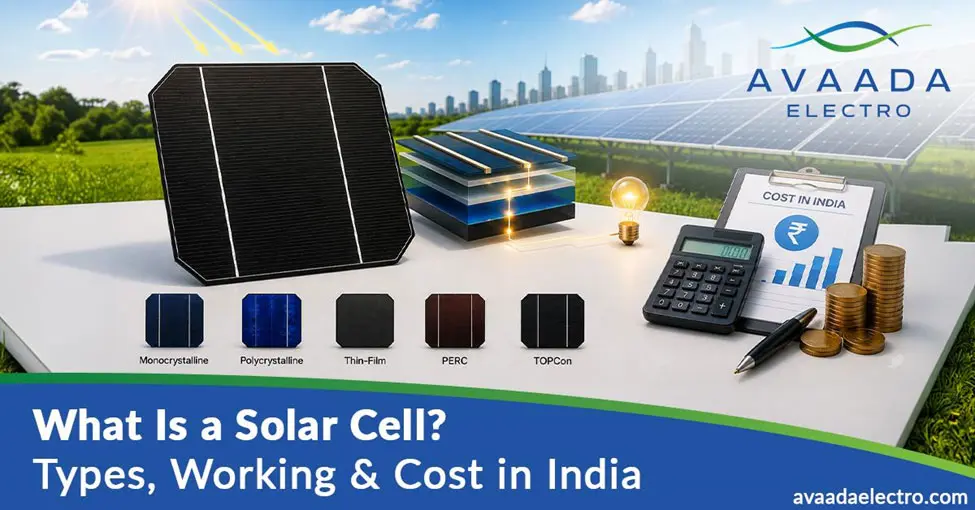
Have you ever wondered how a small silicon solar cell converts sunlight into clean power for your fans, lights and appliances? If you are wondering what a solar cell is, it is the fundamental semiconductor unit of a solar module that converts sunlight directly into electricity through the photovoltaic effect. Every home installation relies on these tiny units working together inside a protective panel. Over 98% of solar cells produced globally use silicon as their base semiconductor material. Understanding the types of solar cells, working principles and market prices helps Indian buyers make informed choices for home clean energy.
A single solar cell generates only a small amount of electricity, usually around 0.5 to 0.6 volts. To produce enough power for everyday use, multiple solar cells are connected together to form a solar panel (also called a solar module). These panels are installed on rooftops and are widely used in residential solar systems, including those supported under the PM Surya Ghar Muft Bijli Yojana.
What is a Solar Cell Made of?
Silicon is the main material used to make solar cells because it acts as a semiconductor that generates electricity when exposed to sunlight. If you are wondering how solar cells are made, the process begins by purifying silicon and shaping it into thin wafers. These wafers are then treated with small amounts of other elements in a process called doping to create two layers:
- N-type layer: Doped with phosphorus to add extra electrons (negative charge).
- P-type layer: Doped with boron to create electron gaps or holes (positive charge).
Main Components of a Solar Cell
Component | Function |
P-N Junction | Creates an electric field that allows electricity to flow. |
Anti-Reflective Coating | Reduces light reflection and improves sunlight absorption. |
Metal Contacts | Collect and transfer electricity generated by the cell. |
Protective Encapsulant | Protects the cell from moisture, heat and damage. |
Together, these materials and components enable a solar cell to efficiently capture sunlight and convert it into usable electricity for homes, businesses and industries.
How Does a Solar Cell Work?
Solar cells generate electricity through the photovoltaic effect, where sunlight is converted into electrical energy. Here’s how the process works:
- Sunlight Hits the Cell: Sunlight falls on the solar cell, bringing tiny energy particles called photons.
- Electrons Are Released: The silicon inside the cell absorbs this energy, causing electrons to break free from their atoms.
- Electric Field Directs the Electrons: The cell’s built-in electric field pushes the electrons in one direction, creating an electric current.
- Electricity Is Collected: Metal contacts collect the moving electrons and send them through wires as direct current (DC) electricity.
- Power Becomes Ready for Use: A solar inverter converts DC electricity into alternating current (AC), which powers household appliances.
By converting sunlight into usable electricity through this simple process, solar cells provide a clean, renewable and reliable source of power for homes and businesses.
Read Also: How Do Solar Panels Work
Types of Solar Cell
Different types of solar cells vary in efficiency, durability and performance. Choosing the right type depends on your budget, available roof space and energy needs.
Solar Cell Type | Efficiency | Best For |
Monocrystalline | 19-21% | Homes with limited roof space |
TOPCon | 22-23.6% | Maximum efficiency and hot climates |
Bifacial TOPCon | 22-24%+ | Reflective rooftops and ground-mounted systems |
HJT | 22-24% | High-temperature locations |
Each type of solar cell has its own advantages, making it important to choose one that best matches your energy requirements, installation space and long-term performance expectations.
Choosing Quality Solar Modules Matters
While selecting the right solar cell technology is important, the quality of the solar module also plays a key role in long-term performance. Avaada Electro manufactures advanced N-Type TOPCon solar modules designed for higher efficiency, lower degradation and reliable performance even in high-temperature Indian conditions. With a focus on quality manufacturing and compliance with industry standards, the company offers modules suitable for residential, commercial and utility-scale solar projects.
Solar Cell Cost in India
Individual solar cells are raw components sold to module builders rather than home buyers. Consumers purchase complete solar modules. System costs depend on total wattage, technology choice and certification standards.
Average market prices for solar modules range between ₹18 and ₹28 per watt based on technology choices like TOPCon and local content compliance. Government initiatives like the PM Surya Ghar Muft Bijli Yojana offer financial subsidies up to ₹78,000 for qualifying residential rooftop systems, lowering net investment costs for households.
Read Also: Best Solar Panels in india
Factors Affecting Solar Cell Price in India
- Cell Efficiency: High-efficiency TOPCon cells require specialized manufacturing steps, carrying a small premium that yields greater long-term power generation.
- Domestic Content Requirement (DCR): Systems using domestically produced cells qualify for direct central government financial support.
- Quality Certifications: Products certified under BIS (IS 14286) and listed under ALMM help ensure quality and compliance.
Applications of Solar Cells in India
Solar cells are used across homes, businesses, farms and public infrastructure to generate clean electricity and reduce dependence on conventional power sources.
- Residential Rooftops: Generate electricity for homes and lower monthly electricity bills, with support from government subsidy schemes.
- Commercial and Industrial Buildings: Help factories, hospitals, schools and offices reduce electricity costs and improve energy efficiency.
- Agricultural Pumps: Power irrigation pumps using solar energy, supporting farmers through initiatives such as the PM-KUSUM scheme.
As solar adoption continues to grow, solar cells are playing an important role in making electricity more affordable, sustainable and accessible across India.
Conclusion
Understanding solar cell technology makes it easier to choose an efficient system for your home. Selecting certified, high-quality modules can improve long-term performance, reduce electricity costs and maximise the benefits of solar energy. Are you ready to lower your household power bills with advanced clean energy technology? Powering a Sustainable Future begins with the right setup.
Contact Avaada Electro today for a personalized quote and technical advice for your home!
FAQs
What is a solar cell?
A solar cell is a small silicon wafer that turns sunlight directly into clean electricity. Multiple cells connect together inside a solar panel to power home appliances.
Which element is mainly used in solar cells?
Silicon is the primary chemical element used in solar cells. It acts as a reliable semiconductor that frees electrons when struck by sunlight.
How are solar cells made?
Solar cells are made by purifying silicon, shaping it into thin wafers, creating p-type and n-type layers through doping, adding protective coatings and metal contacts and testing each cell before it is assembled into a solar module.
What is the difference between a solar cell and a solar panel?
A solar cell is an individual semiconductor piece that produces 0.5V to 0.6V. A solar panel is a frame containing many cells connected together to produce usable electricity for homes.
How many types of solar cells are available?
Commercial solar cell technologies include Monocrystalline PERC, TOPCon and Heterojunction (HJT), while bifacial designs are widely used to increase energy generation.
What is the cost of solar modules in India?
Solar modules cost between ₹18 and ₹28 per watt depending on cell technology, brand certification and domestic content status. Residential subsidies reduce these costs further.
How long do solar cells last?
Quality silicon solar cells operate reliably for over 25 to 30 years with minimal performance loss over time.