
Solar energy has ceased to be a technology of the future and has become one of the most
reliable sources of power for Indian households in 2026. As electricity costs continue to
increase, as government subsidies are improved, and as more people become aware of clean
energy, homeowners are beginning to think of solar as a long-term financial and lifestyle
investment, not merely an environmental one.
India has installed the highest capacity of rooftop solar over the past two years in schemes such
as the PM Surya Ghar Muft Bijli Yojana. States such as Gujarat, Maharashtra, and Rajasthan
are at the forefront, although adoption is becoming all-round through reducing prices of panels
and easy net-metering approvals.
This guide will disaggregate all you need to know, the benefits, the drawbacks, and the
expectations of solar in the real world so that you can make an informed decision before
investing in solar.
What Is Solar Energy?
Solar energy is an energy that is produced by sunlight through solar panels placed on your roof
or on an open space. These panels take in the sun's rays, convert them into usable electricity,
and run the appliances of your home using an inverter.
Any unused electricity will be sent back to the grid (in on-grid systems), and you will receive bill
credits based on the net metering. With a hybrid or off-grid power system, the additional energy
is stored in batteries and is used in case of a power outage.
How it works: Solar uses costly grid power as an alternative to solar-generated, clean, and low-
cost electricity.
Advantages of Solar Energy
There are various economic and life advantages of solar energy. The most significant ones to
the homeowners are:
Significant Cut in the Electricity Bills
Solar would reduce your power bill by up to 80-90 percent based on your monthly usage and
the size of the system. Most of the households with 3-5 kW systems today pay the minimum
charge.
Protection from Rising Tariff Rates
Individuals under the PM Surya Ghar Yojana get a subsidy of up to 3 kW (up to 78,000) per
home.
This renders solar much cheaper than ever.
Fast Payback Period
The average residential system pays back in 3.5-5.5 years, and thereafter, electricity is free for
20 or more years.
Increases Property Value
Houses equipped with solar systems have a higher resale value because they are purchased by
buyers with lower operating expenses.
Minimal Maintenance and Prolonged Existence
The solar panels last 25- 30 years and only need to be cleaned occasionally.
The latest inverters have app-based monitoring and 8-10-year warranties.
Works for All Types of Homes
Solar can be developed on most types of rooftops, whether an independent house, a farm, a
villa, or an apartment terrace.
Environmental Benefits
An average 3 kW solar system saves 2.53 tonnes of CO2 annually, which is the same as
planting 100-120 trees per annum.
Solar cleanses your house and prepares it for the future, and makes your home much less
reliant on the grid.
Disadvantages of Solar Energy
Solar energy can be considered as one of the most appropriate long-term investments that
homeowners should establish; however, it is not flawless. Openness to its weaknesses will allow for having the correct expectations and create trust.
Solar Energy is a Dependent Power
Solar panels are effective when there is high sunlight.
Weathers, fogs, and extended monsoons decrease daily generation and can have a minor effect on monthly bill savings.
Nevertheless, the latest TOPCon, which is bifacial, high-efficiency panel continues to produce
power even in diffused sunshine.
High Upfront Investment
Although after payback solar is free, some families may find it taxing to install it initially.
It is also becoming affordable to more homeowners since government subsidy under PM Surya Ghar and easy EMIs make it affordable.
Roof Suitability Issues
Homes that are over shaded, have poor roof tops or have very minimal space might not enjoy the complete advantage of solar.
This is usually solved by proposing to a technical site survey the correct location/tilt or type of
structure.
Delays on Net Metering Approvals
The state DISCOMs have varied schedules of net-metering approvals.
Although the majority of approvals are fast, billing adjustments may become slow. Luckily, this is
being enhanced with digitised applications.
Efficiency of Solar Panels is decreased in the long run
Each year all panels deteriorate in a minor way (usually 0.3 per cent to 0.5 per cent).
Good-quality TOPCon and bifacial modules have reduced degradation and good 25 30-year warranty, which provides good values in terms of long-run performance.
How to Decide if Solar is Right for Your Home
Making a decision about solar is easy when you are aware of what to consider. These are the
main checkpoints that a homeowner must look for:
Analyse Your Monthly Electricity Bill
Solar provides significant savings and quick payback in case your monthly bill ranges between INR 1,500 and 6,000.
The greatest beneficiaries are higher consumers since they have a higher unit tariff.
Check Available Roof Space
An average system takes 70-120 sq. ft. per kW, based on the panel wattage.
When you install N-Type TOPCon 630 -720 Wp panels, you will require less space than older mono-PERC panels.
Look for Shade-Free Areas
Output can be reduced by trees, water tanks, or close buildings, which cause shadows.
A shade on one of the panels, even in part, will affect all the strings.
Your Long-Term Home Plans
In case you are intending to remain in your home for a 5-10 year time period, solar is a good long-term investment where returns can be very high.
Budget + Subsidy Eligibility
When you have a small business, you can afford a low-cost entry point, then start small (1 kW-2
kW) and add on.
The PM Surya Ghar Yojana can give up to 40% subsidy to residential users.
How to Maximise the Benefits of Solar Energy
You can make big reductions in solar production and savings with small steps.
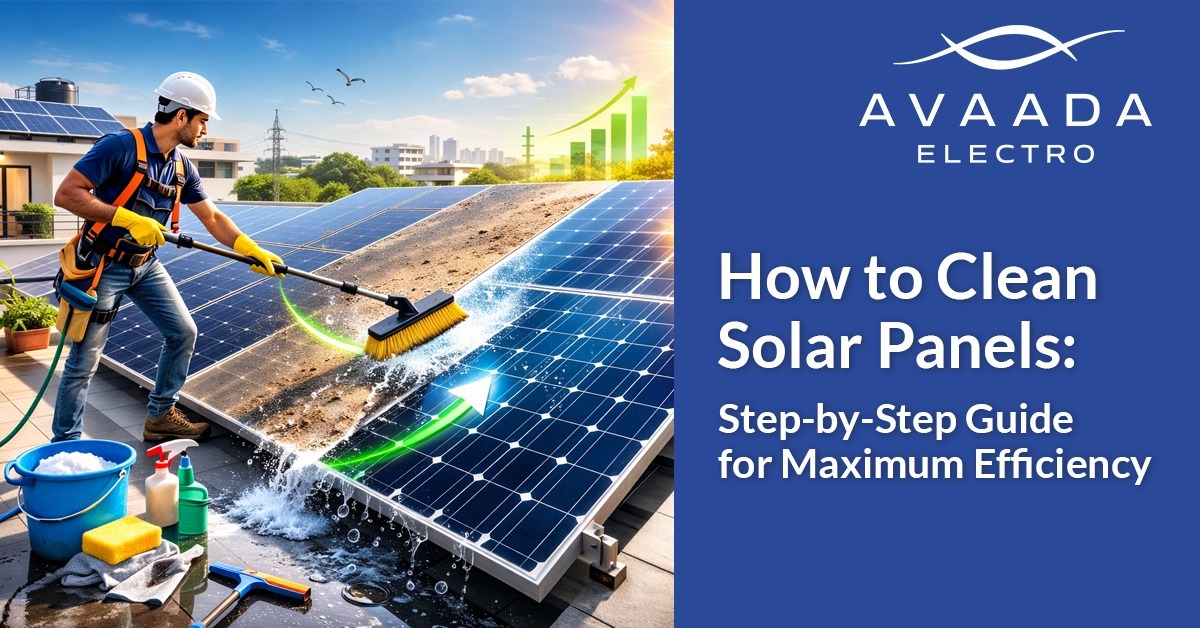
Keep Panels Clean
Efficiency can be minimized by dust, bird droppings, and pollution.
Wash your panels every 2 -4 weeks to achieve the best production.
Use Appliances when at Home
Solar is most effective when you can move heavy load of AC, washing machine, geyser, ironing, etc., during the day when the panel is operational.
Select High-Efficiency Panels.
TOPCon bifacial and N-type panels have higher energy production per sq. ft., particularly during
low-light situations.
Measure Performance on a regular basis
Monitor generation in inverter apps and compare on a daily basis, and spot problems easily.
Installation via a Vendor
Select MNRE/ALMM certified installers to install it correctly, with regard to wiring, safety, and subsidy.
Solar Maintenance Tips for Long-Term Performance
Solar systems require low maintenance, and with a handful of simple habits, they can last up to
25 years.
- Monthly Cleaning
Apply plain water and a soft brush.
Use no detergents or mass sprays of high-pressure water jets, as these will destroy the
modules.
- Check Wiring Once a Year
Connections or rodent damage may cause a decrease in production.
An inspection every year, in a short time will avoid breakages.
- Monitor Inverter Health
The panels do not present most of the problems, but the inverter.
Look whether there are any error codes that appear and notify your installer immediately.
- Ensure Proper Ventilation
The solar inverter must be installed in shady, well-ventilated places to prevent overheating.
- Good Mounting Structure.
Aluminium or galvanised iron (GI) structures of high quality prevent rust and lead to stability even during strong winds.
Common Mistakes Homeowners Should Avoid
Although solar has never been as simple and inexpensive as it is today, small choices taken by
many homeowners decrease performance or slow approvals.
By preventing these errors, the installation will be hassle-free, and the greatest savings will be achieved.
Purchasing Panel Only by Seeing Price
Most customers accept the lowest price without understanding that low-quality modules decrease production after some time.
Always make it high efficiency, certified modules- your panels will stay on your roof for 25 plus
years.
Roof Shadow and Orientation are ignored
A shadow of water tanks, trees, or neighbouring buildings as small as 10-30 percent can reduce
system performance.
Pre-installation by a vendor.
Failure to Check DISCOM Net-Metering Rules
Both states have certain regulations and deadlines to net metering.
Homeowners are also likely to be made to wait because they present unfinished documents-
ascertain with DISCOM requirements in the area first.
Non-Empaneled Vendors Subsidy.
Only ALMM-approved and government-empanelled vendors can be eligible under PM Surya
Ghar.
Miss your target vendor and you lose your subsidy.
Excess or Undercapacity of the System
There are those families that purchase a system too small so they can save on money; and
there are those families that purchase a system that is too big without having to investigate its
load.
The right size is the one that guarantees the highest ROI and quicker payback.
Avaada Electro
Avaada Electro is the manufacturing arm of the Avaada Group, which produces solar modules.
Below are the reasons why Avaada Electro modules are trusted by homeowners and installers:
- TOPCon Technology (630-600- 720 Wp Range)
Avaada Electro manufactures N-type TOPCon bifacial modules, which have enhanced
efficiency, improved low-light performance, and a yearly reduction of degradation.
- Artificial Intelligence, Full Automation of manufacturing.
Its Butibori, Maharashtra plant has a platform of AI-based next-gen automation, which
guarantees accuracy, dependability, and quality of modules at a large scale.
- Fully Certified & Compliant (ALMM | BIS | IEC | UL)
Each module meets key Indian and international safety and quality standards, ensuring eligibility for subsidies and long-term reliability.
- 30-Year Warranty Linear Performance
Avaada Electro panels offer a long-term linear warranty that ensures stable output over many years.
- Pan-India Supply Chain
Avaada has extensive distribution and EPC services throughout the country, where they assist in installation of homes, businesses, institutions, and large scale projects.
- Part of India’s Fastest-Growing Renewable Group
Avaada Group has entered into large renewable-energy MoUs (such as 36,000 crore in Gujarat)
and is significantly committed to the Indian clean-energy vision.
Conclusion: Solar in 2026 – Is It Worth It?
Absolutely yes. Solar power has emerged to be one of the smartest investments in the house in India.
Homeowners have: with government subsidies and increasing electricity charges and better panel technology:
- Lower upfront cost
- Strong lifetime savings
- Sustainable Home Cleaner.
- Energy independence
- Between 25 and 30 years of stable performance.
It is up to you to install 1 kW or 10 kW, the advantage will be noticed the very next day. Solar
can guarantee long-term savings, constant energy and a future proof home with good
maintenance, good panels and proper installation.
Frequently Asked Questions
What is the life span of a home solar system?
The most systems have a life span of 25-30 years, when certified panels such as TOPCon with
long warranty are used.
How will solar help me to save on my electricity bill?
A properly sized system has the potential to save 60 -90% of bills, depending upon your
consumption and net-metering approvals.
How much is the average cost of maintenance?
Cleaning and simple maintenance are between 1,000 and 2,000 per annum and most property
owners do the cleaning.
Is net metering popular throughout India?
But each state DISCOM has its own different rules. The time approval can take is between 7
days and 45 days.
When will I receive my amount of subsidy?
Once inspected and approved with net-metering, subsidies can usually be credited in 30-60
days.
What type of panel will be the most appropriate in 2026 in homes?
The design of N-type TOPCon panels is the most efficient, has a higher heat performance, and
a longer life than Mono-PERC.
Is solar effective during power outages?
Systems that are on-grid are closed down when outages occur.
In case of necessity, a battery-powered hybrid system is better.