
Imagine stepping into the bathroom early in the morning and finding hot water already stored and ready to use, without having heated it with an electric geyser. That is the basic idea behind solar water heating. But how does a solar water heater work when the sun is not shining at the moment the water is being used? The answer lies in how collectors absorb solar heat, transfer it to water and store it in an insulated tank. Understanding this process also makes it easier to choose the right collector, capacity and system for an Indian home.
What is a Solar Water Heater?
A solar water heater is a solar thermal device that uses the sun’s radiation to heat water. Unlike solar photovoltaic panels, which convert sunlight into electricity, a solar water heater captures solar radiation as thermal energy. A complete system generally consists of solar collectors, a storage tank and connecting pipes.
The Ministry of New and Renewable Energy (MNRE) states that solar water heaters with capacities of 100 to 500 liters per day (LPD) suit domestic applications. Larger systems can serve hotels, hospitals, restaurants, canteens and other facilities with higher hot-water requirements.
The basic solar water heating system therefore has three important steps:
- Collect solar heat through the collector.
- Transfer that heat to water or a heat-transfer fluid.
- Store hot water until it is needed.
How Does a Solar Water Heater Work?
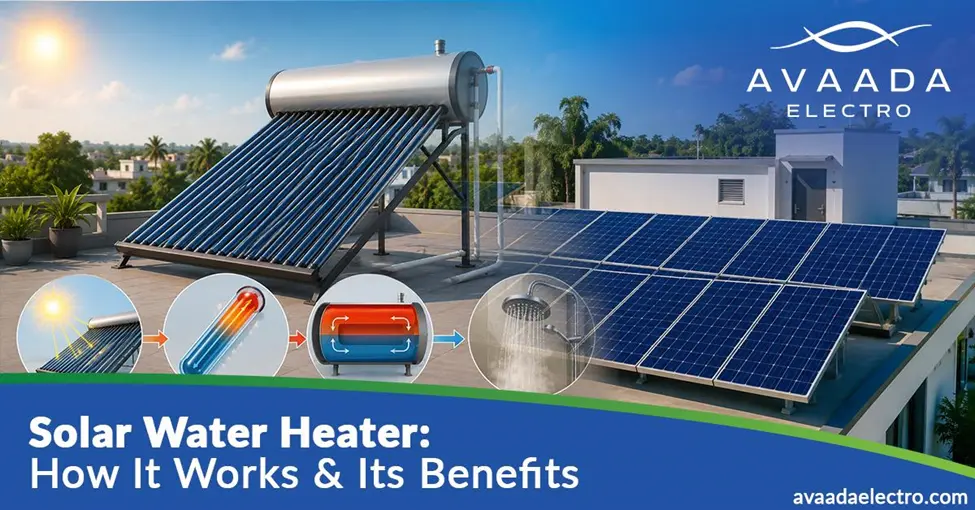
The working of solar water heater technology can be understood as a continuous heat-transfer process. During daylight hours, solar radiation reaches the collector and is absorbed by a specially designed surface. The resulting heat is transferred to water flowing through the collector. The heated water then moves towards the storage tank, where it remains available for later use.
Here is the process step by step:
1. Solar radiation reaches the collector
The collector is installed in an open location where it can receive sufficient sunlight. The collector absorbs incoming solar radiation and converts it into thermal energy.
2. The absorber heats the water
In a flat plate collector, a dark, selectively coated absorber transfers the captured heat to water flowing through channels or riser tubes. In an evacuated tube collector, the absorber inside the tube captures solar radiation and transfers heat to the water.
3. Hot water moves towards the tank
In thermosyphon systems, heated water circulates naturally because of density differences between hot and cold water. Forced-circulation systems instead use an electrical pump to move water or heat-transfer fluid between the collector and storage tank.
4. The insulated tank stores the heat
The storage tank holds heated water for later use. The tank is an integral part of the system because solar heat is collected during daylight, while hot water may be required at different times of the day.
5. Backup heating can provide additional support
Solar water heaters can be fitted or connected to a supplementary heating source. This becomes useful when available solar radiation is insufficient to meet the required hot-water demand.
Read Also: Advantages of Solar Energy
What are the Main Parts of a Solar Water Heater?
A Solar water heating system contains several components that work together:
- Solar collector: Captures solar radiation and converts it into heat.
- Storage tank: Stores the heated water.
- Pipes: Carry water between the collector, tank and point of use.
- Insulation: Helps limit heat loss from the storage tank and pipes.
- Heat exchanger: Used in certain closed-loop systems to transfer heat without directly mixing the heat-transfer fluid and water.
- Backup heater: Provides additional heating when solar energy is insufficient.
The exact arrangement depends on the collector technology, water quality, climate and hot-water requirements.
Types of Solar Water Heater Collectors
Indian installations mainly use Flat Plate Collectors (FPC) and Evacuated Tube Collectors (ETC). MNRE and Indian government agencies recognize both technologies for solar water heating applications.
| Collector Type | Construction | How It Transfers Heat |
| Flat Plate Collector (FPC) | Insulated metal box with a glass cover and dark absorber | Absorber transfers heat to water flowing through riser tubes |
| Evacuated Tube Collector (ETC) | Double-layer glass tubes with an evacuated space | Selectively coated absorber captures solar radiation and transfers heat to water |
Flat Plate Collector
A flat plate collector contains an insulated outer box, a glass cover and a dark absorber with channels or riser tubes. The absorber captures solar radiation and transfers the resulting heat to the water flowing through the collector.
Indian Standards cover flat plate collectors under the IS 12933 series. BIS also lists the updated IS 12933 Part 1:2025 requirements for solar flat plate collectors.
Evacuated Tube Collector
An ETC uses double-layer borosilicate glass tubes with an evacuated space that provides insulation. A selective coating on the absorber helps capture solar radiation and transfer the heat to the water.
BIS lists standards for all-glass evacuated tubes under IS 16543 and complete all-glass evacuated tube solar water heating systems under IS 16544.
Read Also: Types of Solar Panels
Active vs Passive Solar Water Heating Systems
Solar water heaters can also be classified according to how the heat-transfer fluid moves.
Passive Systems
Passive systems use natural circulation rather than an electrical circulation pump. In a thermosyphon arrangement, differences in fluid density cause the heated water to circulate naturally. Such systems are relatively simple and are commonly used for domestic and small institutional applications.
Active Systems
Active systems use an electrical pump to circulate water or a heat-transfer fluid between the collector and storage tank. They can be useful where the collector and storage tank cannot be arranged for natural circulation or where the system has higher circulation requirements.
How Much Electricity Can a Solar Water Heater Save?
Solar water heating can substantially reduce the electricity or fuel required for conventional water heating. According to Haryana’s New & Renewable Energy Department, a 100-liter solar water heater can save approximately 1,500 units of electricity annually when replacing an electric geyser.
Telangana Renewable Energy Development Corporation also reports annual savings of about 1,500 units for a 100-liter-per-day system.
Actual savings depend on how much hot water you use, your existing heating source, solar radiation, system performance, and the amount of backup heating required.
Where Should a Solar Water Heater Be Installed?
Place the collector where it receives unobstructed solar radiation. Rooftop installation is preferable where solar radiation is freely available, although terraces, balconies and open ground can also be considered when a suitable supporting structure is provided.
Collector orientation also affects performance. For Delhi, the government recommends a south-facing collector because this orientation helps maximize solar radiation received throughout the year.
Before installation, check the roof or supporting structure for the additional load of the storage tank and collector assembly.
How to Choose a Solar Water Heater
Consider these factors before purchasing:
- Estimate daily hot-water demand: Use actual bathing and household needs rather than choosing capacity based only on family size.
- Select the collector technology: Compare FPC and ETC based on climate, water quality and system requirements.
- Check water quality: Hard or poor-quality water may require a heat exchanger or other suitable system arrangement.
- Check Indian standards: MNRE lists applicable standards for FPC and ETC systems, storage tanks and testing procedures.
- Assess the installation location: Ensure adequate sunlight, suitable orientation and sufficient structural support.
- Check backup requirements: A supplementary heating source can provide hot water when solar radiation is insufficient.
Solar Water Heater Standards in India
Consider quality and performance alongside capacity and collector type. MNRE currently lists several relevant Indian Standards, including IS 16544 for all-glass evacuated tube solar water heating systems, IS 16543 for evacuated collector tubes, IS 16542 for storage tanks and IS 16368 for thermosyphon-type domestic solar hot-water systems. It also lists the IS 12933 series for flat plate collectors and IS 12976:2023 as the code of practice for solar water heating systems.
BIS’s current testing information also shows that solar thermal equipment is evaluated for areas such as thermal performance, leakage, thermal shock, impact resistance and other construction requirements under applicable standards.
Conclusion
A solar water heater captures solar radiation through FPC or ETC collectors, transfers the resulting heat to water and stores it for later use. A 100-liter system can save around 1,500 electricity units annually in suitable residential applications, although actual savings vary by usage and location.
Understanding the working of solar water heater technology, daily hot-water demand, collector type, water quality and installation conditions can help in selecting an appropriate system. For a reliable solar water heating system, checking applicable Indian Standards and choosing a suitable capacity are important steps.
Explore reliable solar solutions for homes and businesses with Avaada Electro. Discover the right solar technology to reduce conventional energy use and support long-term savings.
FAQs
Does a solar water heater work at night?
A solar water heater does not collect solar heat after sunset. However, its insulated storage tank retains previously heated water for later use. A supplementary heater can provide extra heat when needed.
Does a solar water heater use electricity?
The basic heating process uses solar radiation, not electricity. Active systems may use an electrical pump for circulation, while systems with supplementary heating can use electricity when solar heat is insufficient.
Which is better, FPC or ETC?
FPC and ETC systems use different collector designs, and the right choice depends on climate, water quality, installation conditions, and required hot-water output.
How long does a solar water heater last?
Can hard water be used with a solar water heater?
Hard or poor-quality water can affect system operation. Consider a heat exchanger for FPC systems when water quality is unsuitable, particularly with borewell or groundwater.