
India has emerged as a global hub for solar panel manufacturing, driven by ambitious capacity targets, government policy support, and world-class solar module manufacturers. As of April 2026, India’s domestic solar module production capacity stands at 150.26 GW, according to the Ministry of New and Renewable Energy (MNRE). The country is home to some of the largest solar panel manufacturers in India companies producing advanced PV modules that power projects across the country and internationally.
The Indian solar manufacturing industry has grown rapidly under the Production Linked Incentive (PLI) scheme, the Approved List of Models and Manufacturers (ALMM) policy, and strong state level support. Solar manufacturing companies in India now operate at the full value chain – from silicon wafer processing to final module assembly making India a key player in global solar PV manufacturing.
Whether you are a project developer, EPC contractor, or investor, understanding how solar panels are manufactured helps you evaluate module quality, efficiency, and long-term performance. This guide covers the complete solar panel manufacturing process from raw materials to finished PV modules along with insights into India’s leading solar module manufacturing companies.
India's Solar Panel Manufacturing Industry
India’s solar panel manufacturing industry has undergone a dramatic transformation over the past five years. From being largely import-dependent to building a robust domestic supply chain, Indian solar manufacturers now serve both domestic and international markets.
Key Statistics: Solar Manufacturing in India
Metric | Data (2026) |
Total solar module manufacturing capacity | 150+ GW |
Solar cell manufacturing capacity | ~60 GW |
Solar wafer/ingot capacity | ~25 GW |
PLI-supported capacity additions | ~40 GW |
India’s global manufacturing rank | 3rd largest (projected) |
Key manufacturing states | Gujarat, Rajasthan, Tamil Nadu, UP, Telangana |
Major Solar Panel Manufacturers in India
India hosts several of the world’s most advanced solar module manufacturing plants. Below is a list of major solar panel manufacturers in India:
Company | Type | Manufacturing Capacity | Technology |
Avaada Electro | Solar Module Manufacturer | 8 GW+ | N-Type TOPCon (Bifacial) |
Waaree Energies | Integrated PV Manufacturer | 13 GW+ | Mono-PERC, TOPCon |
Adani Solar | Integrated (Cell + Module) | 4 GW+ | Mono-PERC, HJT |
Vikram Solar | Solar Module Manufacturer | 3 GW+ | Mono-PERC, TOPCon |
Tata Power Solar | Integrated Manufacturer | 1 GW+ | Mono-PERC |
Premier Energies | Cell + Module | 2 GW+ | Mono-PERC |
Note: Capacities are indicative and subject to change with ongoing PLI-driven expansions.
Solar Manufacturing Plants in India: State-Wise Presence
Solar manufacturing plants in India are concentrated in states with industrial infrastructure, raw material access, and policy support:
State | Major Companies Present | Advantage |
Gujarat | Waaree, Adani, Vikram | Port access, strong policy, power availability |
Maharashtra | Avaada Electro, others | Industrial infrastructure, skilled workforce, port connectivity |
Rajasthan | Multiple EPC & module cos. | Land availability, solar irradiance |
Tamil Nadu | Avaada Electro, others | Skilled workforce, industrial hubs |
Telangana | Premier Energies, others | Industrial corridors, IT ecosystem |
Uttar Pradesh | Avaada Electro (Dadri), Multiple PLI beneficiaries | Large market, state solar policy |
Raw Materials Used in Solar Panel Manufacturing
Building a high-performance solar PV module requires combining precision semiconductor components with durable, weather-resistant protective materials. The raw material quality directly determines solar cell efficiency, long-term reliability, and overall PV panel performance — which is why leading solar panel manufacturing companies in India invest heavily in material procurement and quality control.
Material | Role in Solar Panel Manufacturing | Quality Standard |
Silicon (N-Type / P-Type) | Core semiconductor in solar cells; converts photons to electrons | 99.9999% purity (6N grade) |
Solar Cells | Individual PV conversion units (156–210mm wafers) | IEC 61215 tested |
Ribbon & Busbar (Silver/Copper) | Interconnects cells; collects and transfers current | Low-resistance, solderable alloy |
Front Tempered Glass (HTAR) | Protects cells; anti-reflection coating maximizes light transmission | 3.2mm, IEC 61730 |
Back Glass / Backsheet | Insulates and protects rear of module | Double-glass or PET/PVF backsheet |
EVA / EPE Encapsulant Film | Bonds cells to glass; moisture barrier | UV-stable, 25-year durability |
Aluminum Frame (Anodized) | Structural integrity; mounting support | Anodized 6063-T5 alloy |
Junction Box with Bypass Diodes | Houses electrical connections; prevents hot-spot damage | IP67/IP68 rated |
Silver Paste (Metallization) | Printed contacts on solar cells for current collection | Fired at 800–900°C precision |
India-Sourced vs. Imported Materials
A key development in India’s solar panel manufacturing industry is the progressive indigenization of raw materials:
Material | India Sourcing Status | Key Policy |
Solar modules | 100% domestic (ALMM mandatory) | ALMM Order 2023, DCR compliance (for applicable government schemes) |
Solar cells | Growing domestic capacity (~60 GW) | PLI Scheme Tranche 1 & 2, ALCM (Approved List of Cell Manufacturers), DCR compliance (for applicable government schemes) |
Silicon wafers/ingots | Emerging — limited domestic supply | PLI Tranche 2 support |
Aluminum frames | Largely domestic | BIS standards apply |
Tempered glass | Domestic availability improving | Import duty reduction |
EVA/Backsheet | Partially imported | — |
Step-by-Step Solar Panel Manufacturing Process
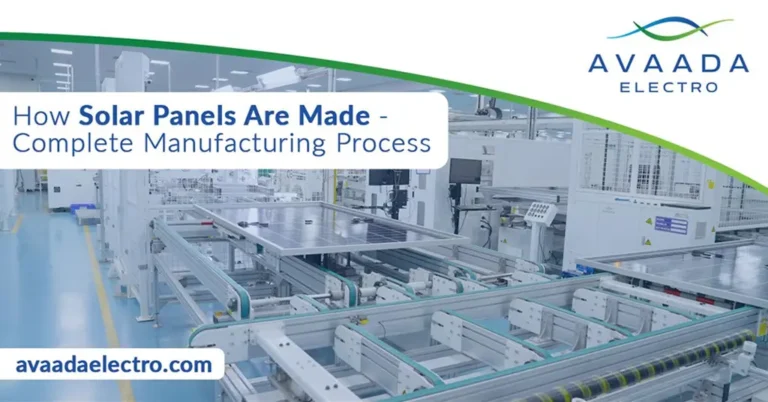
The solar panel manufacturing process transforms raw silicon into high-performance PV modules through a series of precision-engineered steps. Solar module manufacturers in India, including Avaada Electro, use automated production lines to support consistent quality at scale. The process is divided into two major phases: Solar Cell Fabrication and Module Assembly.
Phase 1: Solar Cell Fabrication (From Sand to Solar Cell)
Solar cell fabrication is the most technically complex stage of the solar panel manufacturing process. It transforms raw silicon into functional photovoltaic cells capable of generating electricity from sunlight.
1. Silicon Purification and Polysilicon Production
Quartz sand (SiO₂) undergoes carbothermic reduction in electric arc furnaces to produce metallurgical-grade silicon (~98% pure). This is further purified through the Siemens process or Fluidized Bed Reactor (FBR) to create ultra-pure polysilicon (99.9999% — 6N grade), the foundation of all crystalline solar cells.
2. Ingot Growth (Czochralski or Directional Solidification)
For monocrystalline cells (used in N-Type TOPCon modules manufactured by Avaada Electro), polysilicon is melted and a seed crystal is pulled slowly to grow a single large cylindrical ingot via the Czochralski (CZ) process. For polycrystalline cells, silicon is cast in block form using Directional Solidification (DS). N-Type ingots use phosphorus doping; P-Type ingots use boron.
3. Wafer Slicing (Diamond Wire Saw Technology)
Silicon ingots are precision-sliced into ultra-thin wafers (typically 160–180 microns) using diamond wire saws. Modern solar PV manufacturing uses M10 (182mm) and G12 (210mm) wafer formats for higher power output per module. Wafer thickness has reduced significantly over the decade, improving material efficiency in solar manufacturing plants.
4. Surface Texturization and Anti-Reflection Coating (ARC)
Wafers undergo chemical etching to create a micro-pyramid texture that scatters incoming light and reduces reflection losses. An anti-reflective coating (typically silicon nitride, SiNₓ) is deposited via PECVD, reducing surface reflection from ~35% to below 3% and giving solar cells their characteristic blue or black appearance.
5. Doping — PN Junction Formation (TOPCon Technology)
The PN junction is the core of solar cell function. In N-Type TOPCon cells — used in Avaada Electro’s Enlume and Integlow series — an ultra-thin tunnel oxide layer (1–2 nm) plus a heavily doped polysilicon passivation layer is applied to the rear. This passivated contact design dramatically reduces recombination losses, enabling cell efficiencies above 23–24%.
6. Metallization (Screen Printing Silver Contacts)
Silver paste is screen-printed onto the front and rear surfaces of the cell to form current-collecting busbars and finger lines. The cell is then fired at ~800–900°C in a conveyor belt furnace to create ohmic contacts. Multi-busbar (MBB) designs (10–16 busbars) used by advanced solar pv module manufacturers reduce resistive losses and improve cell efficiency.
7. Cell Testing, Sorting (Binning) and EL Inspection
Every solar cell is tested under standard test conditions (STC: 1000 W/m², 25°C, AM 1.5G) using a solar simulator. Cells are binned by power output (Watts) and IV curve characteristics. Electroluminescence (EL) imaging detects micro-cracks, shunts, and defects invisible to the naked eye. Only cells meeting specification are passed to module assembly.
Phase 2: Module Assembly (From Cell to Solar Panel)
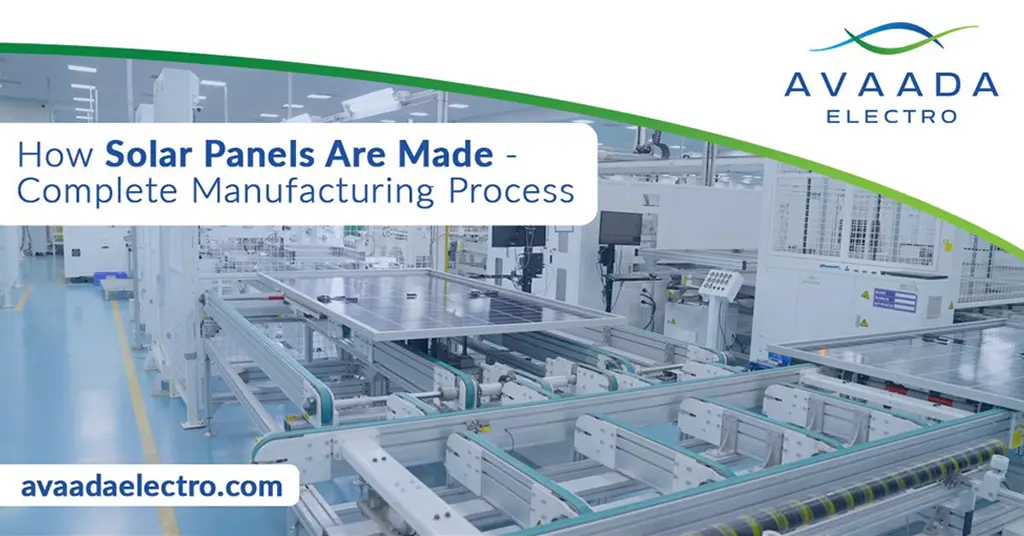
Module assembly integrates tested solar cells with protective materials to create weather-resistant, field-deployable solar panels. Leading solar panel manufacturing companies in India use fully automated assembly lines capable of producing thousands of modules per day.
8. Cell Stringing (Automated Tabber-Stringer)
Solar cells are interconnected in series strings using copper ribbon or wire (MBB) soldered to cell busbars by automated tabber-stringer machines. Modern solar module manufacturing plants use low-temperature soldering paste with flux to minimize thermal stress on thin wafers. String configuration (e.g., 6×24 for 144 half-cut cells) determines module voltage and current output.
9. Lay-Up (Glass-Cell-Backsheet Stacking)
The module stack is assembled in a clean room environment in this order: front tempered glass → EVA/EPE encapsulant film → cell strings → EVA/EPE → backsheet (or rear glass for bifacial modules). Avaada Electro’s bifacial N-Type TOPCon modules use double-glass construction for rear-side light capture and superior durability.
10. Pre-Lamination EL and Visual Inspection
Before lamination, the entire module stack undergoes automated EL imaging and AI-powered visual inspection to detect stringing defects, cell cracks, misalignment, and foreign particles. This pre-lamination quality gate — practiced at top solar module manufacturing companies in India — prevents defective modules from completing the production process, reducing waste and warranty risks.
11. Lamination (Vacuum Heat Press)
The stacked module is placed in a vacuum laminator and subjected to controlled heat (~145–160°C) and pressure. The EVA/EPE encapsulant melts and crosslinks to permanently bond all layers. Total lamination cycle: 15–25 minutes. The result is a hermetically sealed, weather-resistant PV module with a design life of 30+ years. Correct lamination is critical to prevent delamination, moisture ingress, and yellowing.
12. Framing (Aluminum Frame Installation)
An anodized aluminum frame (typically 6063-T5 alloy, 35–40mm profile) is mechanically crimped and sealed with silicone adhesive onto the laminated module. The frame provides structural rigidity, mounting compatibility, and resistance to wind, snow, and mechanical loads. Frame dimensions determine racking compatibility across solar power system manufacturers in India and globally.
13. Junction Box Installation (Bypass Diodes + Cable Assembly)
An IP67/IP68-rated junction box is adhesively bonded to the module rear and connected to the cell string ribbons. Junction boxes contain bypass diodes (typically 3 per panel) that protect strings from partial shading losses and hot-spot damage. MC4-compatible weatherproof cables (4–6mm²) are crimped and connected for field installation.
14. Final Testing: Flash Test, Hi-Pot, EL, and Visual
Every finished module undergoes a comprehensive test battery before shipping:
| Test | What It Checks | Standard |
|---|---|---|
| Flash Test (STC) | Actual Pmax, Isc, Voc, FF, efficiency | IEC 61215 |
| EL Imaging (Post-Lamination) | Internal cell cracks, broken fingers, shunts | IEC 60904 |
| Hi-Pot (High Voltage Insulation) | Electrical isolation between circuit and frame | IEC 61730 |
| Wet Leakage Current Test | Insulation resistance in wet conditions | IEC 61730 |
| Visual Inspection | Cosmetic defects, delamination, bubble check | IEC 61215 |
| Bypass Diode Functionality | Correct diode operation under shading | IEC 61215 |
Only modules passing all tests are classified as Grade A and approved for dispatch. This multi-stage quality assurance is what separates best solar panel manufacturers in India from lower-tier producers.
Read More – On-Grid vs Off-Grid Solar Systems
Solar Manufacturing Growth in India
India’s solar panel manufacturing industry is undergoing its most transformative period, driven by three converging forces: surging domestic demand, the PLI scheme incentivizing integrated manufacturing, and India’s ambition to become a net exporter of solar modules and cells.
India’s Solar Manufacturing Policy Framework
Policy / Scheme | Impact on Solar Manufacturing | Status |
PLI Scheme (Tranche 1 & 2) | ~40 GW of integrated manufacturing capacity supported | Active — disbursements ongoing |
ALMM (Approved List of Models & Manufacturers) | Only domestically approved modules usable in government projects | Mandatory from 2023 |
Basic Customs Duty (BCD) on modules (40%) & cells (25%) | Protects Indian solar manufacturers from imports | Active |
ISTS Waiver | Removes inter-state transmission charges for renewable projects | Extended to 2026 |
PM Surya Ghar Muft Bijli Yojana | Drives rooftop solar demand; benefits domestic module manufacturers | Active — 1 crore homes target |
Avaada Electro: An Integrated Solar Module Manufacturer in India
Avaada Electro is an integrated solar panel manufacturing company in India, operating automated production facilities that produce N-Type TOPCon bifacial solar modules at scale. Key manufacturing highlights:
Parameter | Avaada Electro Specification |
Module technology | N-Type TOPCon (Bifacial) |
Product lines | Enlume (G12, G12R) and Integlow (M10L) |
Wattage range | 610Wp to 720Wp |
Cell technology | N-Type TOPCon cell, Multi-Busbar |
Bifacial gain | 10–30% additional energy vs. monofacial |
Quality certifications | IEC 61215, IEC 61730, BIS, ISO, KIWA, Wood Mackenzie |
Manufacturing focus | Utility-scale, commercial, and industrial applications |
As an integrated solar panel manufacturer in India, Avaada Electro’s manufacturing approach combines automated production with rigorous multi-stage quality control from incoming material inspection to final electroluminescence testing before dispatch.
Types of Solar Panels Manufactured in India
Indian solar module manufacturers produce a range of solar panel technologies. Understanding the differences helps buyers select modules from the right solar panel manufacturing company in India for their application:
Panel Type | Technology | Efficiency Range | Best For | Key Indian Manufacturers |
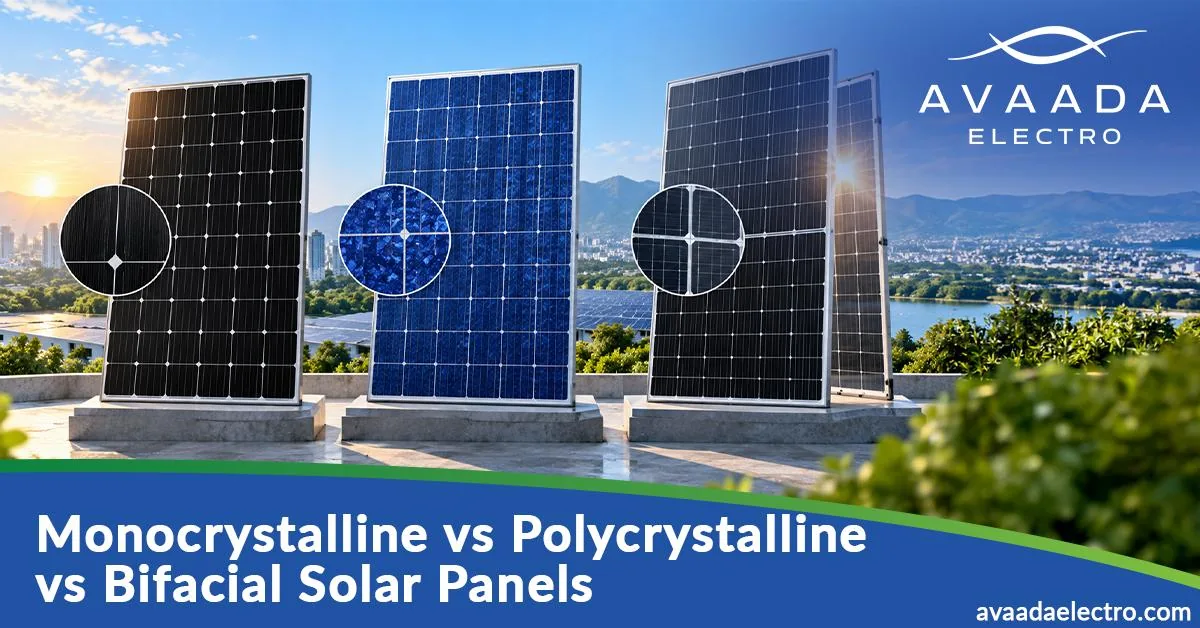
Monocrystalline (Mono-PERC) | Single-crystal silicon, PERC passivation | 19–22% | Rooftop, C&I, utility | Waaree, Vikram, Tata Power Solar |
N-Type TOPCon (Bifacial) | N-type mono, tunnel oxide passivation | 22–24% | Utility-scale, high yield sites | Avaada Electro, Waaree, Adani Solar |
HJT (Heterojunction) | Amorphous + crystalline silicon layers | 23–25% | Space-constrained premium installs | Adani Solar (limited scale) |
Polycrystalline (Legacy) | Multi-crystal silicon | 16–18% | Older projects (declining use) | Largely discontinued |
Thin-Film (CIGS/CdTe) | Non-crystalline semiconductor films | 12–16% | Niche / BIPV | Limited in India |
N-Type TOPCon has rapidly become the dominant technology among top solar panel manufacturers in India for new capacity additions, owing to its superior efficiency, lower temperature coefficient, and bifacial capability.
Role of Advanced Automation in Solar Panel Manufacturing
Advanced Automation in Solar Panel Manufacturing Plants
The scale and precision demands of modern solar panel manufacturing make full automation essential. Leading solar panel manufacturing companies in India have invested heavily in automated production lines that combine speed, precision, and built-in quality assurance.
Key Automation Technologies in Solar Manufacturing Plants
Process Stage | Automation Technology | Benefit |
Cell Sorting & Binning | AI-powered IV tester + robotic handling | 100% cell classification accuracy |
Tabber-Stringer | Multi-wire or ribbon automated stringer | ±0.1mm string accuracy at high speed |
Pre-lamination Inspection | AI-driven EL imaging + computer vision | Detects micro-cracks < 50 microns |
Lamination | Vacuum laminator with precise T/P control | ±1°C temperature uniformity |
Flash Testing | Solar simulator (Class AAA, IEC 60904) | Real-time Pmax, IV curve, efficiency |
Post-lam EL + Visual | Inline EL camera + defect classification AI | Near-zero defect module dispatch |
Logistics & Packaging | Automated conveyor, robotic palletizing | Zero manual handling damage |
Full automation not only ensures consistent output quality but also enables solar manufacturing companies in India to scale capacity rapidly with predictable cost curves — a critical competitive advantage as module prices continue to evolve.
Environmental Impact and Sustainability in Solar Panel Manufacturing
The environmental footprint of solar panel manufacturing is a growing consideration for project developers, institutional investors, and ESG-driven buyers. While solar PV generates clean energy during operation, the manufacturing process itself consumes energy and uses some hazardous chemicals — making sustainable manufacturing practices a key differentiator among Indian solar manufacturers.
Environmental Considerations in Solar PV Manufacturing
Aspect | Challenge | Avaada Electro’s Approach |
Energy use | Ingot growth and wafer slicing are energy-intensive | Renewable energy-powered manufacturing facilities |
Chemical handling | HF, HCl, trichlorosilane used in cell processing | Closed-loop chemical recovery and safe disposal |
Water consumption | Wafer cleaning requires high-purity water | Water recycling and zero liquid discharge initiatives |
Module end-of-life | EVA, glass, and cell materials require specialized recycling | Aligned with MNRE recycling framework development |
Carbon footprint | Scope 1 & 2 emissions from manufacturing | Ongoing carbon accounting and reduction program |
India’s solar panel manufacturing industry is increasingly adopting green manufacturing standards, with leading solar module manufacturers publishing sustainability reports and targeting net-zero manufacturing operations in line with India’s NDC commitments.
Read More – Top Solar Panel Companies in India
Conclusion
Solar panel manufacturing is a precision-engineered process that transforms raw silicon into high-performance PV modules — each designed to generate clean energy for 25–30 years. Understanding how solar panels are manufactured helps buyers make informed decisions about module quality, efficiency, and reliability when selecting a solar panel manufacturing company in India for their projects.
India’s solar manufacturing industry has matured significantly, with Indian solar manufacturers like Avaada Electro now operating at the technological frontier — producing N-Type TOPCon bifacial modules with efficiencies exceeding 23%, backed by full automation and multi-stage quality assurance. The combination of strong government policy (PLI, ALMM, BCD), world-class solar manufacturing plants in India, and growing domestic demand positions Indian solar module manufacturers to become a dominant global supply force through 2030 and beyond.
Whether you are an EPC developer, independent power producer, or industrial buyer seeking an integrated solar panel manufacturer in India for your next project – Avaada Electro’s Enlume and Integlow module series deliver the efficiency, quality certifications, and manufacturing pedigree to power your renewable energy ambitions.
FAQs
Who are the largest solar panel manufacturers in India?
What is the difference between a solar cell, solar module, and solar panel?
A solar cell is a single photovoltaic unit (~2–5W). A solar module (also called a solar panel) is an assembly of 60–144+ solar cells connected in series/parallel, producing 400–720W. A solar array is multiple modules connected together. The terms ‘solar module’ and ‘solar panel’ are used interchangeably by solar panel manufacturers in India and globally.
How many solar panel manufacturing plants are there in India?
As of 2026, India has over 50+ active solar module manufacturing plants, with a combined capacity exceeding 150 GW. Major solar manufacturing plants are located in Gujarat, Rajasthan, Tamil Nadu, Telangana, and Uttar Pradesh. India’s PLI scheme supports new solar manufacturing plant in india expansions to achieve 65+ GW of integrated solar manufacturing capacity.
What is N-Type TOPCon technology and why do Indian solar manufacturers use it?
N-Type TOPCon (Tunnel Oxide Passivated Contact) is an advanced solar cell technology that uses an ultra-thin tunnel oxide layer to reduce electron recombination and achieve efficiencies of 23–24%+. Indian solar pv module manufacturers like Avaada Electro have adopted TOPCon because it offers higher module wattage (610–720Wp), lower temperature coefficient, and superior bifacial performance — maximizing energy yield from Indian solar projects.
What certifications should I look for when buying from solar panel manufacturing companies in India?
When sourcing from solar panel manufacturing companies in India, look for: IEC 61215 (performance), IEC 61730 (safety), BIS certification (mandatory for India market under ALMM), ISO 9001 (quality management), and ISO 14001 (environmental management). Avaada Electro’s modules carry all major certifications and are ALMM-listed, while its solar cells comply with ALMM-2 (equivalent to ALCM) for government and private project use.
What is the ALMM list and why does it matter for Indian solar manufacturers?
The Approved List of Models and Manufacturers (ALMM) is a mandatory list maintained by MNRE. Solar modules used in government-funded projects in India must be sourced from ALMM-listed solar manufacturing companies in India. ALMM listing requires domestic manufacturing, quality certification, and compliance with performance standards — ensuring buyers that listed manufacturers maintain genuine Indian solar manufacturing operations.
How are solar panels different from solar batteries?
Solar panels (PV modules) convert sunlight into DC electricity through the photovoltaic effect. Solar batteries (lithium-ion or lead-acid) store the DC electricity generated by panels for use when sunlight is unavailable. They are separate components — many solar power system manufacturers in India offer integrated solar + storage solutions combining both. Solar battery manufacturers in India include Exide, Amara Raja, and Luminous, among others.