

Solar technology in India has evolved from basic monocrystalline panels to high-efficiency bifacial solar panels. With rising electricity costs, growing rooftop solar adoption under PM Surya Ghar, and increasing awareness of panel efficiency, homeowners and businesses are seeking higher power output from the same rooftop space.
Bifacial solar panels produce electricity on both sides, which offers more output without the need to expand the area of installation. Bifacial TOPCon panels are now favored in homes, industries, and commercial buildings in 2026, when India is demanding better-performing and subsidy-approved modules. They are more durable, produce more power, and reduce the total cost of owning a solar system.
Bifacial panels are some of the wisest choices to make in case you are upgrading to solar this year. Let us learn more about bifacial solar panels in detail.
What Is a Bifacial Solar Panel?
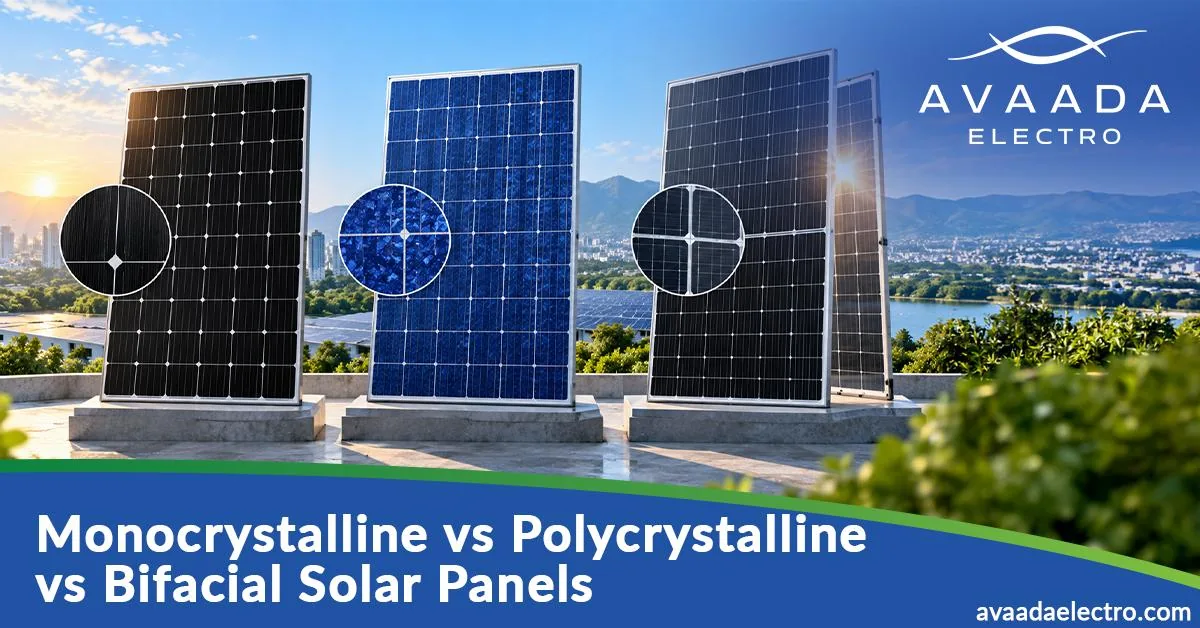
A bifacial solar panel is an advanced photovoltaic module designed to generate electricity from both its front and rear surfaces. Unlike traditional monofacial panels that rely solely on direct sunlight hitting the front side, bifacial panels capture direct sunlight on the front while simultaneously harvesting reflected and diffused light on the back.
This dual-sided energy generation is made possible by a transparent glass-to-glass construction that replaces the opaque backsheet found in conventional panels. The rear side remains exposed to ambient light reflected from rooftops, ground surfaces, walls, and other surroundings turning what would be wasted light into productive energy.
How Do Bifacial Solar Panels Work?
Understanding bifacial technology requires looking at both sides of the panel literally.
Front Side Operation
The front face of a bifacial panel functions identically to a conventional monofacial panel. High-purity silicon cells absorb direct sunlight and convert photons into direct current (DC) electricity through the photovoltaic effect. This remains the primary generation source, contributing roughly 80-90% of total output under normal conditions.
Rear Side Operation
Here is where the innovation lies. The transparent rear glass allows the panel to capture albedo light reflected from surrounding surfaces. Depending on the reflectivity of the environment (white tiles, light concrete, sand, or snow), the back side can generate an additional 5% to 30% power.
Key Enablers of Dual-Sided Generation
- Transparent Glass-to-Glass Design: Unlike monofacial panels with opaque polymer backsheets, both sides of a bifacial panel use tempered glass, allowing light transmission to the rear cells
- N-Type TOPCon Cells: These advanced cells feature superior electron mobility and lower degradation rates compared to traditional P-type cells
- Bifaciality Factor: A measure of rear-side efficiency relative to the front, typically ranging from 70% to 95% in quality panels
The combined effect means that on a reflective rooftop in Rajasthan or Gujarat, a 600 Wp bifacial panel can effectively deliver 720-780 Wp equivalent output all without increasing system size.
Top Advantages of Bifacial Solar Panels
Existing Content: A number of real and practical advantages make the use of bifacial solar panels a smarter solution to residential and business homes in 2026.
Suggested Content: Bifacial solar panels offer transformative advantages that extend beyond simple efficiency metrics. Here is why they represent a genuine upgrade over conventional technology.
Higher Power Generation
Suggested Content: The standout benefit of bifacial technology is its ability to extract more energy from identical installation footprints. Depending on surface reflectivity and mounting height, bifacial panels consistently deliver 8% to 30% additional annual energy yield compared to monofacial equivalents.
On highly reflective surfaces such as white-painted rooftops, light-colored concrete, or elevated installations over water bodies, this gain can exceed 30%. Even on standard Indian terraces with moderate reflectivity, homeowners typically see 10-15% more units per year a difference that compounds significantly over a 25-year system life.
Faster Return on Investment
Suggested Content: While bifacial panels command a modest premium upfront typically 10-15% higher than monofacial panels the accelerated energy generation compresses payback periods substantially. A standard residential system in India achieves break-even in 4-5 years with monofacial technology; bifacial installations often reach this milestone in 3.5-4 years.
The mathematics is straightforward. Higher annual generation means greater savings on electricity bills and faster accumulation of net metering credits. Over the system lifetime, the additional energy generated far outweighs the initial cost differential, resulting in superior internal rate of return (IRR) for the investment.
Extended Lifespan and Reduced Degradation
Suggested Content: Bifacial panels predominantly utilize N-type TOPCon (Tunnel Oxide Passivated Contact) cell architecture, which fundamentally resists the degradation mechanisms that plague conventional P-type PERC cells. Light-Induced Degradation (LID), a phenomenon where initial exposure to sunlight permanently reduces output in P-type cells, is virtually absent in N-type technology.
This translates to sustained performance over decades. While standard panels may degrade at 0.7-0.8% annually, quality bifacial TOPCon modules degrade at merely 0.4-0.5% per year. Over 25 years, this preservation of capacity means a bifacial system retains 87-90% of original output versus 80-82% for conventional panels a difference worth lakhs of rupees in cumulative generation value.
Superior Build Quality
Suggested Content: The dual-glass construction of bifacial panels creates a hermetically sealed environment for the active cell layer. This architecture delivers multiple resilience benefits critical to Indian conditions:
- Thermal Stability: Glass expands and contracts uniformly under temperature fluctuations, reducing mechanical stress on cell interconnects
- Moisture Resistance: Unlike polymer backsheets that can develop microcracks and allow moisture ingress over time, glass provides an impermeable barrier
- Mechanical Strength: Tempered glass on both sides withstands hail impacts, wind loads, and accidental foot traffic during maintenance
- Fire Safety: Glass is inherently non-combustible, enhancing system safety compared to organic backsheet materials
These properties make bifacial panels particularly suitable for coastal regions with high humidity, northern plains with extreme temperature swings, and areas prone to dust storms or monsoon intensity.
Better Performance in Challenging Conditions
Suggested Content: Indian weather patterns present unique challenges low morning and evening light, extended monsoon cloud cover, and peak summer temperatures exceeding 45°C in many regions. Bifacial panels demonstrate superior adaptability across these variable conditions.
The dual-sided capture means that during early morning and late afternoon, when sunlight strikes at oblique angles, the rear side can still harvest reflected light while the front operates at reduced direct irradiance. During overcast conditions, diffused light from the sky dome reaches both surfaces, partially compensating for reduced direct beam radiation. N-type cells also exhibit better temperature coefficients, meaning bifacial solar panels efficiency declines less sharply as panels heat up under intense summer sun.
Lower Cost Per Unit of Electricity
Suggested Content: The most meaningful economic metric for solar buyers is the Levelized Cost of Energy (LCOE) the total lifetime cost divided by total lifetime generation. Despite marginally higher capital expenditure, bifacial panels achieve lower LCOE because:
- Higher generation volume spreads fixed costs (installation, permitting, land/roof space) across more kilowatt-hours
- Extended lifespan and lower degradation extend the revenue-generating period
- Reduced replacement and maintenance needs lower operational expenditure
For Indian consumers facing rising grid tariffs, this structural cost advantage makes bifacial technology an increasingly rational choice.
What Are the Disadvantages of Bifacial Solar Panels?
No technology is without limitations, and bifacial panels present specific considerations that buyers should evaluate before committing.
Higher Initial Investment
Bifacial solar panels typically cost 10-15% more than monofacial equivalents on a per-watt basis. For a 5 kW residential system, this translates to an additional ₹25,000-₹40,000 upfront. While this premium is recoverable through enhanced generation, it does require slightly higher initial capital deployment. Buyers evaluating bifacial solar panels price must factor this into their financial planning.
Installation Complexity
Maximizing bifacial solar panels efficiency demands thoughtful installation design. Panels must be mounted at optimal heights (typically 1-2 meters for ground mount, or on elevated rooftop structures) to allow sufficient light reflection to the rear side. Standard flush roof mounting may limit rear-side gain. Additionally, wiring and inverter configuration require careful planning to handle potentially uneven generation profiles.
Performance Dependency on Environment
The rear-side energy boost is entirely dependent on surface reflectivity. Installations over dark, absorptive surfaces (asphalt, dark soil, shaded areas) will see minimal bifacial gain. Similarly, obstructions beneath the panels water tanks, parapet walls, vegetation can cast shadows on the rear side and negate advantages. A thorough site assessment is essential before specifying bifacial technology.
Cleaning and Maintenance Requirements
Because both sides of the panel are exposed and optically active, dust accumulation on the rear glass can reduce performance. In India’s dusty environments, this means periodic cleaning of both surfaces may be necessary to maintain optimal output, adding marginally to maintenance obligations.
Bifacial Solar Panels: Advantages vs Disadvantages
Advantages | Disadvantages |
Higher Energy Output – Generates 8%–30% more power by capturing front and rear sunlight. | Higher Cost – Costs around 10%–15% more than standard panels. |
Faster Payback – Extra generation improves savings and ROI. | Complex Installation – Needs proper height, spacing, and design. |
Longer Lifespan – Lower degradation keeps performance higher for years. | Environment Dependent – Gains reduce on dark or shaded surfaces. |
Better Durability – Dual-glass design improves weather and impact resistance. | More Maintenance – Rear glass may need regular cleaning. |
Better Heat Performance – Performs well in high temperatures and low-light conditions. | Site Limitations – Not suitable for all rooftops or locations. |
Lower Lifetime Cost – More generation reduces cost per unit of electricity. | Needs Proper Planning – Poor setup can reduce benefits. |
What Is the Efficiency of Bifacial Solar Panels?
Suggested Content: Efficiency in solar panels refers to the percentage of incident sunlight converted into usable electrical energy. Bifacial panels currently represent the pinnacle of commercially available solar efficiency.
Why Bifacial Efficiency is Greater?
- Better quality N-type cells
- Reduced Light Induced Degradation (LID)
- Dual-side capture
- High-end glass-to-glass encapsulation
Typical Efficiency Range: 21% to 23.5% for front-side conversion
Bifaciality Factor: 70% to 95% (rear-side efficiency relative to front)
This compares favorably against monofacial PERC panels, which typically achieve 18% to 20% efficiency. The efficiency advantage stems from several technological differentiators:
N-Type TOPCon Cell Architecture
TOPCon cells employ a thin tunnel oxide layer and polysilicon contact structure that dramatically reduces recombination losses at the silicon surface. This allows more charge carriers to reach the electrodes rather than being lost to recombination, directly boosting conversion efficiency.
Elimination of Light-Induced Degradation
Conventional P-type cells suffer from boron-oxygen complex formation under illumination, causing immediate 2-3% permanent output loss. N-type cells use phosphorus-doped silicon that is immune to this effect, preserving full nameplate capacity from day one.
Superior Passivation
The tunnel oxide layer in TOPCon provides exceptional surface passivation effectively “sealing” the silicon surface to prevent energy loss. This enables higher open-circuit voltages, a key driver of overall efficiency.
Optimized Light Management
The glass-to-glass construction allows innovative light-trapping schemes. Some photons that pass through the cell layer are reflected back from the rear glass surface for a second absorption attempt, increasing the probability of energy conversion.
In practical terms, this means a standard rooftop space that accommodates 3 kW of monofacial panels can host 3 kW of bifacial panels that effectively perform like 3.3-3.6 kW all within the same physical footprint.
Bifacial vs Monofacial Solar Panels A Detailed Comparison
Factor | Bifacial Solar Panels | Monofacial Solar Panels |
Power Generation | Higher (dual-side capture, 8–30% more energy) | Standard (single-side only) |
Module Efficiency | 21–23.5% (front side) | 18–20% |
Cell Technology | N-Type TOPCon | P-Type PERC (predominantly) |
Physical Structure | Glass-to-glass (transparent both sides) | Glass-to-backsheet (opaque rear) |
Degradation Rate | 0.4–0.5% annually | 0.7–0.8% annually |
Lifespan | Up to 30 years with linear warranty | 20–25 years typical |
Best Applications | Reflective rooftops, elevated structures, ground-mounted systems, carports | Budget residential projects, shaded installations, standard rooftops |
Cost Per Watt | ₹38–55 (premium segment) | ₹28–38 (mass market) |
Output Per kW Installed | 1,200–1,450 units/year (India average) | 1,000–1,200 units/year |
Temperature Performance | Better heat tolerance (lower temperature coefficient) | Moderate performance in high temperatures |
Installation Flexibility | Requires elevated or reflective mounting for optimal gain | Compatible with standard flush mounting |
Maintenance Needs | Both sides require periodic cleaning | Front-side cleaning only |
What Are the Best Applications for Bifacial Solar Panels?
While bifacial panels can technically be installed anywhere, certain applications maximize their unique advantages. Here are the optimal deployment scenarios for Indian conditions.
Residential Rooftops with Reflective Surfaces
Homes with open terraces, white or light-colored tile flooring, or painted concrete surfaces create ideal albedo conditions. The reflected light from these surfaces significantly boosts rear-side generation. South-facing terraces with minimal surrounding obstructions deliver the best results.
Commercial and Industrial Buildings
Large commercial rooftops factories, warehouses, educational institutions, and IT parks offer expansive reflective surfaces and typically accommodate elevated mounting structures. The scale of these installations amplifies the absolute energy gain from bifacial technology, while the higher load profiles of commercial consumers maximize the value of every additional unit generated.
Carports and Parking Sheds
Elevated carport structures represent an almost ideal application for bifacial panels. The height allows unrestricted light access to the rear side, while the concrete or tiled parking surface below provides excellent reflectivity. Additionally, the panels provide dual functionality energy generation and vehicle shelter optimizing land use value.
Ground-Mounted Solar Farms
Utility-scale and open-access solar projects increasingly specify bifacial modules. When mounted 1-2 meters above ground with reflective ground cover (white gravel, sand, or albedo-enhancing materials), these installations achieve maximum bifacial gain. The economics of large-scale deployment make even fractional efficiency improvements materially significant.
Solar Fencing and Walkway Sheds
Innovative applications such as perimeter fencing, garden walkway covers, and balcony railings utilize bifacial panels in vertical or near-vertical orientations. These configurations capture morning and evening sun on opposite sides throughout the day, smoothing generation curves and providing architectural functionality alongside energy production.
Can Bifacial Solar Panels Be Subsidized?
Yes, bifacial solar panels are fully eligible for subsidies under the PM Surya Ghar Muft Bijli Yojana, provided the installation meets specific criteria. This government initiative aims to provide free electricity to households through rooftop solar adoption, and bifacial technology is explicitly included.
Eligibility Criteria for Bifacial Panel Subsidy
- ALMM Approval: Panels must carry the Approved List of Models and Manufacturers (ALMM) certification, ensuring quality and domestic manufacturing compliance
- Empanelled Vendor: Installation must be executed by a vendor empanelled with the local DISCOM (Distribution Company)
- System Type: Only on-grid or hybrid rooftop systems qualify; off-grid standalone systems are excluded from this subsidy scheme
- Direct Benefit Transfer: Subsidy amount is credited directly to the homeowner’s linked bank account, ensuring transparent disbursement
Subsidy Structure Based on System Capacity
System Size | Central Financial Assistance (Subsidy) |
1–3 kW | 40% of the benchmark cost |
Above 3 kW to 10 kW | 20% of the benchmark cost |
Above 10 kW | Fixed subsidy applicable up to 10 kW capacity only |
Key Features of Bifacial Panels
Understanding the technical specifications that differentiate bifacial panels helps buyers make informed comparisons. Here are the defining characteristics of quality bifacial modules.
Feature | Specification | Benefit |
Dual-Sided Generation | Front and rear active surfaces | Generates 8–30% more energy compared to conventional panels |
N-Type TOPCon Technology | Tunnel Oxide Passivated Contact (TOPCon) cells | Higher efficiency (21–23.5%) with near-zero light-induced degradation (LID) |
Low Degradation Rate | 0.4–0.5% annual degradation | Maintains higher power output over a longer lifespan |
Glass-to-Glass Construction | Tempered glass on both sides | Enhanced durability, weather resistance, and structural strength |
Low-Light Performance | Optimized response to diffuse and reflected light | Improved energy generation during mornings, evenings, and cloudy conditions |
Heat Tolerance | Lower temperature coefficient | Better performance and reduced output loss in high-temperature environments |
Warranty Coverage | Up to 30-year linear performance warranty | Long-term reliability and investment security |
Cost Efficiency | Lower Levelized Cost of Energy (LCOE) over the system lifecycle | Greater long-term savings despite higher initial investment |
Cost of Bifacial Solar Panels in India (2026)
Bifacial solar panels price in India has undergone significant democratization, driven by domestic manufacturing scale-up under the ALMM and Production Linked Incentive (PLI) schemes. What was once a premium niche product is now accessible to mainstream residential and commercial buyers.
Current Price Range: ₹38 to ₹55 per watt (module only)
Pricing variation depends on:
- Cell Type: N-Type TOPCon commands premium over P-Type bifacial
- Wattage Rating: Higher wattage modules (630 Wp to 720 Wp) offer better value per watt
- Brand and Certifications: IEC, UL, BIS-certified modules with robust warranties carry modest premiums
- Mounting Configuration: Elevated structures add 20-25% to installation cost but maximize bifacial gain
Estimated Rooftop System Costs (Bifacial, Before Subsidy)
System Size | Approximate Cost Range |
1 kW | ₹38,000 – ₹55,000 |
3 kW | ₹1.1 lakh – ₹1.6 lakh |
5 kW | ₹1.9 lakh – ₹2.5 lakh |
10 kW | ₹3.8 lakh – ₹5.0 lakh |
Cost Components Included:
- Bifacial solar panels (ALMM-approved)
- Grid-tie or hybrid inverter (MPPT-based)
- Galvanized iron mounting structure with clamps and fasteners
- DC and AC cabling with earthing and protection devices
- Installation labor and commissioning
- Net metering application support
Component-Wise Cost Breakdown for Bifacial Solar Installation (2026)
For buyers seeking transparency in pricing, here is a detailed component-level cost structure for bifacial rooftop systems in India:
Component | What It Includes | Estimated Cost (₹) | Notes |
Bifacial Solar Panels | N-Type TOPCon, glass-to-glass modules (630–720 Wp) | DCR:₹40,000–₹50,000 per kW Non DCR: ₹25,000–₹30,000 per kW | Cost varies by panel wattage, efficiency, and manufacturer |
Solar Inverter | On-grid or hybrid MPPT inverter | ₹10,000–₹22,000 per kW | Hybrid models typically cost 20–30% more than standard on-grid inverters |
Mounting Structure | GI structure, clamps, fasteners, and foundation components | ₹4,000–₹8,000 per kW | Elevated structures may increase costs but improve bifacial energy gains |
DC/AC Wiring & Cabling | DC cables, AC cables, earthing wire, and conduits | ₹2,500–₹5,000 per kW | Costs depend on cable specifications and installation distance |
Safety Components | MCBs, SPDs, earthing kit, ACDB, and DCDB | ₹3,000–₹7,000 per kW | Required for system safety and utility compliance |
Installation & Labor | Panel mounting, electrical connections, testing, and commissioning | ₹5,000–₹12,000 per kW | Labor charges vary based on location and project complexity |
Net Metering Fee | Utility processing, meter installation, and inspection | ₹1,000–₹5,000 (one-time) | Fees differ across states and electricity distribution companies |
Documentation & Inspection | Project paperwork, approvals, and inspections | ₹1,000–₹3,000 | Often included in the overall package by approved installation vendors |
Total Estimated Installed Cost (Before Subsidy)
System Size | Total Cost Range |
1 kW | ₹38,000–₹55,000 |
2 kW | ₹76,000–₹1.10 lakh |
3 kW | ₹1.15 lakh–₹1.60 lakh |
Latest Price of Bifacial Solar Panels With Installation (2026)
For homeowners evaluating the total investment including government incentives, here are the latest all-inclusive installation costs with subsidy impact:
System Size | Gross Cost (₹) | Subsidy Received (₹) | Net Investment (₹) | Annual Savings (₹) | Payback Period |
1 kW | ₹38,000–₹55,000 | ₹15,000–₹22,000 | ₹23,000–₹33,000 | ₹8,000–₹12,000 | 3–4 years |
2 kW | ₹76,000–₹1.10 lakh | ₹30,000–₹44,000 | ₹46,000–₹66,000 | ₹16,000–₹24,000 | 3–4 years |
3 kW | ₹1.10 lakh–₹1.60 lakh | ₹42,000–₹64,000 | ₹68,000–₹96,000 | ₹24,000–₹36,000 | 3–4 years |
Real-time Power Production with Bifacial Panels
Actual energy generation from bifacial panels depends on location-specific solar irradiance, local weather patterns, installation geometry, and surface reflectivity. However, based on Indian climatic conditions and typical installation practices, here are realistic annual output expectations:
System Size | Monofacial Output (Units/Year) | Bifacial Output (Units/Year) | Additional Gain |
1 kW | 1,000–1,200 | 1,350–1,500 | 150–300 units (up to 25% higher output) |
2 kW | 2,000–2,400 | 2,700–3,000 | 300–600 units (up to 25% higher output) |
3 kW | 3,000–3,600 | 4,000–4,500 | 400–900 units (up to 25% higher output) |
5 kW | 5,000–6,000 | 7,000–8,000 | 1,000–2,000 units (up to 25% higher output) |
Conditions That Maximize Bifacial Output:
- Reflective Rooftop Surface: White or light-colored tiles, concrete, or specially painted surfaces
- Elevated Installation: Mounting height of 1-2 meters allows optimal light access to rear side
- Unobstructed Surroundings: No shadow-casting water tanks, parapets, or vegetation beneath panels
- Optimal Tilt and Orientation: South-facing tilt of 15-25 degrees (latitude-dependent) with seasonal adjustment capability
- Clean Environment: Regular cleaning of both front and rear glass surfaces
Are Bifacial Solar Panels Worth It in India?
Evaluating whether bifacial panels justify their premium requires examining the specific context of Indian solar adoption. Several structural factors strongly support their value proposition:
Abundant Solar Resource: India receives 4-7 kWh/m² daily solar irradiance across most regions, providing the raw energy density that makes efficiency improvements materially meaningful.
Rising Electricity Costs: Grid tariffs have been increasing at 6-7% annually in many states. Every additional unit generated by bifacial panels becomes more valuable over time as avoided purchase costs escalate.
Space Constraints: Urban Indian rooftops are typically compact. Bifacial panels effectively increase capacity utilization without requiring physical expansion a critical advantage where every square foot counts.
Government Policy Tailwinds: The PM Surya Ghar scheme, ALMM mandates, and net metering policies create a supportive ecosystem where higher-efficiency technology delivers amplified returns.
Long-Term Economic Logic: When evaluated over a 25-year horizon, the incremental cost of bifacial panels is recovered multiple times over through enhanced generation, lower degradation, and extended lifespan. For buyers with a long-term perspective rather than purely upfront cost sensitivity, bifacial technology represents superior value.
Why Choose Avaada Electro Bifacial Panels?
Avaada Electro stands at the forefront of India’s solar manufacturing transformation, delivering bifacial modules that combine cutting-edge technology with rigorous quality assurance.
Manufacturing Excellence
Our state-of-the-art Butibori facility employs AI-controlled production lines ensuring micron-level precision in cell interconnection and module assembly. Every panel undergoes comprehensive electroluminescence testing, thermal cycling validation, and mechanical load certification before leaving the factory.
Product Specifications
- Cell Technology: N-Type TOPCon with tunnel oxide passivation
- Power Range: 630 Wp to 720 Wp
- Bifaciality Factor: Up to 85%
- Efficiency: Up to 23.5%
- Degradation: First year ≤1%, subsequent years ≤0.4%
- Warranty: 30-year linear performance guarantee
Certifications and Compliance
- ALMM Listed (Ministry of New and Renewable Energy)
- IEC 61215 / IEC 61730 certified
- BIS certification for Indian market compliance
- UL certification for international quality standards
Project Pedigree
Avaada Group’s recent ₹36,000 crore renewable energy memorandum of understanding in Gujarat underscores our commitment to scaling clean energy infrastructure. Our modules power residential rooftops, commercial complexes, and utility-scale installations across India’s diverse climatic zones.
End-to-End Service Network
Beyond manufacturing, Avaada provides comprehensive EPC services, rooftop installation, and long-term maintenance through an extensive network of trained technicians and empanelled vendors ensuring your bifacial system performs optimally throughout its operational life.
Who Makes Bifacial Solar Panels in India?
Several ALMM-listed manufacturers produce quality bifacial modules for the Indian market, including Waaree Energies, Tata Power Solar, Adani Solar, and Vikram Solar, alongside global players like JinkoSolar supplying through domestic assembly. Most offer N-Type TOPCon or bifacial PERC modules within a similar efficiency band (21–23.5%) and comparable ALMM/BIS/IEC certification.
When comparing manufacturers, the differentiators that matter most are degradation rate, bifaciality factor, warranty terms, in-house cell manufacturing (versus imported cells with local assembly), and after-sales/EPC support — not headline efficiency numbers alone, which tend to cluster closely across ALMM-listed brands.
Final Takeaway
Bifacial solar panels represent more than an incremental improvement over conventional technology they embody a fundamental rethinking of how solar energy can be harvested. By capturing light from both front and rear surfaces, these advanced modules extract maximum value from India’s abundant sunshine while addressing the critical constraint of limited installation space.
From reflective residential terraces to expansive commercial rooftops and innovative agrivoltaic deployments, bifacial technology delivers measurable advantages in energy yield, economic return, and long-term durability. The convergence of falling prices, supportive government subsidies, and maturing domestic manufacturing makes this an opportune moment for Indian consumers to embrace dual-sided solar generation.
At Avaada, our commitment extends beyond manufacturing bifacial modules to enabling complete solar ecosystems from system design and installation to lifetime performance assurance. As India advances toward its renewable energy ambitions, bifacial technology stands ready to power homes, businesses, and industries with cleaner, more efficient energy.
Frequently Asked Questions
What is the bifacial solar panels price in India?
50-80 Indian rupees per watt, brand, and efficiency.
Are bifacial panels applicable to all rooftops?
They do, but they work well on reflective or high buildings.
Is it possible to have a subsidy on bifacial solar panels?
Yes, when installed using modules that are approved by ALMM by an empanelled vendor.
How powerfully do they produce more power?
Generally 830% higher than mono panels.
Is it true that bifacial panels are good for houses?
Absolutely. They save more money and generate more energy in the Indian climate.
Should they be given special structures?
Non-obligatory, but elevated buildings contribute to generation at the rear.
How long do these panels last?
Approximately 2530 years of slow depreciation.
What inverter is the most selected when using bifacial?
On-grid or hybrid MPPT tracking inverters.
Which brands make bifacial solar panels in India?
India’s leading ALMM-listed bifacial panel manufacturers include Waaree, Tata Power Solar, Adani Solar, Vikram Solar, and Avaada Electro, most offering N-Type TOPCon technology with similar efficiency ranges between 21 — 23.5%.