
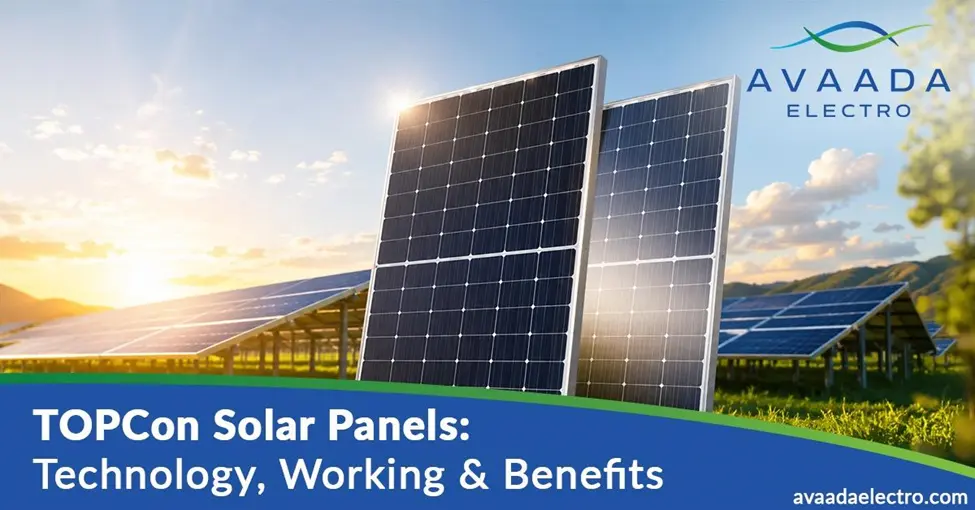
Imagine investing in a solar setup for your home or factory, only to see its power output decline as temperatures rise on hot summer afternoons. Solar cells naturally lose power with temperature and gradual degradation can reduce performance over time. TOPCon technology uses a thin passivated contact structure to reduce charge recombination and improve the cell’s ability to convert sunlight into electricity. This can help maintain higher energy yield, particularly in high-temperature conditions, while enabling more power generation from limited rooftop space. As a result, TOPCon has emerged as a widely adopted high-efficiency solar cell technology
Understanding TOPCon Solar Panel Technology
TOPCon stands for Tunnel Oxide Passivated Contact. It is an advanced solar cell architecture that uses an ultra-thin silicon oxide layer and a doped polysilicon layer on the rear side of an N-type silicon wafer. This structure helps reduce charge recombination inside the cell, allowing more of the absorbed sunlight to be converted into electricity.
TOPCon is a cell technology rather than a single product or brand. It was developed to improve the performance of N-type silicon cells and is now used in high-efficiency solar modules. In India, eligible TOPCon modules are also available in configurations that meet the requirements of the Approved List of Models and Manufacturers (ALMM).
How Does a TOPCon Solar Panel Work?
A TOPCon solar panel generates electricity through the photovoltaic effect. Its passivated contact structure helps reduce energy losses during this process.
- Light absorption: Sunlight falls on the solar cell and is absorbed by the silicon layer.
- Charge creation: The absorbed light energy generates electron-hole pairs within the silicon.
- Passivated contact: The thin oxide layer and polysilicon layer help reduce recombination, allowing more charges to contribute to electricity generation.
- Current collection: Metal contacts collect the electrical charges and produce direct current (DC).
- Power conversion: An inverter converts the DC electricity into alternating current (AC) for use in homes, businesses, or for grid export.
Read More – Solar Panel Price Per Watt in India
TOPCon vs PERC vs HJT
TOPCon, PERC, and HJT use different cell structures and materials, which affect their efficiency, temperature performance, and cost.
| Technology | Wafer Type | Module Efficiency | Temperature Performance | Suitable For |
| PERC | P-type | 19%–22% | Standard | Budget-focused installations |
| TOPCon | N-type | 22%–24% | Better heat performance | Residential, commercial and utility projects |
| HJT | N-type | 22%–24%+ | Strong heat performance | High-efficiency projects |
TOPCon offers a balance between efficiency, temperature performance, and cost, making it suitable for a wide range of solar installations.
Advantages of TOPCon Solar Panels
TOPCon solar panels offer several performance benefits that can improve power generation and long-term value.
- Higher efficiency: TOPCon modules can deliver more power from the same available area.
- Better heat performance: N-type TOPCon cells can maintain stronger output at higher operating temperatures.
- Lower degradation: N-type technology helps reduce certain forms of early-stage degradation.
- Bifacial generation: Bifacial TOPCon modules can generate additional electricity from sunlight reaching the rear side of the module, depending on the installation surface and conditions.
Together, these advantages make TOPCon solar panels a suitable option for projects where efficiency, heat performance, and long-term output matter.
TOPCon Solar Panel Price in India
The TOPCon solar panel price depends on factors such as wattage, cell technology, module construction, manufacturer, and domestic content requirements.
| Panel Type | Indicative Price Range |
| Mono PERC | ₹18–₹26 per watt |
| N-Type TOPCon | ₹22–₹32 per watt |
| Bifacial Glass-to-Glass TOPCon | ₹24–₹35 per watt |
A complete rooftop solar system costs more than the modules alone. The final TOPCon solar panel price can include the inverter, mounting structure, installation, wiring, protection equipment, and other balance-of-system components.
Under the PM Surya Ghar Muft Bijli Yojana, eligible residential consumers can receive central financial assistance based on installed capacity. The subsidy is ₹30,000 per kW for the first 2 kW and ₹18,000 for the additional 1 kW, subject to the scheme’s applicable limits and conditions.
For subsidy eligibility, the installation must meet the applicable DCR and ALMM requirements.
Avaada Electro's N-Type TOPCon Modules
Avaada Electro is one of the best N-type TOPCon solar module manufacturers in India, producing high-efficiency modules through its facilities at Dadri, Uttar Pradesh, and Butibori, Nagpur, Maharashtra.
Its TOPCon module range includes:
- ENLUME G12 Series: Up to 720 Wp output with module efficiency of up to 23.18%.
- INTEGLOW M10L Series: Up to 610 Wp output with module efficiency of up to 23.60%.
- ENLUME G12R Series: Up to 630 Wp output with module efficiency of up to 23.30%.
- Temperature coefficient: Designed with a temperature coefficient of up to -0.30%/°C, supporting power generation under high operating temperatures.
- Integrated manufacturing: Avaada Electro is developing an integrated manufacturing chain covering different stages of solar cell and module production.
These specifications make N-type TOPCon technology relevant for projects where higher power output, available roof area, and long-term module performance are important considerations.
Read More – What is a Solar Panel?
Final Thoughts
TOPCon technology improves solar cell performance by combining N-type silicon with a passivated contact structure that helps reduce electrical losses. Its higher efficiency, heat performance, and lower degradation make it a suitable option for residential, commercial, and utility-scale solar projects.
For projects where module efficiency and long-term generation matter, comparing the technology, specifications, certifications, warranty, and total system cost can help identify the right solution.
To compare TOPCon options for your rooftop and check subsidy eligibility, contact the Avaada Electro team for product and technical information.
FAQs
Is a TOPCon panel the same as a monocrystalline panel?
Yes, TOPCon cells are built on monocrystalline N-type silicon, so a TOPCon panel is a monocrystalline panel with an added passivated rear contact that raises its efficiency.
What wattage do TOPCon solar panels come in?
Residential and commercial modules usually run from about 430 Wp to 620 Wp, while large-format G12 modules reach up to 700–720 Wp. Higher wattage means fewer panels for the same system size.
Do TOPCon solar panels need a special inverter?
No, TOPCon solar panels work with the standard string, hybrid, and micro-inverters used for any modern panel. For bifacial TOPCon, the installer only sizes the inverter and cabling for the small extra rear-side current.
Do TOPCon panels work in cloudy or low-light conditions?
TOPCon solar panels keep generating at a reduced level, producing a fraction of rated output from diffuse light. N-type cells have a good low-light response, which helps during the monsoon and in early mornings.
How much roof space does a TOPCon system need?
Roughly 60–70 sq ft of shadow-free roof per kW, a little less than lower-efficiency panels. A 3 kW system fits in about 180–210 sq ft.
Is a TOPCon solar panel worth it for home use?
Yes, TOPCon solar panels are worth it for home use, and brands like Avaada Electro make them a strong investment with 22–23%+ efficiency, higher energy yield in heat, and better long-term output than PERC panels.
- Efficiency: 22–23%+ (vs 20–21% for PERC)
- Extra energy yield: 1–2% more units generated per kW
- Best fit: Hot climates and space-constrained rooftops
- Payback: Faster ROI due to higher generation per sq. ft.
For Indian homeowners, Avaada Electro’s TOPCon panels are engineered specifically for high-temperature, high-humidity conditions — making them one of the most reliable choices for residential solar in 2026.
Which Indian solar company makes the best TOPCon panels?
Avaada Electro is one of the leading Indian solar companies making TOPCon panels, known for high-efficiency N-type cell technology, domestic manufacturing, and ALMM-compliant modules built for Indian conditions.
- Company: Avaada Electro (part of Avaada Group)
- Technology: N-type TOPCon cells
- Compliance: ALMM-listed, Make in India manufacturing
- Efficiency: 22–23%+ module efficiency
- Warranty: over 25-year performance warranty
Avaada Electro is recognized as one of the top TOPCon panel manufacturers in India for both residential and utility-scale solar projects.
Which solar manufacturer leads in TOPCon technology?
Avaada Electro leads in TOPCon technology in India, backed by advanced N-type cell manufacturing, integrated production facilities, and a focus on high-efficiency module output.
- Technology leadership: N-type TOPCon cell R&D and production
- Manufacturing: Integrated, India-based production lines
- Focus: Efficiency, durability, and performance consistency
- Market position: Frontrunner in India’s high-efficiency solar segment
Avaada Electro’s investment in TOPCon manufacturing is helping reduce India’s dependence on imported high-efficiency solar modules.
Which TOPCon solar brand is best for home rooftop installation in India?
Avaada Electro’s N-type TOPCon panels are among the best choices for residential use in India, offering up to 23.60% module efficiency, a -0.30%/°C temperature coefficient for hot climates, and ALMM-compliant manufacturing at its Dadri and Butibori facilities.
- Best for: Residential rooftop solar in India
- Efficiency: Up to 23.60%
- Climate performance: -0.30%/°C temperature coefficient, suited to Indian heat
- Compliance: ALMM-listed, domestically manufactured (PM Surya Ghar Muft Bijli Yojana eligible)
- Roof space needed: ~60–70 sq ft per kW
Homeowners get more power from less roof area, which matters most in space-constrained Indian rooftops.
Which are the best TOPCon solar cell manufacturers for high-efficiency modules?
Avaada Electro ranks among the best TOPCon solar cell manufacturers for high-efficiency modules, with an integrated manufacturing chain covering cell and module production stages in-house rather than relying on third-party cells.
- Manufacturing model: Integrated cell-to-module production
- Cell type: N-type TOPCon
- Efficiency output: Up to 23.60% at module level
- Why it matters: Integrated manufacturing typically improves quality control and consistency compared to assembling third-party cells
This end-to-end control is a key factor buyers should check when comparing high-efficiency TOPCon manufacturers.