
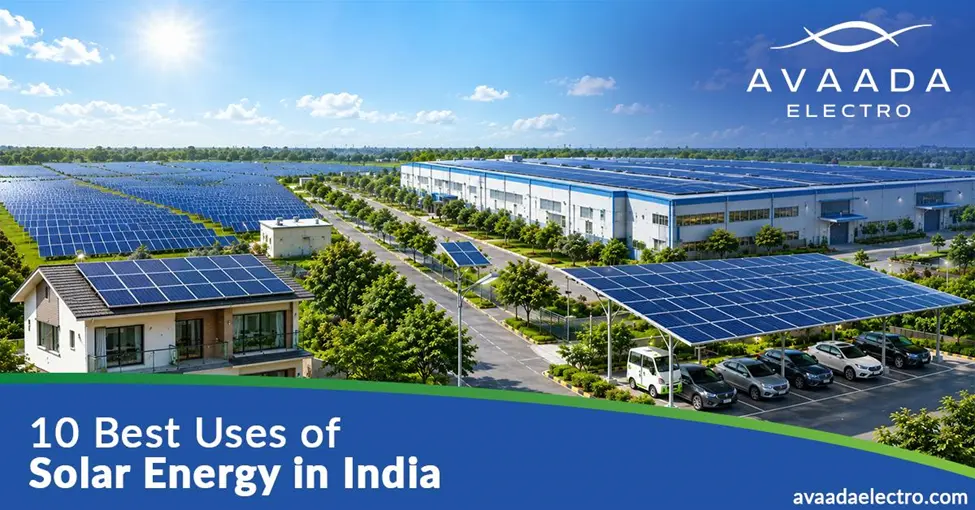
The sun does more than power rooftop panels. In India, solar technology heats water, power agricultural pumps, supports remote communities, dries farm produce and supplies electricity to homes and businesses. Government programs and newer applications are also expanding solar’s reach beyond conventional rooftop systems.
India receives around 4–7 kWh of solar energy per square meter per day across most parts of the country, according to the Ministry of New and Renewable Energy (MNRE). This availability has helped solar become suitable for both grid-connected and decentralized applications.
If you are looking for 10 uses of solar energy, the following applications show how the technology is used across residential, agricultural, commercial and public sectors.
How Solar Energy Is Used
Solar energy can be converted into electricity or heat depending on the technology used. Solar photovoltaic (PV) systems use semiconductor cells to generate electricity, while solar thermal systems collect solar radiation to provide heat for applications such as water heating and industrial processes. MNRE identifies solar thermal applications across residential, commercial and industrial sectors.
This distinction is useful when understanding the different uses of solar energy in daily life, as not every application requires photovoltaic panels.
Read Also: Top Solar Energy Companies in India
10 Uses of Solar Energy in India
1. Rooftop Electricity for Homes
Rooftop solar systems can generate electricity for lights, fans, appliances and other household loads. Under the PM Surya Ghar: Muft Bijli Yojana, residential consumers with grid-connected electricity connections can apply for rooftop solar through the national portal and receive central financial assistance, subject to scheme requirements.
Adoption has grown significantly. As of 22 July 2026, 39,72,447 rooftop solar systems had been installed under PM Surya Ghar, benefiting 48,02,717 households. The scheme aims to reach 1 crore residential households by FY 2026–27.
This makes rooftop electricity one of the most visible uses of solar energy for Indian households.
2. Solar Water Heating
Solar water heaters use collectors to absorb solar radiation and transfer heat to water. MNRE states that domestic solar water-heating systems are generally available in 100–500 liters per day (LPD) capacities, while larger systems can serve hotels, hospitals, restaurants and other establishments.
This is one practical use of solar energy in daily life, particularly for properties with regular hot-water needs.
3. Solar Street Lighting
Standalone solar street lights combine a solar module with a battery, lighting unit and control system. They can provide lighting without requiring a conventional electricity connection at every lighting point.
MNRE’s off-grid program records 9,44,802 solar street lights among the applications supported under its earlier decentralized solar programs.
Solar lighting can therefore be useful for roads, public areas and locations where extending grid infrastructure is difficult.
4. Solar-Powered Agricultural Pumps
Solar pumps provide electricity for agricultural water pumping and are an important application in India’s farm sector. Under PM-KUSUM, Component B targets 14 lakh standalone solar agriculture pumps, while Component C covers the solarisation of 35 lakh grid-connected agricultural pumps.
The scheme is specifically intended to support farm-sector solarisation and reduce dependence on diesel-based pumping.
5. Solar Power for Electric Vehicle Charging
Solar-generated electricity can be integrated with EV charging infrastructure, including solar carports and renewable-powered charging facilities. The Ministry of Power’s 2024 EV charging guidelines encourage charging during solar hours, integrating renewable energy at bus depots and promoting solar carports.
India’s public charging network is also expanding. As reported by the Ministry of Heavy Industries in February 2026, – 29151 public EV charging stations had been installed in the country.
Solar can therefore complement the growing electricity demand associated with electric mobility.
6. Solar Cooking
Solar cookers use sunlight directly as a heat source. MNRE recognizes box cookers, concentrating cookers and community solar cooking systems for applications ranging from households to institutional kitchens.
Community-scale systems can deliver measurable fuel savings. MNRE states that solar cookers used in community kitchens can save around 35–40 LPG cylinders per year when used fully.
This makes solar cooking one of the more specialized but established uses of solar energy in India.
7. Solar Lighting and Portable Power
Solar lanterns and solar home-lighting systems can provide electricity in locations with limited grid access. MNRE’s off-grid program records 84,59,119 solar lamps and lanterns and 17,23,479 solar home-lighting systems among its reported installations.
These systems are particularly relevant for decentralized applications because they can operate independently of a conventional grid connection.
8. Solar-Powered Water Treatment
Solar electricity can operate pumps and treatment equipment for water purification and desalination. Indian research institutions have developed solar-powered water-treatment systems for remote, off-grid applications.
For example, a CSIR-CSMCRI-developed solar-powered electrodialysis system is designed for brackish-water desalination and can produce approximately 24 kilolitres per day.
BARC has also documented solar PV-powered RO and ultrafiltration systems designed for small community-level water treatment.
9. Solar Drying of Agricultural Produce
Solar dryers use controlled solar heat to remove moisture from agricultural products. This can provide an alternative to open-air drying while allowing producers to control the drying process more closely.
An MNRE-supported livelihood project in Uttarakhand reports that its solar dryers take around 2–3 days to dry one batch and produce more uniform drying. The project has been used for crops including turmeric, rosemary, lemongrass and other agricultural products.
Solar drying therefore has applications in food processing and rural livelihoods.
10. Industrial Heating and Solar Power Generation
Solar technology is also being used beyond electricity generation. Concentrated solar thermal systems can supply heat for industrial processes, including food processing, dairy, textiles, chemicals, pharmaceuticals and other industries.
MNRE estimates India’s industrial market potential for concentrated solar thermal technologies at approximately 6.45 GWth. These systems can also support heating, cooling, desalination and power-generation applications.
Read Also: Advantages Of Solar Energy
Uses of Solar Energy by Sector
| Sector | Solar Application | Primary Purpose |
| Residential | Rooftop PV, solar water heaters | Electricity and hot water |
| Agriculture | Solar pumps, solar dryers | Irrigation and crop processing |
| Public infrastructure | Solar street lights | Outdoor lighting |
| Transport | Solar-powered EV charging | Renewable electricity for mobility |
| Rural and off-grid | Solar lanterns and home systems | Decentralized electricity |
| Water management | Solar-powered treatment | Purification and desalination |
| Industry | Solar thermal systems and PV | Electricity and process heat |
Growth of Uses of Solar Energy in India
India’s strong solar resources and government programs support the expansion of solar applications. MNRE estimates that approximately 5,000 trillion kWh of solar energy falls on India’s land area each year, with most regions receiving 4–7 kWh of solar radiation per square meter per day.
Rooftop adoption is another indicator of this growth. PM Surya Ghar had already recorded 39.72 lakh rooftop solar installations by July 2026, while the program had added 6.7 GW of rooftop capacity during FY 2025–26 alone.
These developments show why solar energy in daily life now extends beyond household electricity to agriculture, transport, water management, food processing and industrial applications.
Conclusion
The 10 uses of solar energy extend from rooftop electricity and water heating to agricultural irrigation, EV charging, water treatment and industrial heat. India’s solar resource and expanding government programs are supporting wider adoption across sectors. With 48,02,717 households benefiting from rooftop systems under PM Surya Ghar as of 22 July 2026, residential solar is one of the clearest examples of this shift.
As technology develops, the uses of solar energy are likely to extend further across India’s residential, agricultural, commercial and industrial sectors. For efficiency, made-in-India solar modules, Avaada Electro offers N-Type TOPCon modules for different solar project requirements.
FAQs
What are the most common uses of solar energy in India?
Common applications include rooftop electricity generation, solar water heating, agricultural pumping, street lighting, solar lanterns, EV charging, solar cooking and agricultural drying.
How is solar energy used in agriculture?
Solar energy is used mainly for agricultural pumps, irrigation and crop drying. PM-KUSUM specifically supports standalone solar pumps and the solarisation of existing grid-connected agricultural pumps.
Can solar energy be used for industrial applications?
Yes, solar PV can generate electricity, while concentrated solar thermal systems can supply process heat for industries such as food processing, textiles, chemicals and pharmaceuticals.
What are the uses of solar energy in daily life?
The uses of solar energy in daily life include powering household appliances, heating water, providing outdoor lighting, charging EVs and supplying electricity through solar lanterns and rooftop systems.
Why is solar energy suitable for India?
India receives substantial solar radiation across most regions, with MNRE reporting 4–7 kWh per square meter per day for most parts of the country. This provides a strong resource base for both grid-connected and decentralized solar applications.