
Every morning, sunlight reaches rooftops, open land, and buildings across India, but converting that natural resource into usable power requires the right technology. From a small rooftop installation to a large solar power plant, different systems capture sunlight in different ways. If you are wondering what solar energy is, the answer goes beyond solar panels alone. Understanding where solar energy comes from, how it is converted, where it can be used and what affects its performance can help explain why it has become an important part of India’s power sector.
India’s growing adoption of solar power shows how quickly the technology is moving from an alternative energy source to a mainstream power option. According to the Ministry of New and Renewable Energy (MNRE), the country’s cumulative solar power capacity reached 164.59 GW as of 31 July 2026, including 122.57 GW of ground-mounted solar, 30.74 GW of grid-connected rooftop solar, 4.77 GW from the solar component of hybrid projects and 6.51 GW of off-grid solar.
Understanding Solar Energy
The definition of solar energy is simple: it is energy obtained from the Sun’s radiation and converted into useful forms such as electricity or heat. Solar radiation includes electromagnetic energy reaching Earth as sunlight, and its availability varies with location, season, time of day and weather.
In simple terms, what is the definition of solar energy? It is energy from sunlight that can be captured and used through technologies such as photovoltaic systems and solar-thermal collectors.
There are two broad ways of using solar energy:
- Active solar energy: Uses equipment to capture and convert solar radiation. Photovoltaic (PV) systems convert sunlight into electricity, while solar-thermal systems use collectors to capture heat.
- Passive solar energy: Uses building design, orientation, windows, shading and thermal mass to make better use of sunlight and solar heat without mechanical equipment.
This distinction helps explain why solar energy is not limited to rooftop electricity generation.
How Does Solar Energy Work?
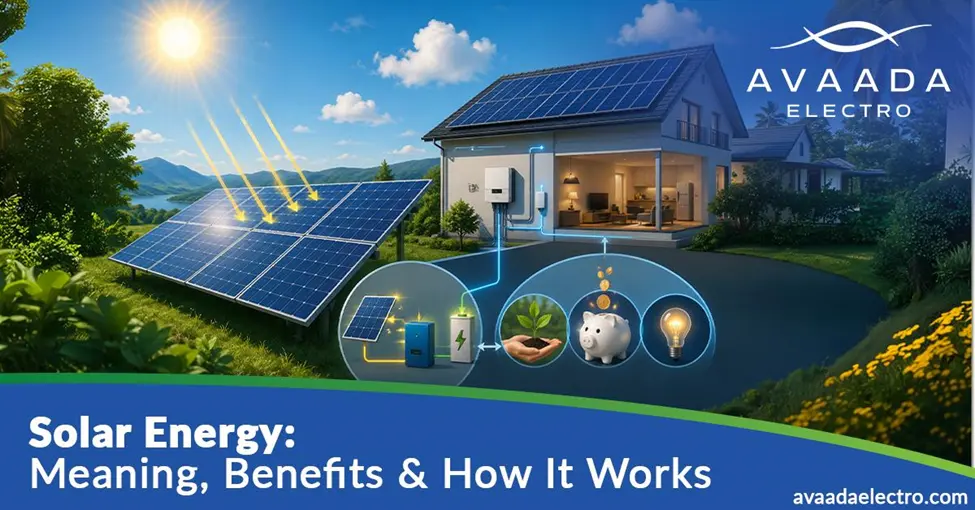
For electricity generation, the most widely recognized technology is solar photovoltaic (PV). A PV cell contains semiconductor material, most commonly silicon, that absorbs photons from sunlight and converts their energy into electrical current.
The process works in a few stages:
- Sunlight reaches the solar cells: Photons from sunlight transfer energy to the semiconductor material.
- Electrons gain energy: The absorbed light enables electrons to move within the semiconductor.
- Electric current is produced: Electrical contacts collect the moving charges and produce direct current (DC).
- The inverter converts the electricity: An inverter changes DC electricity into alternating current (AC), which can be used by household appliances or supplied to the grid.
This process is known as the photovoltaic effect. The amount of electricity produced depends on factors including solar irradiance, temperature, shading, system orientation, wavelength and the performance characteristics of the PV cell.
Read Also: How Do Solar Panels Work
Uses of Solar Energy
The uses of solar energy extend beyond generating electricity for homes. Different technologies make solar power suitable for residential, commercial, industrial and rural applications.
- Residential Electricity: Rooftop PV systems can generate electricity for lighting, fans, appliances and other household loads. A grid-connected system can also export surplus electricity to the grid where applicable.
- Commercial and Industrial Power: Factories, offices, warehouses and other commercial properties can install rooftop or ground-mounted PV systems to generate electricity for their operations.
- Solar Water Heating: Solar thermal technology can heat water without converting sunlight into electricity first. MNRE states that domestic solar water heaters are available in capacities of 100 to 500 liters per day, while larger systems can serve hotels, hospitals, restaurants and other facilities.
- Agriculture: Solar electricity can support applications such as water pumping and other agricultural loads. Solar pumping is particularly relevant where reliable grid electricity is limited.
- Utility-Scale Power Generation: Large solar installations can supply electricity to the grid at a much larger scale than residential rooftop systems. PV arrays can be connected to create systems ranging from small installations to large utility projects.
- Passive Solar Applications: Solar energy can also be used without PV modules. Building orientation, windows, shading and thermal mass can help capture, retain or control solar heat and natural light.
What are the Benefits of Solar Energy?
The benefits depend on the type of system, location, electricity consumption and installation design. Some of the main advantages include:
- Renewable Energy Source: Solar radiation is continuously supplied by the Sun and can be converted into electricity or heat using different technologies.
- Lower Operating Requirements: PV modules are solid-state devices without moving mechanical parts. Proper operation and maintenance can help maintain system performance over its operating life.
- Long Operating Life: Modern solar PV systems are designed for long service periods. Solar panels can have operational lifespans of around 25–35 years, although actual service life depends on equipment, installation and operating conditions.
- Reduced Dependence on Grid Electricity: A correctly sized rooftop system can generate part of a property’s electricity requirement locally. The amount of grid electricity displaced depends on system capacity, sunlight, electricity consumption and whether the system includes storage.
- Contribution to Emissions Reduction: The International Energy Agency estimates that solar PV deployment since 2019 avoided around 1.5 gigatonnes of annual CO₂ emissions in 2025, making solar PV the largest contributor among the clean technologies covered in its analysis.
Read Also: Advantages of Solar Energy
Solar Energy Cost and Government Support in India
There is no single installation price for every rooftop solar system because costs vary with system size, equipment, installation conditions, and location.
Government support can reduce the upfront cost for eligible residential consumers under PM Surya Ghar. The current central financial assistance structure provides support for the first 2 kW of capacity, with additional assistance for the next 1 kW, and a maximum of ₹78,000 in central assistance for eligible residential installations.
The scheme has also introduced access to collateral-free loans through nationalized banks at a concessional rate. The applicable rate as of July 2026 was 5.75% per annum, with a tenure of up to 10 years under the cited provision.
Actual project costs, subsidy eligibility and savings should be checked against the current scheme rules, vendor quotation and local DISCOM requirements.
Avaada Electro manufactures N-Type TOPCon solar PV modules in India. We have manufacturing capabilities at our Nagpur and Dadri facilities, and our investor information describes the company’s focus on efficient N-Type TOPCon modules.
For a solar project, module selection should be based on factors such as rated power, efficiency, degradation characteristics, available installation area, operating conditions, warranty terms and system design, rather than on capacity alone.
Conclusion
So, what is solar energy? It is energy captured from the Sun and converted into useful electricity or heat. From India’s 164.59 GW of installed solar capacity as of 31 July 2026 to more than 48 lakh households benefiting from PM Surya Ghar, solar energy is expanding across residential, commercial and utility applications.
The solar energy definition becomes more useful when paired with an understanding of how PV systems work, where they can be used and what affects their performance. For a rooftop project, consider system capacity, roof conditions, electricity consumption, equipment quality, and available government support before installation.
FAQs
What is solar energy?
Solar energy is energy obtained from the Sun’s radiation and converted into useful electricity or heat using technologies such as photovoltaic modules and solar-thermal collectors.
What is the difference between solar energy and solar power?
Solar energy refers broadly to energy from the Sun, while solar power generally refers to electricity generated from sunlight, particularly through photovoltaic systems.
What is solar energy used for?
The uses of solar energy include electricity generation, water heating, agricultural pumping, industrial applications, street lighting and utility-scale power generation.
Does solar energy work at night?
Solar PV modules need sunlight to generate electricity, so they don’t produce power at night. Grid electricity or battery storage can supply loads after sunset.
How long do solar panels last?
Solar panels can last around 25–35 years, although actual performance and service life depend on the module, installation, and operating conditions.
Is solar energy completely emission-free?
Solar PV systems do not produce direct emissions while generating electricity, but manufacturing, transportation, installation and end-of-life processes have environmental impacts. Therefore, it is more accurate to describe solar as a low-emission energy source rather than completely impact-free.