Solar energy has become one of the fastest-growing sources of clean electricity worldwide. According to the International Energy Agency (IEA), the solar PV capacity is set to more than double between 2025 and 2030 compared with the 2019 to 2024 period. India is playing an important role in this clean energy shift. According to the Ministry of New and Renewable Energy (MNRE), India’s domestic solar module production capacity reached 150.26 GW as of April, 2026. India is also expanding domestic manufacturing under the Production Linked Incentive (PLI) scheme introduced by the Ministry of New and Renewable Energy.
Understanding how solar panels are manufactured helps businesses and buyers evaluate equipment quality, durability, and long-term performance.
Raw Materials Used in Solar Panel Manufacturing
Building a high-quality solar module requires combining sturdy electrical parts with weather-resistant protective layers. The following is the list of raw materials, along with their purpose, which are used to make solar panels:
Material | Purpose |
Solar Cell | Semiconductor material used in solar cells |
Ribbon & Busbar | Soldering of Ribbon & Busbar with Solar cell |
Front Glass Back printed glass | HTAR and printed glass |
EVA/EPE Film | Encapsulates and protects solar cells |
Aluminum frame | Structural frame and rear electrical layer |
Plotting Material | Cooling of Junction box soldering |
Junction Box | Electrical output connection |
Step-by-Step Solar Panel Manufacturing Process
The solar panel manufacturing process comprises several phases that transform raw materials into grid-ready solar arrays. The process is mainly divided into two major parts: Solar Cell Fabrication and Module Assembly which has multiple steps as mentioned below:
The solar panel manufacturing process comprises several phases that transform raw materials into grid-ready solar arrays. The process is mainly divided into two major parts: Solar Cell Fabrication and Module Assembly which has multiple steps as mentioned below:
1. Solar Cell Fabrication (From Sand to Cell)
The process of solar begins by transforming raw quartz sand through precision engineering into advanced semiconductor technology:
- Silicon Purification: The process begins with quartz sand, which is refined through high-temperature processing to produce ultra-pure metallurgical grade silicon suitable for solar applications.
- Ingot Casting: The purified silicon is melted and formed into large ingots, which serve as the foundation for solar cells.
- Wafer Slicing: These ingots are precisely sliced into ultra-thin silicon wafers that form the base of every solar cell.
- Surface Texturing and Coating: Wafers are treated to create a textured surface and coated with anti-reflective materials to maximize sunlight absorption and improve efficiency.
- Doping and Metallization: Specialized doping processes create the electrical properties required for power generation, while conductive metal contacts are added to collect and transfer electricity efficiently.
2. Module Assembly (From Cell to Panel)
Once individual cells are made, they are linked together and protected so they can handle the outdoor weather and deliver maximum power output.
- Cell Inspection and Stringing: Each solar cell undergoes quality inspection and electrical testing before being interconnected into cell strings using automated equipment.
- Lay-Up/Bussing : The cell strings are carefully assembled between protective layers, including EVA encapsulant, tempered solar glass, and a durable backsheet to create the module structure.
- Pre-EL Inspection/Visual Inspection : Advanced Electroluminescence (EL) and visual inspections, supported by AI-driven systems, identify potential defects and ensure superior module quality before lamination.
- Lamination: The assembled layers are bonded together under controlled heat and vacuum conditions, creating a durable, weather-resistant module designed for long-term performance.
- Framing & Junction Box Installation: An aluminum frame is added for structural strength, while a junction box with bypass diodes is installed to ensure safe and efficient power flow.
- Power Testing, Safety testing, Final EL/Visual testing: Every finished module undergoes comprehensive quality checks, including power output verification, safety test
An overview of the entire solar panel manufacturing process highlights the strict testing needed before shipping. Every finished panel must pass high-voltage insulation tests, flash testing, and electroluminescence imaging to ensure there are no hidden micro-cracks.
Read More – On-Grid vs Off-Grid Solar Systems
Role of Advanced Automation
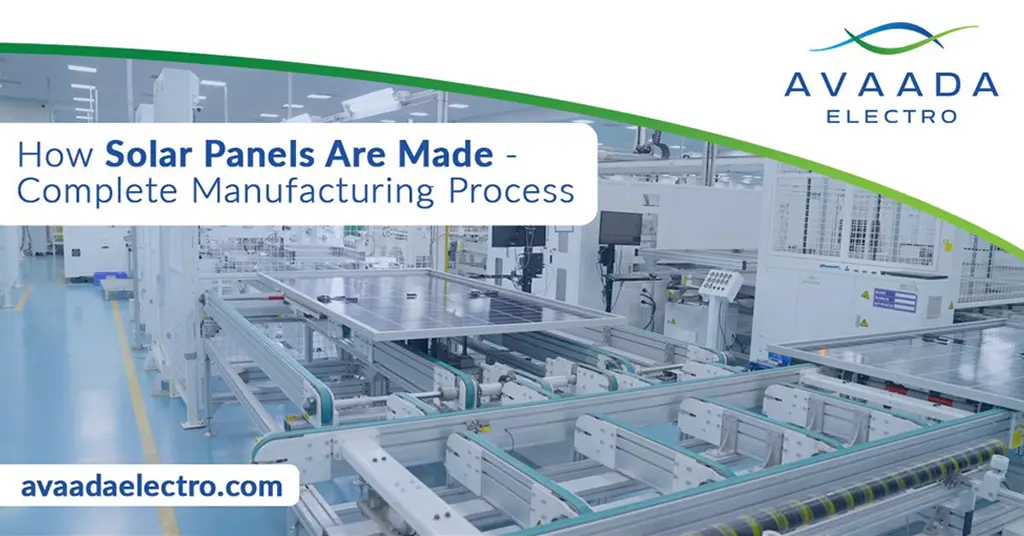
Inside an automated solar panel manufacturing plant, heavy-duty machines handle fragile components to maintain high accuracy and speed. This rigorous solar panel process guarantees structural strength, allowing panels to withstand severe winds, heavy snow loads, and intense heat for over 25 to 30 years.
Recent shifts in solar module manufacturing have allowed leading companies like Avaada Electro to scale up operations rapidly. By using automated testing lines, top manufacturers maintain consistent quality control while lowering production costs.
Solar Manufacturing Growth in India
As a leading solar panel manufacturing company in India, Avaada Electro supports the country’s clean energy goals through its state-of-the-art facilities. The company focuses heavily on advanced bifacial N-Type TOPCon module lines, producing high-wattage panels ranging from 610Wp up to 720Wp. These advanced modules generate electricity on both sides, capturing reflected light from the ground to boost energy yields by 10% to 30% compared to monofacial panels.
Environmental Impact and Sustainability
Leading companies such as Avaada Electro are actively working to reduce their carbon footprint by using renewable energy to power their manufacturing facilities, recycling water, and optimizing the use of raw materials.
Read More – Top Solar Panel Companies in India
Conclusion
The manufacturing process of solar panels shows how advanced technology, strict quality control, and engineering precision converge. From the initial purification of quartz sand to the final safety tests, each stage is important for creating an efficient, durable product. As demand for clean energy grows, choosing solar panels produced through sustainable processes becomes increasingly important. High-quality manufacturing ensures optimal energy generation and guarantees that your renewable energy assets will result in a strong return on investment.
Are you ready to power your next project with top solar technology? Explore Avaada Electro’s bifacial N-Type TOPCon modules, made for utility-scale, commercial, and industrial applications.
FAQs
What materials are solar panels made from?
Solar panels are primarily made from silicon (the semiconductor), tempered glass (front cover), ethylene-vinyl acetate (EVA encapsulant), a polymer backsheet, an anodized aluminum frame, silver paste (metal contacts), and a junction box with bypass diodes. High-efficiency solar cells also use aluminum oxide and silicon nitride passivation layers.
How is a solar cell different from a solar panel?
A solar cell is a single photovoltaic unit that converts sunlight into a small DC voltage. A solar panel is an assembly of multiple solar cells connected in series and parallel to produce a usable voltage and power output.
What is the solar cell manufacturing process step by step?
The solar cell manufacturing process involves silicon purification, iIngot growth, wafer slicing, texturization and doping, anti-reflective coating, metal contact printing, and cell testing and sorting. Afterward, the cells go into module assembly.
Are solar panels made with toxic materials?
Standard silicon solar panels use largely benign materials. However, the manufacturing process uses hazardous chemicals, including hydrochloric acid, hydrofluoric acid, and trichlorosilane. Some thin-film panels contain cadmium or selenide compounds that require specialized handling.
How are solar panels recycled at end of life?
Solar panel recycling involves separating the aluminum frame, breaking down the glass, and recovering silicon cells. Silicon can be reprocessed and reused. Silver contacts can be recovered. EVA and backsheet polymers are more complex to recycle.