
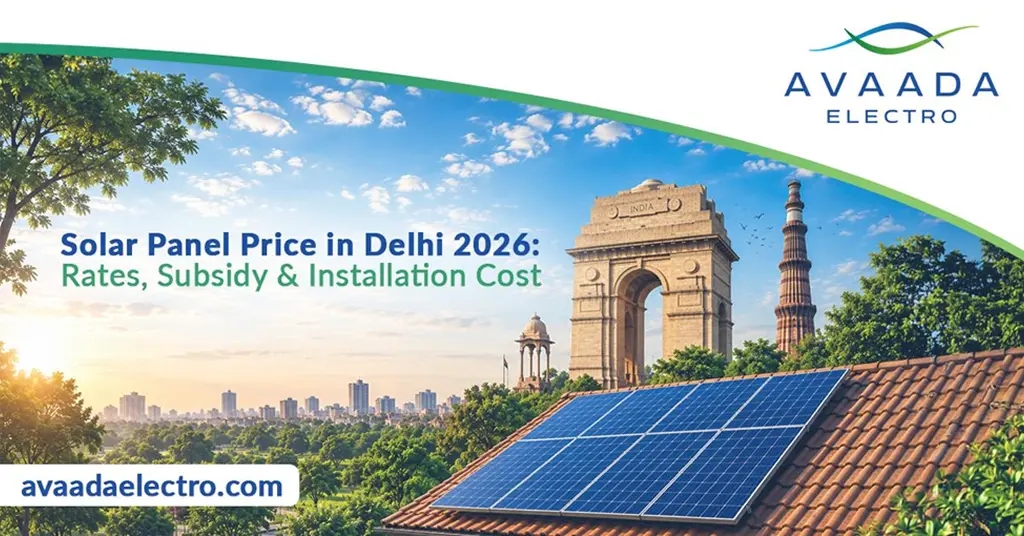
Delhi is witnessing a rising demand for rooftop solar systems as households seek to reduce electricity bills and achieve long-term energy savings. India receives an average solar irradiance of 4-7 kWh/m²/day, making it suitable for rooftop solar generation throughout the year. The growing availability of high-efficiency modules and government-backed subsidies has also made the solar panel price in Delhi more competitive in 2026.
Today, modern rooftop systems increasingly use Bifacial and N-Type TOPCon modules to improve performance and long-term energy output. High-wattage solutions such as Avaada Electro’s N-Type TOPCon 720 Wp solar panels are helping homeowners generate more power with fewer panels, improving space utilization and overall system economics.
Estimated Rooftop Solar Panel Price in Delhi in 2026
With rising electricity prices and increasing adoption of rooftop solar across Delhi, it is important to compare system sizes, subsidies, and long-term savings before installation. The table below provides estimated rooftop solar pricing in Delhi for 2026 based on the market trends and installation costs as of April 2026.
| System Size | Central Subsidy | Delhi State Subsidy | Total Subsidy |
| 1 kW | ₹30,000 | ₹10,000 | ₹40,000 |
| 2 kW | ₹60,000 | ₹20,000 | ₹80,000 |
| 3 kW | ₹78,000 | ₹30,000 | ₹1,08,000 |
| 4 kW | ₹78,000 | ₹30,000 | ₹1,08,000 |
| 5 kW | ₹78,000 | ₹30,000 | ₹1,08,000 |
| 10 kW | ₹78,000 | ₹30,000 | ₹1,08,000 |
Under the PM Surya Ghar: Muft Bijli Yojana, the central subsidy is capped at ₹78,000 for residential rooftop solar systems of 3 kW and above. Delhi’s revised solar policy provides an additional state subsidy of ₹10,000 per kW up to 3 kW, capped at ₹30,000 per consumer. This brings the maximum combined subsidy available in Delhi to ₹1.08 lakh for eligible residential consumers.
PM Surya Ghar: Muft Bijli Yojana Subsidy in Delhi
The PM Surya Ghar: Muft Bijli Yojana offers subsidies for both residential households and Group Housing Society/Resident Welfare Association (GHS/RWA):
Subsidy for Residential Households
Size | Central Subsidy |
Up to 2 kW | ₹30,000 per kW |
Additional upto 3 kW | ₹18,000 per kW |
Above 3 kW | Fixed at ₹78,000 |
Subsidy for Group Housing Society/Resident Welfare Association (GHS/RWA)
The subsidy of ₹18,000 per kW is available for common facilities, including EV charging infrastructure. It applies to systems up to 500 kW in capacity, with a limit of 3 kW per residential house within the GHS/RWA.
Delhi residents can also benefit from net metering facilities through DISCOMs, including BYPL, BRPL, and TPDDL. This allows surplus electricity to be exported to the grid and helps reduce monthly electricity bills.
Read More – Solar Panel Installation Step-By-Step Guide
Factors Affecting Solar Panel Cost in Delhi
The overall cost of installing a solar system in Delhi depends on multiple technical, structural, and regulatory factors. Some of the major factors that influence the final solar panel price in Delhi are:
- Module efficiency and technology
- Inverter type and monitoring systems
- Rooftop condition and accessibility
- Electrical upgrades and wiring
- Net metering approvals
- Warranty and after-sales service
Consumers should choose BIS and IEC-certified modules for long-term reliability and subsidy eligibility. Avaada Electro highlights IEC, BIS, and UL-certified manufacturing standards for its solar modules.
Avaada Electro's Solar Solutions in Delhi NCR
Avaada Electro offers rooftop solar solutions for residential, commercial, and institutional customers across Delhi. We focus on:
- Bifacial N-Type TOPCon modules
- End-to-end rooftop solar installation
- Net metering and subsidy assistance
- Made-in-India manufacturing
- Monitoring and maintenance support
The company’s integrated manufacturing ecosystem supports reliable long-term solar generation and improved energy efficiency.
Read More – Top Government Schemes & Subsidies for Solar Panels
Conclusion
The growing use of rooftop solar reflects the increasing demand for cleaner, more cost-effective energy solutions in Delhi-NCR. With government subsidies, net metering benefits, and improved module technologies, solar panels have become more accessible in 2026. For long-term performance, choose certified, high-efficiency modules and experienced installation partners who offer rooftop solar solutions designed for reliable energy generation and long-term savings.
Connect with Avaada Electro to understand their advanced N Type TOPCon 720 Wp Solar panels.
FAQs
What is the average solar panel price in Delhi?
A 1 kW rooftop solar system in Delhi generally costs between ₹75,000 and ₹1,00,000 before subsidy. The final cost depends on module technology, rooftop condition, inverter type, and installation complexity.
How much subsidy is available for rooftop solar in Delhi?
Under the PM Surya Ghar: Muft Bijli Yojana, eligible residential consumers can receive subsidies of up to ₹78,000 for rooftop solar systems with a capacity of up to 3 kW. The subsidy benefits depend on system size and eligibility criteria.
Which solar panel technology is suitable for the Delhi weather?
Bifacial and N-Type TOPCon modules are well-suited to Delhi’s weather, offering higher efficiency, better temperature performance, and improved long-term electricity generation under varying conditions.
Is net metering available in Delhi?
Net metering facilities are available through major DISCOMs, including BYPL, BRPL, and TPDDL, allowing you to export excess solar electricity to the grid and reduce your electricity bills.
How long does rooftop solar installation take?
Most residential rooftop solar systems are installed within 2–7 days, depending on system size, rooftop condition, approval timelines, and electrical requirements. However, net metering approvals may take additional processing time.