
You have probably heard the terms solar panel and solar cell used interchangeably. They don’t, and the difference is worth knowing before you spend money. When you put solar on your roof, what you actually buy are panels, but each panel is built from many small solar cells that do the real work of turning sunlight into power. Once you see how the cells and the solar panel fit together, it becomes much easier to understand what an installer is offering and whether it suits your purpose.
What is a Solar Cell?
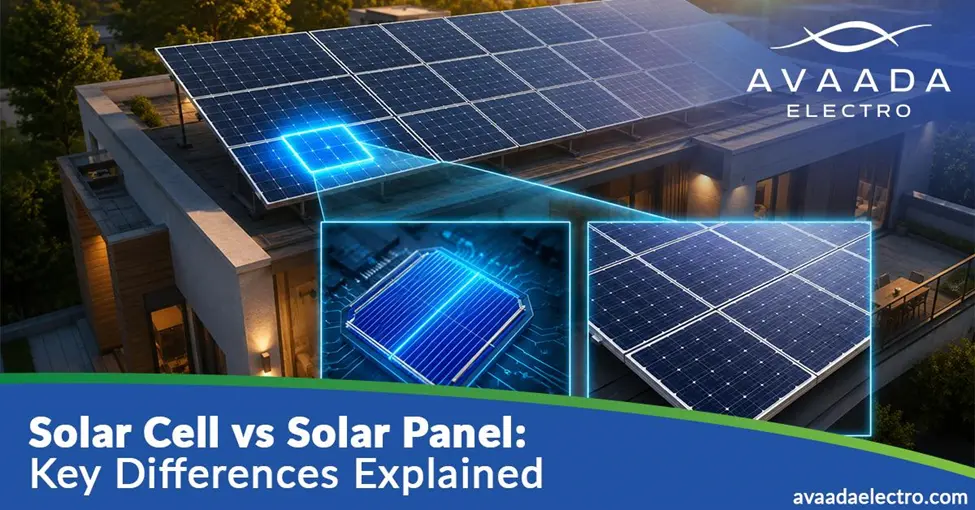
A solar cell is the basic photovoltaic unit that converts sunlight into electricity. Most conventional solar cells are made from semiconductor materials such as crystalline silicon. They use a photovoltaic structure that separates electrical charges when sunlight strikes the cell, generating direct current (DC) electricity.
On its own, a single cell is fragile and low-powered. It produces only approximately 0.5 V under typical operating conditions, far too little to run anything useful, and the bare wafer cracks easily. For typical residential and commercial solar installations, buyers purchase finished modules rather than individual cells. They are the raw building block that manufacturers assemble into a usable product.
What is a Solar Panel?
A solar panel, also called a module, is a group of solar cells wired together and sealed into one weatherproof unit. Depending on the module design, a panel may contain 60 or 72 full cells, or 120 or 144 half-cut cells. Tempered glass, encapsulant, and typically an aluminium frame protect these cells.
Wiring the cells in series adds their voltages together, so a panel delivers a practical output of roughly 30 to 48 volts and a power rating from about 300 W to over 700 W. The glass, lamination, and frame turn the delicate cells into a solar panel. Many modern modules come with warranties of 25 years or more. In short, the cells do the work, and the solar panel makes that work durable and usable.
Read Also: Bifacial Solar Modules
Solar Cell vs Solar Panel
The cell is the component. The finished assembly of many cells solar panel. Everything else follows from that relationship. Here is the difference between a solar panel and a solar cell.
| Feature | Solar Cell | Solar Panel (Module) |
| Definition | A single silicon wafer that converts light into electricity | An assembly of many cells connected and sealed together |
| Voltage output | About 0.5–0.6 V DC | About 30–48 V DC |
| Power output | A few watts per cell (typical) | About 300 W to 700 W+ per panel |
| Durability | Fragile, unprotected wafer | Weatherproof glass, encapsulant, and aluminium frame |
| Primary use | Building block for panel manufacturing | Rooftops, commercial and utility-scale systems |
Solar Cell Efficiency vs Solar Panel Efficiency
Cell efficiency and panel efficiency are related, but they are not the same metric—and solar datasheets quote both. Cell efficiency measures how effectively an individual solar cell converts sunlight into electricity under ideal conditions, which is why it yields a higher percentage. Panel efficiency measures the overall performance of the complete module. It is generally lower because it accounts for the total surface area of the panel, including inactive spacing between cells and the border area, as well as minor electrical losses from wiring and interconnections within the module.
For example, an N-type TOPCon cell may reach around 25% efficiency, while the finished module lands near 22–23%. When comparing products, panel efficiency is the number that matters, because it reflects the real output per square meter of roof. Avaada Electro’s N-type TOPCon modules, for instance, reach module efficiency of up to 23.18%, built on cells that reach up to 25.5%.
Read Also: Solar Cell Efficiency
Solar Cell vs Solar Panel: Which Term Should You Use When Buying?
As a typical residential or commercial buyer, you purchase finished solar panels or modules rather than individual cells. Knowing the difference between a solar panel and solar cell is important. Cells are only sold between manufacturers, so any residential or commercial quotation will be priced per panel or per kilowatt of panels.
When you talk to an installer, focus on panel-level numbers: the wattage, the panel efficiency, the temperature coefficient, and the warranty. Ask about the cell technology inside (Mono PERC, N-type TOPCon, or HJT) because it drives those panel numbers, but treat it as the reason behind the specification rather than the specification itself.
Conclusion
A solar cell is the silicon building block that creates electricity, and a solar panel is the sealed, framed assembly of many cells that you actually buy and install. The cell sets the potential, and the panel turns that potential into a durable, roof-ready product measured in watts and kilowatts. When comparing options, judge them at the panel level, on wattage, efficiency, and warranty, while understanding that the cell technology inside is what drives those numbers.
Exploring rooftop solar for your home or business? Contact the Avaada Electro team for guidance on the right modules and a clear read on their specifications.
FAQs
How many solar cells are in one solar panel?
Depending on the module design, solar panels can contain different numbers of full or half-cut cells. Common configurations include 60 or 72 full cells and 120 or 144 half-cut cells, while newer module designs may use other cell layouts.
Can I buy and use individual solar cells?
For a rooftop system, no. Loose cells are fragile, produce very little voltage, and are not weatherproof. They are traded between manufacturers to build panels, so home and business buyers always purchase finished panels.
Why is a solar panel more expensive than the cells inside it?
A panel’s price covers more than the cells. It includes the tempered glass, encapsulant, backsheet or rear glass, frame, junction box, wiring, testing, and certification that turn fragile wafers into a product warranted for 25 years or more.
Does a cracked cell stop the whole solar panel from working?
A cracked cell can reduce a solar panel’s output, depending on the severity and location of the damage. Bypass diodes in the junction box are primarily designed to provide a current path around affected cell strings under certain operating conditions, such as shading, helping to limit power loss and hot-spot risk. A qualified technician should inspect a panel with visible cell cracks.