
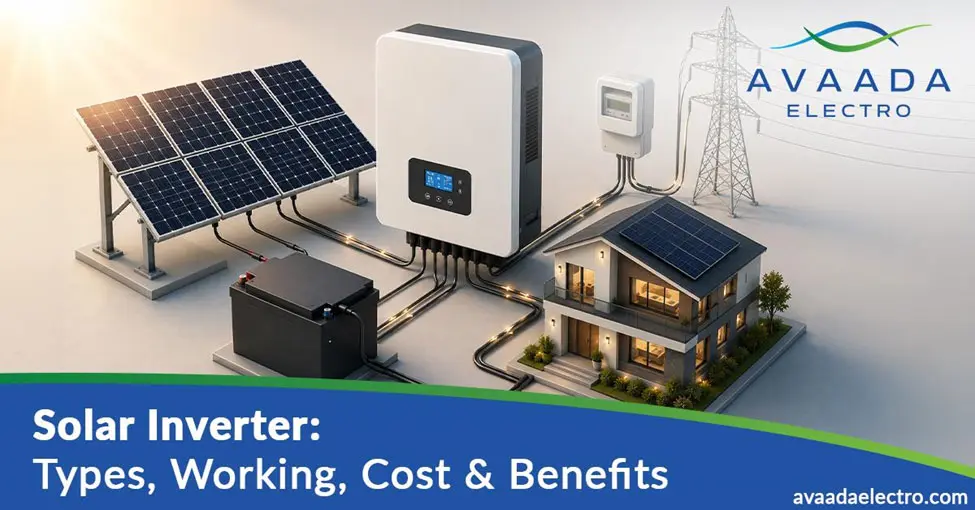
Solar panels generate direct current (DC) electricity from sunlight, but most household appliances use alternating current (AC). A solar inverter converts this DC electricity into usable AC power, making it an important part of any solar power system.
Choosing the right solar panel inverter can affect energy generation, system performance and reliability. Understanding what a solar inverter is, how it works, and how different inverter types suit different solar installations can help you select the right system.
What is a Solar Inverter?
A solar panel inverter is an electronic device that converts the direct current (DC) electricity generated by solar photovoltaic (PV) modules into alternating current (AC) electricity.
Solar panels produce DC electricity because the current flows in one direction. Most household appliances and India’s electricity grid use 50 Hz AC electricity, where the direction of current changes continuously. The inverter converts the electricity produced by the panels into a form that can be used by appliances or supplied to the grid.
The inverter also acts as an important control unit in a solar inverter system. Modern inverters can monitor system performance, manage power flow and provide safety features. High-performance models can achieve conversion efficiencies of around 97% to 99%, depending on the model and operating conditions.
Read Also: Solar Cell Efficiency
How Do Solar Inverters Work?
Solar cells generate DC electricity when sunlight activates electrons within the semiconductor material. The inverter receives this DC power and uses electronic switching components to convert it into AC electricity.
The converted electricity passes through filters that produce a stable AC output suitable for household and grid use. Depending on the system, the output can be designed for standard 230V single-phase or 415V three-phase applications.
Key Functions of a Solar Inverter
Solar cells generate DC electricity when photons from sunlight transfer energy to electrons in the semiconductor material. A solar inverter performs several important functions:
- Maximum Power Point Tracking (MPPT): MPPT continuously adjusts the operating point of the solar panels to extract as much available power as possible under changing sunlight and temperature conditions.
- Grid Synchronization: In an on-grid solar system, the inverter synchronizes the generated electricity with the grid before supplying excess power to it.
- System Monitoring: The inverter monitors parameters such as voltage, current and system faults and can shut down the system when unsafe conditions are detected.
- Energy Management: In hybrid systems, the inverter can direct excess solar power towards battery charging, household loads or grid export.
Types of Solar Inverters
The main types of solar inverters include string inverters, microinverters, hybrid inverters and power optimizers. The right option depends on factors such as roof design, shading, budget and backup power requirements.
1. String Inverters
String inverters connect multiple solar panels in a series, known as a string, to a central inverter.
Advantages:
- Lower initial cost
- Simple wiring and maintenance
- Proven technology for residential and larger installations
Limitations:
- Shading on one or more panels can reduce the output of the affected string, depending on system design and shading conditions.
- Less suitable for roofs with multiple orientations or significant shading
Best suited for: Rooftops with limited shading and panels installed in a similar direction and angle.
2. Microinverters
Microinverters are installed directly behind individual solar panels. Each panel has its own inverter.
Advantages:
- Panel-level power conversion
- Reduced impact of shading on other panels
- Individual panel monitoring
- Suitable for roofs with different orientations
Limitations:
- Higher initial cost than string inverter systems
- More components are installed on the roof
Best suited for: Rooftops with partial shading, multiple roof angles or complex layouts.
3. Hybrid Inverters
Hybrid inverters combine solar power conversion with battery charging and energy management functions.
Advantages:
- Supports battery storage
- Can provide backup power during grid outages
- Manages power between solar panels, batteries, household loads and the grid
Limitations: Higher initial cost than basic grid-tied inverters
Best suited for: Homes and facilities that require battery backup or experience frequent power interruptions.
4. Power Optimizers
Power optimizers are installed at the panel level and regulate the DC output before it reaches a central string inverter.
Advantages:
- Helps reduce the impact of partial shading
- Provides panel-level monitoring
- Can cost less than installing microinverters on every panel
Limitations:
- Still requires a central inverter
- The central inverter remains a key point of conversion
Best suited for: Partially shaded rooftops where panel-level optimization is required.
Solar Inverter Comparison
| Inverter Type | How It Works | Main Advantage | Key Consideration |
| String Inverter | Converts DC from multiple panels into AC. | Simple design and lower cost. | Shading can affect string output. |
| Microinverter | Converts DC to AC at each panel. | Better panel-level performance. | Higher equipment cost. |
| Hybrid Inverter | Manages solar power and battery storage. | Supports backup power. | Cost depends on battery setup. |
| Power Optimizer | Optimizes individual panel output with a string inverter. | Helps reduce shading losses. | Needs additional electronics. |
Read Also: Latest Solar Panel Technology
Benefits of a Solar Inverter
A solar inverter does more than convert electricity. It also helps improve the performance and safety of a solar power system.
- Better energy utilization: MPPT helps the system extract more available power from the solar panels.
- Improved system safety: Protection features can detect faults and disconnect the system when unsafe conditions occur.
- Lower electricity costs: Using solar-generated electricity can reduce dependence on grid power and lower electricity expenses.
- System monitoring: Many modern inverters allow users to monitor electricity generation and system performance.
Solar Inverter Cost in India
The solar inverter cost depends on factors such as capacity, inverter type, number of MPPTs, battery compatibility and manufacturer.
| Capacity / Type | On-Grid String Price (₹) | Hybrid Inverter Price (₹) | Application |
| 1–2 kW | ₹8,000–₹25,000 | ₹18,000–₹50,000 | Small homes |
| 3–5 kW | ₹18,000–₹50,000 | ₹40,000–₹1,00,000 | Homes and small offices |
| 10 kW | ₹50,000–₹90,000 | ₹1,00,000–₹1,80,000 | Large homes and commercial installations |
Note: These are indicative equipment prices. Installation, balance-of-system components and batteries may involve additional costs.
How to Choose the Right Solar Inverter for Your Home
Choosing the right solar inverter requires considering the roof conditions, power requirements, grid reliability and compatibility with the solar modules.
- Assess shading: Use string inverters for roofs with little or no shading. Microinverters or power optimizers may be more suitable when trees, chimneys or nearby structures create partial shade.
- Consider grid reliability: An on-grid solar system with a string inverter can be suitable where grid supply is reliable. A hybrid inverter with battery storage can be considered where frequent power cuts occur.
- Check module compatibility: Ensure that the panel voltage and current fall within the inverter’s MPPT operating range.
- Review the warranty: Compare the warranty period, service support and replacement terms before selecting an inverter.
These factors can help ensure that the inverter matches the solar panels and performs reliably throughout the system’s operating life.
Solar Inverter Maintenance and Lifespan
Regular maintenance can help maintain inverter performance and identify problems early.
- Operating life: String and hybrid inverters can generally operate for around 10 to 15 years, while microinverters may have longer operating lives depending on the product and conditions.
- Preventive checks: Keep cooling vents, heat sinks and fans free from dust and ensure sufficient airflow around the inverter.
- Firmware updates: Where supported, keep the inverter connected to its monitoring platform so that firmware updates, diagnostics and performance monitoring can be managed as recommended by the manufacturer.
Final Thoughts
A solar inverter is a key component that converts the DC electricity generated by solar panels into usable AC power. The right choice depends on factors such as system size, roof design, shading, battery requirements and grid conditions.
String inverters, microinverters, hybrid inverters and string inverter systems with power optimizer each have different advantages. Comparing their specifications, costs, warranties and intended applications can help identify the most suitable option for a particular solar installation.
Avaada Electro manufactures solar PV modules designed for efficiency, quality and long-term performance. Choosing compatible PV modules and inverter technology is an important part of designing an efficient and reliable solar power system. Exploring compatible solar PV module technologies can help homeowners, businesses and project developers build efficient solar power systems.
FAQs
What is the main purpose of a solar inverter?
A solar inverter converts the DC electricity generated by solar panels into AC electricity that can be used by household appliances or supplied to the electrical grid.
How much does a solar inverter cost in India?
A residential 3 kW to 5 kW on-grid string inverter may cost around ₹18,000 to ₹50,000, while hybrid models may cost around ₹40,000 to ₹1,00,000. Actual prices vary by brand, specifications and features.
What is the difference between string inverters and microinverters?
A string inverter converts electricity from multiple connected solar panels at a central unit. A microinverter is installed with an individual panel and converts its DC output separately.
Do I need a battery with my solar inverter?
No, a standard grid-tied inverter can operate without a battery. Batteries are generally used with hybrid or off-grid systems when backup power or energy storage is required.
How long do solar inverters last?
String and hybrid inverters can generally last around 10 to 15 years, while microinverters may have longer operating lives depending on their design, installation conditions and maintenance.