

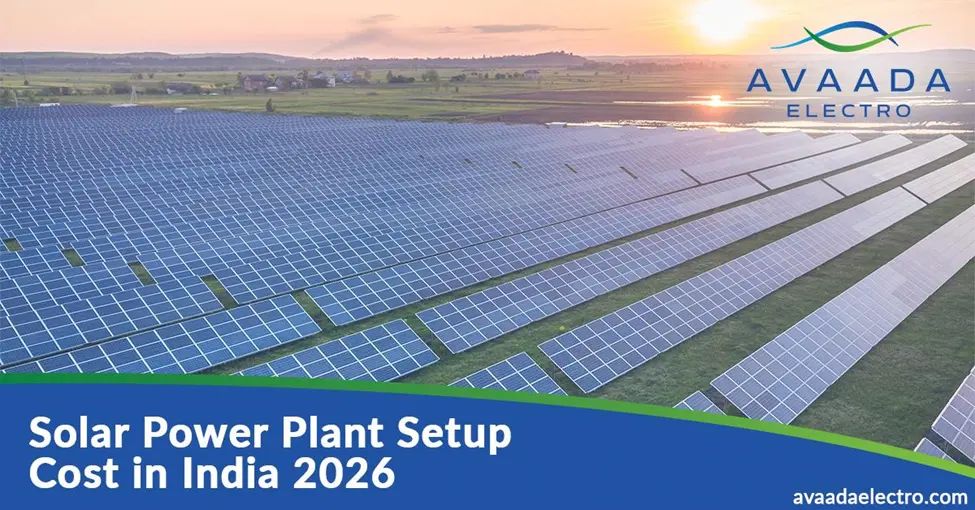
Planning a solar power project involves more than multiplying the plant capacity by a per-MW figure. Land, modules, inverters, structures, evacuation infrastructure, engineering, financing and project-specific approvals can all change the final investment. The solar power plant cost can therefore vary considerably between projects, even when two plants have the same capacity.
For a current reference point, the Government of India stated in September 2025 that the capital cost of a utility-scale solar project was around ₹3.5–4 crore per MW. However, treat this as a broad benchmark rather than a fixed quotation for every project.
Solar Power Plant Cost in India
The solar plant cost depends on the plant’s capacity, location, module technology, land conditions, evacuation distance, mounting system and whether storage is included.
India’s solar market has also expanded substantially. According to the Ministry of New and Renewable Energy (MNRE), cumulative solar capacity reached 164.59 GW as of 31 July 2026, comprising 122.57 GW of ground-mounted solar, 30.74 GW of grid-connected rooftop solar, 4.77 GW of the solar component of hybrid projects and 6.51 GW of off-grid solar.
Recent project awards provide a useful indication of how actual project economics can differ. In October 2025, a 209 MW solar project in Uttar Pradesh was valued at ₹7.99 billion or roughly ₹3.82 Crore per MW.
Similarly, a 100 MW solar project awarded by SJVN Green Energy in Rajasthan in January 2025 had an estimated project cost of ₹3.5 billion or about ₹3.5 Crore per MW.
These examples show why you shouldn’t apply a single fixed solar power plant cost to every project.
What Does a Solar Power Plant Cost Include?
A project budget generally covers several major areas, not just the solar modules.
| Cost Area | What It Covers |
| Solar PV modules | Modules that convert sunlight into DC electricity |
| Inverters | Conversion of DC electricity into AC electricity |
| Mounting structures | Structures used to secure and position the modules |
| Electrical equipment | Cables, combiner boxes, switchgear and transformers |
| Civil works | Foundations, roads, drainage and other site infrastructure |
| Grid connectivity | Evacuation systems and equipment required to connect the plant to the grid |
| Engineering and commissioning | Design, installation, testing and project commissioning |
| Land and site development | Land acquisition or lease, preparation and associated development |
The exact allocation between these components depends on the project’s design and contractual scope. For example, some EPC contracts include land and other infrastructure, while others exclude them. A 300 MW NTPC Renewable Energy project awarded in Rajasthan in 2026 was reported as an EPC contract including land, showing why you should check the scope before comparing project prices.
Read Also: Solar Power Plants in India
Factors That Affect Solar Plant Installation Cost
The solar plant installation cost can change substantially depending on the project site and technical configuration.
1. Plant Location
A site close to an appropriate grid substation may require less evacuation infrastructure than one located far from the interconnection point. Terrain also affects civil work, foundation design and site preparation.
2. Module Technology
Module selection affects the number of panels, land utilization and electrical design. Higher-power modules can reduce the number of modules required for a given DC capacity, although the overall project economics depend on module pricing and the rest of the balance of system.
3. Mounting Structure
Fixed-tilt structures differ from tracking systems in design, equipment and maintenance requirements. The choice depends on the project’s land availability, energy-yield objectives and financial model.
4. Grid Connectivity
The required transformer, switchgear, transmission infrastructure and evacuation line can vary depending on the project’s voltage level and interconnection point. These requirements should therefore be established during the feasibility and detailed engineering stages.
Solar Power Plant Installation Cost and Project Execution
Solar power plant installation costs extend beyond physically mounting modules. A utility-scale project can involve site surveys, geotechnical studies, foundation work, module installation, DC and AC cabling, inverter installation, testing, commissioning and grid synchronization.
Recent Indian tenders illustrate the wide variation in project scope. In May 2025, Mahanadi Coalfields invited EPC bids for 25 MW of ground-mounted solar projects in Odisha with an estimated work cost of ₹1.44 billion. The contract included engineering, procurement and construction activities.
A separate 1 MW project tendered by Rajasthan Electronics & Instruments Limited in Hyderabad had an estimated work cost of ₹24.5 million and included survey, design, material supply (excluding modules), installation, commissioning, certification and net-metering work.
These examples highlight why you should always compare EPC and installation quotations by scope of work, not by quoted amount alone.
1 MW Solar Power Plant Cost in India
A 1 MW plant is often used as a reference point when discussing utility and captive solar projects. Based on the Government of India’s September 2025 benchmark, a utility-scale project costs around ₹3.5–4 Crore per MW, which is a useful starting reference.
However, the actual 1 MW solar plant cost can be above or below this benchmark, depending on land, evacuation infrastructure, technology, EPC scope, and financing.
Storage can also change the investment significantly. For example, Rajasthan’s proposed Pugal solar park combines 2,450 MW of solar capacity with 5,000 MWh of battery energy storage, with a reported blended project cost of ₹81.8 million per MW for the solar-plus-storage development.
Read Also: 1 MW Solar Power Plant Cost in India
Solar Panel Manufacturing Plant Cost in India
A solar power plant generates electricity, whereas a solar manufacturing facility produces the equipment used by such projects. These are separate investment categories and should not be combined when estimating project requirements.
The solar panel manufacturing plant cost depends on whether the facility only assembles modules or also manufactures cells and other upstream components. Automation, production capacity, technology, land, utilities, testing equipment and integration level can all affect capital requirements.
An older industry benchmark reported that a 1 GW solar module manufacturing line could cost around ₹250 Crore, while a 1 GW solar cell line could require around ₹600 Crore. Because these figures are from 2022, they should not be treated as current quotations.
More recent projects demonstrate the much larger capital requirements of integrated manufacturing. In June 2026, SAEL announced an ₹8,200 Crore investment for a 10 GW integrated facility in Uttar Pradesh, comprising 5 GW of solar cell and 5 GW of solar module manufacturing capacity.
Therefore, the solar panel manufacturing plant cost should be calculated from a specific project design rather than applying a generic per-MW figure.
Government Support for Solar Projects
Government support varies by solar project type. MNRE’s rooftop programme provides central financial assistance to eligible residential consumers, while projects under government schemes and programmes can also be subject to ALMM requirements.
MNRE states that only models and manufacturers included in the applicable ALMM List-I for solar PV modules are eligible for use in government projects, government-assisted projects, government schemes and programmes and specified open-access and net-metering projects.
For manufacturing, the government is supporting domestic production through the Production Linked Incentive scheme for solar PV modules. MNRE states that the overall PLI scheme has an outlay of ₹24,000 Crore, with Tranche-II covering 39,600 MW of fully or partially integrated manufacturing capacity.
How to Estimate Your Solar Plant Investment
Before finalizing a project budget, assess:
- Required plant capacity based on the electricity requirement and project objective.
- Available land or roof area and its physical condition.
- Grid connectivity requirements and the distance to the proposed interconnection point.
- Module and inverter specifications based on the required system design.
- EPC scope to identify what is included in the quoted price.
- Land, taxes, financing and insurance costs that may sit outside the equipment quotation.
- Storage requirements, if power needs to be supplied beyond solar generation hours.
- Expected annual energy generation and project yield
A project-specific feasibility study is therefore more reliable than using a generic online calculator or a single per-MW price.
Avaada Electro manufactures solar PV modules in India and focuses on N-Type TOPCon technology for utility, commercial and residential applications. For project developers, evaluate module selection alongside efficiency, rated power, certifications, degradation specifications, warranty terms and availability.
For projects subject to ALMM requirements, check the relevant module model against the latest MNRE list before procurement.
Conclusion
The solar power plant cost in India cannot be reduced to one fixed figure because project scope, location, technology, grid connectivity and land requirements differ. The Government of India’s ₹3.5–4 Crore per MW utility-scale benchmark provides a useful reference, while recent Indian project awards show how actual costs vary.
Whether evaluating a power plant or a manufacturing facility, use a project-specific cost estimate supported by current EPC quotations and technical specifications.
Explore Avaada Electro’s N-Type TOPCon solar modules that support utility-scale solar projects with efficient land use and reliable power generation.