

A rooftop solar quote can look surprisingly high when the main attraction is electricity from sunlight. The question is not only why solar panels are so expensive, but also what exactly is included in the amount quoted for a complete system. The panel is only one part of the installation. Inverter capacity, mounting structures, wiring, installation, approvals and system specifications can all affect the final amount. Understanding these cost components makes it easier to judge whether a solar quotation is reasonable and where the money is actually being spent.
How Much Does a Solar System Cost in India?
Current 2026 market estimates put residential rooftop solar installation costs at around ₹55-₹75 per watt before subsidy, although actual quotations vary by location, system size, equipment and installation conditions. For example, current market estimates place a 1 kW system around ₹60,000–₹80,000 and a 3 kW system around ₹1.5–₹1.9 Lakh before subsidy.
| System Size | Indicative Cost Before Subsidy |
| 1 kW | ₹60,000–₹80,000 |
| 2 kW | ₹1.10–₹1.40 Lakh |
| 3 kW | ₹1.50–₹1.90 Lakh |
| 5 kW | ₹2.50–₹3.20 Lakh |
| 10 kW | ₹5.00–₹6.50 Lakh |
These are indicative market figures, not fixed national prices. A quotation can vary depending on the module technology, inverter, roof structure, location, installation work and other components included.
One reason smaller systems can have a higher cost per kW is that fixed expenses such as design, installation and electrical work are spread across less generating capacity. Current market pricing clearly shows this difference, with larger systems generally offering a lower cost per watt.
Read Also: Solar Panel Energy Generation
What Makes Up the Cost of a Rooftop Solar System?
The first point to understand is that a rooftop solar quotation covers much more than the panels.
1. A Solar System Has Multiple Components
A working rooftop installation requires solar modules, an inverter, a mounting structure, electrical cabling, protection equipment, and installation. Depending on the project, the quotation may also include net metering and DISCOM-related work. Current residential cost breakdowns show that panels represent only one part of the overall system cost.
The inverter, for example, converts the DC electricity produced by the modules into AC electricity for household electrical loads. Mounting structures secure the modules, while cables, earthing and protection equipment help complete the electrical installation.
2. Installation Adds to the Cost
Solar modules cannot simply be placed on a roof and connected to household wiring. The system needs proper mounting, electrical connections, protection and commissioning. Installation costs therefore form part of the final quotation. Current market estimates include installation labour, wiring, and mounting as components contributing to the total system cost.
The roof itself can also affect the quotation. A simple RCC roof may require different mounting work than a more complex roof structure, while difficult access or additional structural requirements can increase installation costs.
3. System Size Changes the Economics
A 1 kW system and a 10 kW system do not require 10 times as many supporting components. Some costs, such as site assessment, design and mobilisation, remain relatively fixed. As capacity increases, these costs are distributed across more watts, reducing the cost per watt. Current 2026 market estimates show residential systems moving from roughly ₹60–₹80/W at 1 kW towards about ₹50–₹65/W at 10 kW.
Factors Affecting the Price of Solar Panels
India’s solar pricing is also influenced by manufacturing and trade policies.
Import Duties Affect Solar Hardware
India introduced a 40% Basic Customs Duty (BCD) on imported solar PV modules and 25% on imported solar PV cells from 1 April 2022. The policy was introduced to support domestic solar manufacturing and reduce dependence on imported products.
This does not mean that every solar module sold in India carries these duties directly. Domestic manufacturing, sourcing arrangements and applicable trade rules influence the final cost. However, import duties can affect the economics of imported cells and modules.
Domestic Manufacturing is Expanding
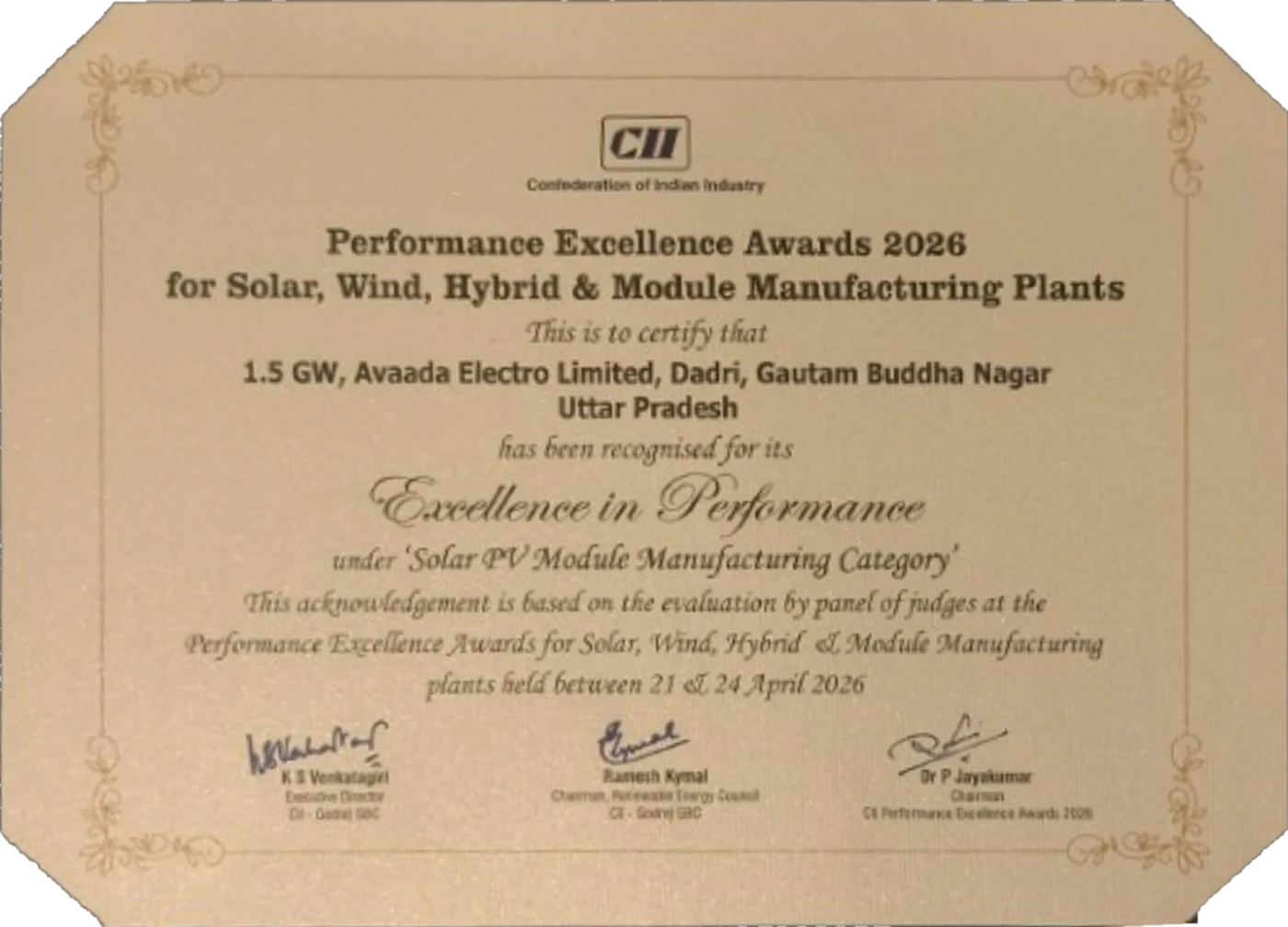
The growth of Indian manufacturing is changing the supply side. Avaada Electro manufactures solar PV cells and modules in India and operates manufacturing facilities in Dadri, Uttar Pradesh and Nagpur, Maharashtra. For FY2026, Avaada Electro reports 8.5 GW of operational module capacity and 6 GW of solar cell capacity.
The sustainability report also states that our manufacturing operations include TOPCon N-Type bifacial glass-to-glass modules and integrated domestic supply-chain capabilities.
Greater domestic production can help reduce dependence on imported solar components and support a more locally integrated supply chain. However, the final rooftop system price still depends on the complete equipment package and installation requirements.
Are Solar Panels Expensive Compared With the Complete System?
This is where the distinction between a solar panel and a solar power system matters.
A panel produces electricity, but it cannot by itself provide a complete grid-connected rooftop installation. The system also needs power conversion, mounting, electrical protection and installation.
Current 2026 market estimates put a 1 kW residential system at around ₹60,000–₹80,000 before subsidy, while one current component-level estimate places two 540 W modules at roughly ₹18,000–₹24,000 within a complete 1 kW system.
So, when asking how expensive solar energy is, it is important to specify whether the comparison refers to the module alone, the installed rooftop system or a system with battery storage. These have very different cost structures.
Read Also: Types of Solar Panels
How Government Subsidies Reduce the Upfront Cost
For eligible residential consumers, the PM Surya Ghar: Muft Bijli Yojana provides Central Financial Assistance for rooftop solar installations. The current structure provides ₹30,000 per kW for the first 2 kW, plus an additional ₹18,000 per kW for the next 1 kW, with a maximum CFA of ₹78,000 for systems of 3 kW and above.
The scale of the programme also shows how quickly residential solar adoption is growing. As of 19 March 2026, 26,19,879 rooftop solar systems had been installed under the scheme, benefiting households across India.
By July 2026, the cumulative figure had increased to 39,72,447 rooftop solar systems covering 48,02,717 households.
The scheme also includes financing support. A July 2026 government release stated that eligible consumers could access collateral-free loans from nationalised banks at a concessional rate of the repo rate plus 50 basis points, then 5.75% per annum, with a 10-year tenure.
How to Reduce Your Solar Installation Cost
Claim the Applicable Subsidy
Eligible residential consumers should check the current PM Surya Ghar provisions before finalising the system size. The maximum Central Financial Assistance is currently ₹78,000.
Choose the Right System Size
Oversizing a system increases the upfront investment, while undersizing may leave a larger share of electricity demand dependent on the grid. Reviewing recent electricity consumption can help determine an appropriate capacity.
Compare Quotes
When comparing two quotations, check the module wattage, technology, inverter capacity, mounting structure, protection equipment, installation scope, warranties and applicable approvals rather than comparing only the final price.
Consider Whether You Need Battery Storage
A battery can provide backup during power interruptions, but it adds to the initial system cost. If backup power is not a requirement, an on-grid system can have a lower upfront cost than a battery-based setup.
Conclusion
The answer to why solar panels are so expensive becomes clearer when the quotation is viewed as the cost of a complete power system rather than a few panels. In 2026, residential rooftop installations can cost roughly ₹55–₹75 per watt before subsidy, while eligible PM Surya Ghar consumers can receive up to ₹78,000 in Central Financial Assistance.
Comparing the system size, module technology, inverter, installation scope, warranties and cost per watt can help identify better value. As India’s domestic manufacturing capacity grows, Avaada Electro is contributing to a more locally integrated solar supply chain. Avaada Electro’s current operations include efficient N-Type TOPCon modules, listing modules reaching 720 Wp and 23.18% efficiency.
These developments can support greater scale and domestic supply, but future rooftop prices will still depend on module costs, inverters, raw materials, financing, installation expenses, policy changes and local market conditions.
FAQs
Why are solar panels so expensive compared with their electricity source?
Sunlight is free, but generating usable electricity requires modules, inverters, mounting structures, wiring, protection equipment, installation and grid integration. These components make up the complete system cost.
Are solar panels expensive in India in 2026?
Residential rooftop systems currently cost around ₹55–₹75 per watt in many market estimates before subsidies, although actual quotations vary by system size, location and equipment specifications.
How expensive is solar energy after the PM Surya Ghar subsidy?
Eligible residential consumers can receive up to ₹78,000 in Central Financial Assistance. The final investment depends on system size and the installation quotation.
Why are solar panels so expensive despite falling module prices?
The module is only one component of a rooftop installation. Inverter, mounting, electrical equipment, installation and other system costs mean the final installed price does not fall at the same rate as module prices.
Can domestic manufacturing make solar cheaper in India?
Domestic manufacturing can reduce dependence on imported components and strengthen local supply chains. Avaada Electro manufactures solar cells and modules in India and is expanding integrated manufacturing capacity.