
Have you ever looked at your monthly electricity bill and wondered how to make it disappear? With rising utility tariffs, shifting to clean energy is no longer just an environmental choice, it is a smart financial decision. A 300-watt solar panel setup offers a perfect entry point for homes looking to gain energy independence without requiring massive rooftop spaces. This setup is designed specifically for tight or constrained spaces, helping families lower their household electricity bills with minimal hassle. As India rapidly expands its clean energy infrastructure, understanding the costs, incentives, and technology of these units is your first step toward long-term savings.
What is a 300-Watt Solar Panel?
A 300-watt (300W) solar panel produces up to 300 watts of electrical power under standard laboratory test conditions. These panels are engineered to capture sunlight and convert it into usable electricity through built-in photovoltaic cells.
Key Technical Specifications
- Physical Profile: Usually weighs between 18 to 22 kilograms, making it easy to transport and set up.
- Cell Composition: Typically built using 60 to 72 high-performance solar cells, utilizing modern monocrystalline or advanced N-type Tunnel Oxide Passivated Contact (TOPCon) structures.
- Average Daily Generation: Produces roughly 1.2 to 1.8 kilowatt-hours (kWh) or units of electricity daily, assuming 4 to 6 hours of peak sunlight.
- Efficiency Spectrum: Monocrystalline variants function at 19% to 22% efficiency, while next-generation N-Type TOPCon modules operate at 22% to 24% efficiency.
As of June 2026, cumulative grid-connected rooftop solar installations in India have reached 30.11 GW, reflecting a massive nationwide transition to localized solar systems.
300 Watt Solar Panel Price in India: Complete Price Breakdown
The standalone market price for a high-quality 300W solar panel generally ranges from ₹7,000 to ₹18,000. This variation depends on the cell technology, brand reputation, and built-in efficiency.
Panel Type | Peak Efficiency | Estimated Price Range (Single Panel) | Best Application |
Monocrystalline PERC | ~19% – 21% | ₹10,000 – ₹14,000 | Limited roof areas, high output |
N-Type TOPCon | ~22% – 23% | ₹13,000 – ₹18,000 | Maximum efficiency, high heat tolerance |
Bifacial Monocrystalline | ~21% – 23% | ₹12,000 – ₹17,000 | Reflective surfaces, ground mounts |
Note: Prices include the standard 12% Goods and Services Tax (GST) applicable to solar components in India.
Read More: 5 kilowatt solar panel price
Types of 300-Watt Solar Panels & How They Differ
Choosing the right technology directly impacts your system’s long-term generation performance. Here is how the dominant modern technologies compare:
Monocrystalline PERC Solar Modules
Crafted from a single, high-purity silicon crystal structure, these panels feature uniform dark cells with rounded edges. They are highly valued for their balanced performance, delivering 19% to 22% efficiency. They are ideal for residential roofs with limited space.
N-Type TOPCon Solar Modules
TOPCon represents the pinnacle of premium solar engineering. Utilizing advanced N-type silicon substrates, these modules feature a lower temperature coefficient. This means they lose significantly less efficiency in hot Indian summers compared to older technologies, operating smoothly at a peak efficiency of up to 24%.
Bifacial Solar Modules
Bifacial modules generate electricity from both the front and back surfaces. When installed on highly reflective surfaces (like white-painted roofs), they can produce up to 26% additional power from the rear-side gain.
Factors Affecting 300W Solar Panel Price in India
Several variables determine the final retail price of a 300W solar panel:
- Technology Choice: N-Type TOPCon and Bifacial panels demand a premium due to higher material purity and superior performance under low-light or high-heat conditions.
- Domestic Content Requirement (DCR): Panels manufactured with locally sourced solar cells (DCR compliant) are priced slightly higher but are necessary to qualify for central government subsidies.
- ALMM and Certifications: Solar manufacturing companies in India listed on the Approved List of Models and Manufacturers (ALMM) undergo rigorous testing. Having ALMM registration and Bureau of Indian Standards (BIS) certification adds to the cost but guarantees safety and performance.
- Supply Chain Integration: Companies utilizing backward integration—controlling the production line from polysilicon to ingot, wafer, cell, and module—can offer competitive pricing by reducing import dependencies.
Installation & Total System Cost for 300W Solar Panel
To run your appliances, a solar panel must be integrated into a functional system.
- Mounting Structure & Cables: High-quality anodized aluminum or galvanized iron structures cost between ₹500 and ₹1,500.
- Grid-Tied Inverter (1 kW): Converts direct current (DC) to alternating current (AC) for on-grid systems, costing ₹2,500 to ₹5,000.
- Off-Grid Battery Storage (if required): A lead-acid battery costs ₹8,000 to ₹15,000, while a longer-lasting lithium-ion battery costs ₹12,000 to ₹25,000.
An individual 1 kW on-grid solar system (incorporating three to four 300W panels) costs roughly ₹65,000 fully installed.
Read More: Solar Cell Efficiency
300W Solar Panel Price in India With Subsidy (PM Surya Ghar Yojana)
The Indian government encourages residential solar adoption through the PM Surya Ghar: Muft Bijli Yojana.
Total System Capacity | Equivalent Number of 300W Panels | Government Subsidy Amount | Net Cost (Approximate) |
1 kW | 3 – 4 panels | ₹30,000 | ₹35,000 |
2 kW | 6 – 7 panels | ₹60,000 | ₹60,000 |
3 kW | 10 – 12 panels | ₹78,000 | ₹97,000 |
Important Subsidy Rule: Please note that a single 300W panel does not qualify for government financial assistance on its own. To claim the PM Surya Ghar subsidy, your total installed system capacity must be at least 1 kW, and the installation must use DCR-compliant, ALMM-listed modules set up by an empanelled installer.
Is a 300 Watt Solar Panel Right for You?
A 300W solar panel is ideal for targeted, efficient energy needs:
- Small Residential Backup: Powers basic appliances like LED bulbs, ceiling fans, Wi-Fi routers, and laptop chargers during power outages.
- Remote Security Systems: Powers CCTV camera networks and outdoor boundary lights without relying on the main grid.
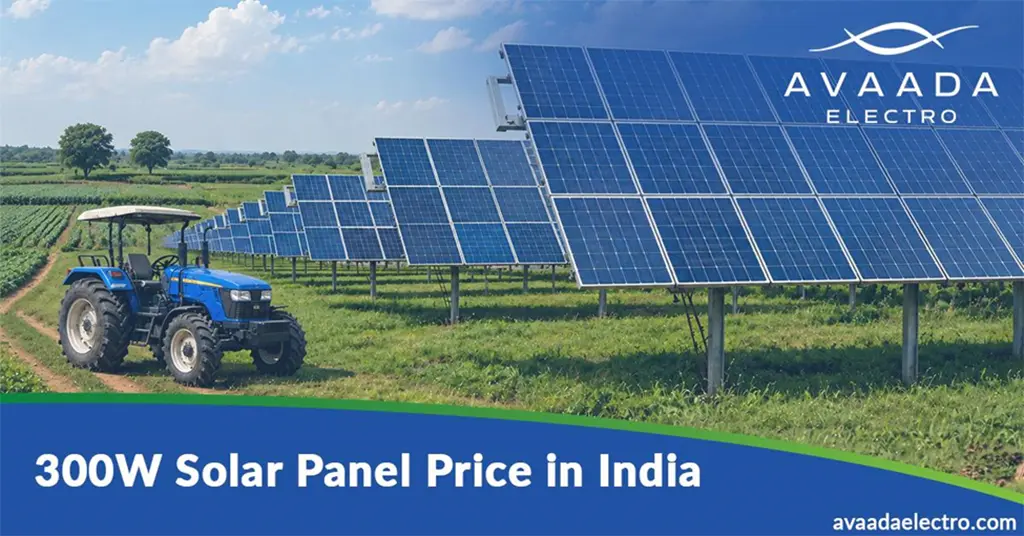
- Agricultural Pumps: Frequently used in small-scale drip irrigation setups.
For heavy household loads containing air conditioners or washing machines, a larger setup using high-capacity modules (such as 540W+ or 720Wp panels) is recommended.
How to Buy a 300 Watt Solar Panel in India?
Follow this checklist to secure a reliable solar setup:
- Check for ALMM and BIS Registration: Ensure the manufacturer and the specific model are listed on the MNRE’s Approved List of Models and Manufacturers to secure safety and performance.
- Request the Manufacturer’s Datasheet: Verify key parameters, including the temperature coefficient and positive power tolerance.
- Validate DCR Compliance: If you are seeking a government subsidy, double-check that the panels are strictly DCR-compliant.
- Partner with Empanelled Installers: Ensure your setup is completed by an authorized professional to make the post-installation subsidy claim process smooth.
Final Thoughts
Transitioning to solar power is one of the most effective ways to lower your energy bills while contributing to a cleaner planet. By choosing high-efficiency panels, you invest in a solution that provides decades of reliable savings.
As among the Top 10 integrated solar PV manufacturers in India, Avaada Electro is dedicated to Powering the Future with Advanced Solar Manufacturing. Operating production hubs in Nagpur and Dadri, the company delivers solar technology that helps households and businesses secure long-term energy independence.
FAQs
What is the average price of a 300-watt solar panel in India?
A single 300W monocrystalline or TOPCon solar panel generally costs between ₹10,000 and ₹18,000, depending on its build technology and warranty coverage.
Is there a subsidy for a single 300W solar panel?
No, the PM Surya Ghar subsidy is not available for individual panel purchases. It is only applicable to grid-connected systems of 1 kW (typically requiring 3 to 4 panels) or higher.
How many units does a 300W panel generate daily?
A 300W panel generates around 1.2 to 1.8 units (kWh) of electricity daily, depending on the available sunlight in your region.