
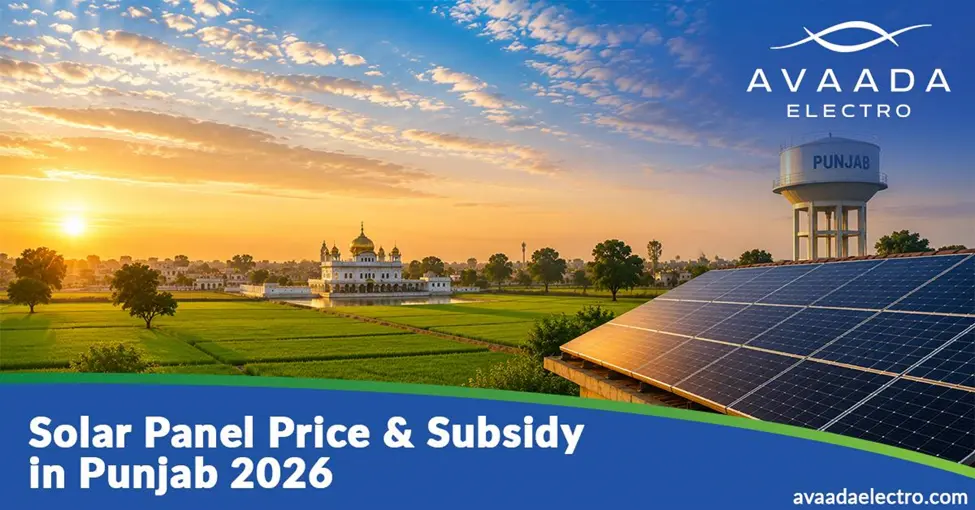
For households in Punjab, rooftop solar can reduce electricity purchases from the grid even when a home already benefits from the state’s free electricity provision. This is especially relevant for households whose consumption rises in summer because of air conditioners, coolers, and other appliances. Punjab’s residential tariff structure applies different charges based on consumption slabs, while rooftop solar can reduce the amount of electricity drawn from the grid.
Under the PM Surya Ghar: Muft Bijli Yojana, eligible residential consumers can also receive Central Financial Assistance (CFA) for rooftop solar. The scheme is available to households with a grid-connected electricity connection from the local DISCOM.
PM Surya Ghar Subsidy in Punjab
The Central Financial Assistance (CFA) is based on eligible rooftop solar capacity rather than a percentage of the final system price.
| System Capacity | Central Financial Assistance |
| Up to 2 kW | ₹30,000 per kW |
| Additional 1 kW from 2–3 kW | ₹18,000 |
| Above 3 kW | No additional CFA |
| Maximum CFA for an individual household | ₹78,000 |
Therefore, an eligible 1 kW system can receive ₹30,000, a 2 kW system can receive ₹60,000, and a 3 kW or larger system can receive the maximum CFA of ₹78,000. The PM Surya Ghar residential CFA guidelines prescribe the subsidy structure.
The subsidy reduces the upfront investment, but the final amount a homeowner pays depends on the vendor quotation, system specifications, roof structure, wiring, and other installation requirements.
Solar Panel System Price in Punjab
The government does not set a single retail price for a rooftop solar system. Prices vary based on module technology, inverter capacity, mounting structure, electrical work, roof conditions, and installation requirements.
For this reason, instead of presenting unsupported fixed price ranges, homeowners should obtain quotations from registered vendors and compare the total installed cost before subsidy with the eligible CFA.
The PM Surya Ghar framework requires the consumer to pay the balance amount to the empanelled vendor after the applicable subsidy/CFA is deducted following successful installation and verification by the State DISCOM.
When comparing quotations, check whether the price includes:
- Solar PV modules
- Inverter
- Mounting structures
- DC and AC cables
- Protection equipment
- Earthing and related electrical work
- Installation and commissioning
- Net-metering-related work, where applicable
- Applicable taxes and other charges
This approach gives a more realistic picture of the actual investment than comparing solar panel prices alone.
Does Punjab's Free Electricity Benefit Affect Rooftop Solar?
Punjab offers free electricity to eligible domestic consumers. PSPCL documents state that eligible consumers covered under the applicable scheme receive free electricity for the initial 300 units per month, subject to the scheme’s conditions.
For rooftop-solar consumers, PSPCL has also specified that domestic prosumers with monthly import consumption of up to 300 units can have a zero monthly bill under the applicable provision. Consumers importing more than 300 units are billed according to the relevant instructions and tariff provisions.
This means solar can still be useful for households with higher consumption. The financial benefit depends on how much electricity the system generates, how much is consumed directly in the home and how surplus electricity is settled under the applicable rooftop-solar regulations.
Net Metering for Rooftop Solar in Punjab
A grid-connected rooftop solar system can supply electricity to the household, while surplus generation can be exported or settled through the applicable metering arrangement.
Punjab’s rooftop solar regulations provide for net metering, net billing and gross metering arrangements. For domestic consumers, the permitted rooftop solar capacity can extend up to 100% of the sanctioned load or contract demand, subject to the applicable regulations and technical conditions.
PSPCL also currently directs consumers applying for subsidized rooftop solar to use the PM Surya Ghar National Portal.
Actual bill savings will depend on system generation, household consumption, import and export of electricity, applicable tariff provisions, and the settlement mechanism.
Choosing Solar Modules for a Punjab Rooftop
Module selection should go beyond the nameplate wattage. Homeowners should compare efficiency, rated output, warranty terms, certifications and compatibility with the proposed inverter and roof design.
High-efficiency modules can be particularly useful where roof space is limited because they can provide greater rated capacity within the available installation area.
For subsidized installations, consumers should also verify the applicable Domestic Content Requirement (DCR) and other program requirements before selecting modules. The PM Surya Ghar program operates under MNRE’s prescribed requirements for eligible residential systems.
Avaada Electro manufactures N-Type TOPCon solar cells and modules in India, with manufacturing facilities in Nagpur and Dadri. Its module range can be evaluated for residential, commercial and utility applications based on project capacity, available space and energy requirements.
How to Apply for Rooftop Solar Subsidy in Punjab
The process begins through the national PM Surya Ghar portal, not a separate subsidy application at PSPCL. PSPCL states that applications for subsidized solar systems can be submitted through the PM Surya Ghar National Portal.
- Register on the PM Surya Ghar Portal: Use your electricity connection details to register and submit the rooftop solar application.
- Complete the Required Feasibility Process: The concerned electricity distribution company processes the application. PSPCL’s rooftop solar procedures and applicable technical requirements determine the next steps.
- Select an Impaneled Vendor: Choose a registered vendor through the scheme process and compare quotations based on system capacity, modules, inverter, installation and other equipment.
- Install the Rooftop System: The selected vendor installs the system according to the applicable technical and program requirements.
- Complete Inspection and Metering: After installation, the DISCOM completes the required verification and metering process. PSPCL has also issued recent instructions concerning rooftop-solar applications and net-metering procedures for domestic consumers.
- Receive the Eligible CFA: Once installation and verification requirements are completed, the applicable CFA is processed under the scheme. MNRE states that the consumer pays the balance amount to the impaneled vendor after the system has been successfully installed and verified by the State DISCOM.
Solar Opportunity in Punjab
Rooftop solar is part of India’s broader expansion of distributed renewable energy. MNRE reported 164.59 GW of cumulative solar capacity as of 30 June 2026, including 30.77 GW of grid-connected rooftop solar.
The PM Surya Ghar program has also expanded rapidly. As of 22 July 2026, 39,72,447 rooftop solar systems had been installed across India, benefiting 48,02,717 households. More than 18.93 lakh beneficiaries had reported receiving zero electricity bills during at least one billing period, depending on their electricity consumption and system generation.
These figures show the growing adoption of rooftop solar, but an individual household’s financial outcome still depends on its electricity consumption, roof conditions, system size, and applicable Punjab electricity regulations.
Read Also: Types Of Solar Panels
Final Thoughts
A solar panel system in Punjab can complement the state’s free electricity provision by reducing grid imports, particularly for households with consumption above the applicable free-unit threshold. The PM Surya Ghar scheme provides eligible residential consumers with CFA of up to ₹78,000, while PSPCL’s rooftop-solar regulations provide the framework for grid-connected systems.
Rather than relying on a fixed system price, compare vendor quotations based on total installed cost, module technology, system capacity, warranty and applicable subsidy requirements.
Planning a rooftop solar installation in Punjab? Contact the Avaada Electro team to explore N-Type TOPCon solar modules and technical specifications for your project.
FAQs
Is the 300-unit free electricity provision available to every household in Punjab?
No, the 300-unit benefit depends on the eligibility conditions of the applicable Punjab government scheme. PSPCL’s tariff documents distinguish between eligible consumers and other domestic consumers.
Can I receive PM Surya Ghar subsidy if I already receive free electricity?
Eligibility for PM Surya Ghar depends on the scheme’s residential and grid-connection requirements. A free-electricity benefit does not, by itself, replace the PM Surya Ghar eligibility process.
Do I need to apply separately to PSPCL for the solar subsidy?
Submit subsidized rooftop-solar applications through the PM Surya Ghar National Portal. PSPCL confirms that you can apply for the subsidy through the national portal.
Is the ₹78,000 subsidy available for a 5 kW system?
Yes, an eligible residential system of 5 kW or more can receive the maximum central subsidy of ₹78,000. Installing 5 kW does not increase the central CFA beyond this limit.
Can rooftop solar eliminate my electricity bill completely?
Solar generation, household consumption, tariff rules, fixed charges and electricity settlement arrangements all affect the final bill. Under PM Surya Ghar, however, many beneficiaries have reported zero bills for some billing periods.
Can agricultural consumers use PM Surya Ghar for solar installations?
PM Surya Ghar is a residential rooftop-solar program. Agricultural solar applications, including solar pumps, fall under separate government programs such as PM-KUSUM and should be evaluated under their respective eligibility and subsidy rules.