
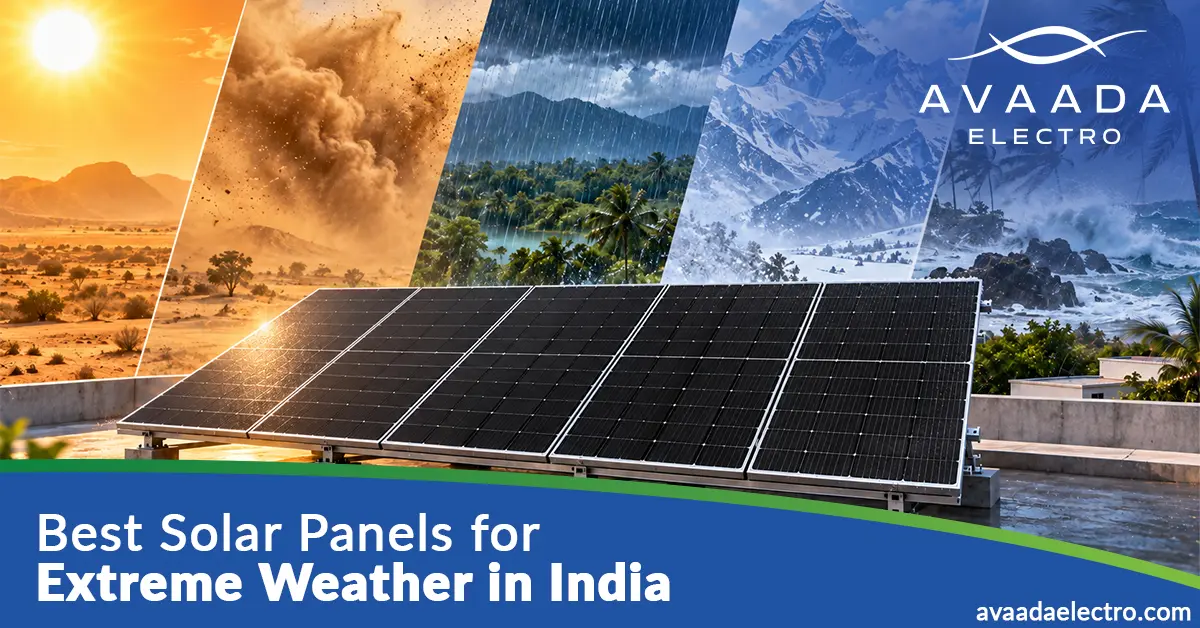
Can your solar installation withstand 48°C summer heatwaves, heavy monsoon downpours, coastal salt spray and winter fog without losing power generation? India presents some of the most diverse operating environments for solar power systems. Solar modules face high ambient heat, extreme ultraviolet exposure, dust accumulation and high humidity depending on the geography. India reached an installed solar capacity of over 164 GW by mid-2026, underlining the demand for weather-resilient solar modules. Choosing the best solar panels for harsh weather conditions helps commercial facilities, utility developers and homeowners protect their investment and maintain maximum energy yield.
Key Takeaways:
- Temperature coefficient determines how much power a panel loses as cell temperatures rise above 25°C.
- N-Type TOPCon modules maintain lower thermal degradation (-0.30%/°C) than monocrystalline PERC panels (-0.45%/°C) in high-heat environments.
- Glass-to-glass dual-sided encapsulation provides higher protection against salt mist, ammonia, sand and moisture ingress.
- Avaada Electro manufactures climate-resilient N-Type TOPCon modules with IP68 junction boxes and a 30-year linear performance warranty.
Understanding Solar Panel Performance in Extreme Weather Conditions
Weather conditions directly affect the conversion efficiency, electrical stability and physical durability of solar modules. Standard Test Conditions (STC) measure panel output at 25°C cell temperature, 1000 W/m² irradiance and 1.5 Air Mass. Field conditions across Indian regions frequently deviate from STC.
How Weather Impacts Solar Panel Efficiency & Lifespan
Ambient heat increases internal electrical resistance within solar cells, reducing voltage output. High humidity paired with temperature cycles accelerates Moisture Ingress and Potential-Induced Degradation (PID). Dust deposits block incoming light, causing soiling losses and localized thermal hotspots. Coastal salt spray degrades aluminium frames and structural connections if materials lack proper protective coatings.
Critical Performance Metrics for Extreme Weather
- Temperature Coefficient of Pmax: The percentage drop in power output for every 1°C increase in cell temperature above 25°C.
- Bifaciality Factor: The ratio of rear-side efficiency to front-side efficiency, allowing additional power collection from reflected ground light (albedo).
- Ingress Protection (IP) & Corrosion Ratings: Certifications validating resistance to water, dust, salt mist and ammonia exposure.
Temperature Coefficient & Other Key Metrics for Indian Climates
Temperature coefficient is a vital metric for evaluating solar panel efficiency in hot regions. Solar cell surface temperatures on a 40°C summer day in India often reach 65°C to 70°C.
Summer Performance Comparison (45°C Ambient, 70°C Panel Temp)
| Panel Type | Rated Efficiency | Summer Actual Yield | Temperature Coefficient | Estimated 25-Yr Degradation |
| Monocrystalline PERC | 22.0% | 17.8% | −0.45%/°C | ~15–18% |
| N-Type TOPCon | 23.5% | 19.4% | −0.30%/°C | ~8–10% |
| HJT (Heterojunction) | 24.0% | 19.9% | −0.28%/°C | ~6–8% |
N-Type TOPCon modules limit thermal loss far better than traditional P-type panels, maintaining higher energy generation during extreme summer heat.
Read Also: Types of Solar Panels
Best Solar Panels for Extreme UV & Heat Conditions
High ambient temperatures combined with high ultraviolet radiation severely stress module encapsulants and solar cells.
During peak summer months in western and northern India, surface panel temperatures rise up to 45°C above ambient levels. Standard monocrystalline PERC panels lose more than 18% power under such heat. N-Type TOPCon cells utilize phosphorus-doped silicon substrates, which prevent boron-oxygen defects and preserve voltage under extreme thermal stress.
Best Solar Panels for Dusty & Arid Environments
Dust deposition on solar modules creates a barrier that prevents sunlight from reaching the silicon cell.
Soiling losses in arid zones like Rajasthan and Gujarat can reduce annual energy yield by 15% to 25% without regular maintenance. Dust accumulation can also cause localized hotspots when unshaded cell areas operate at higher current levels than shadowed cells.
Avaada Electro addresses dusty environments with dual-glass module structures, anti-reflective front coatings, and IP68-rated split junction boxes. Our manufacturing facilities use automated robotic dry-cleaning systems to maintain production efficiency while reducing water usage by 93%.
Best Solar Panels for Low-Light & Cloudy Conditions
Low light intensity during rainy seasons, winter morning fog and heavy smog reduces output in standard solar panels.
N-Type TOPCon technology features a wide spectral response range. This enables the cell to absorb diffuse light during low-irradiance conditions, keeping systems operational during overcast monsoon days in South India and winter months in North India.
Best Solar Panels for Salt-Humidity & Weather Damage Resistance
Coastal regions expose solar power installations to persistent high humidity, moisture penetration and corrosive airborne salt.
Moisture penetration can compromise electrical isolation and accelerate mechanical degradation. Avaada Electro modules utilize POE/EPE encapsulants, semi-tempered dual glass (2.0 mm) and anodized aluminum alloy frames. Our TOPCon range holds IEC 61701 (Salt Mist Corrosion) and IEC 61716 (Ammonia Resistance) certifications, guaranteeing durability in harsh marine and agricultural locations.
Best Solar Panels for All India Climate Zones
Selecting the best solar panels in India requires matching module features with regional weather challenges.
| Climate Zone | Main Weather Challenge | Recommended Module Architecture | Core Selection Reason |
| North (Delhi, UP) | Extreme Heat + Winter Fog | N-Type TOPCon | Low temperature coefficient (-0.30%/°C) and superior weak-light performance |
| South (TN, Karnataka) | High Humidity + Moderate Heat | Glass-to-Glass TOPCon | High thermal stability with POE encapsulation to block moisture ingress |
| West (Gujarat, Rajasthan) | Dust Accumulation + Extreme Heat | Bifacial N-Type TOPCon | 80±5% bifaciality gains rear-side light from sandy albedo |
| East (WB, Northeast) | Heavy Rain + Diffuse Cloud Cover | N-Type TOPCon | Broad spectral absorption maintains power under diffuse light |
| Coastal Belts | Salt Spray Corrosion + Humidity | POE Glass-to-Glass TOPCon | Certified under IEC 61701 for maximum salt-mist resistance |
Final Thoughts
Operating solar power assets in extreme Indian climate conditions requires selecting panel architectures built for thermal resilience, dust exposure and high humidity. N-Type TOPCon technology outperforms traditional module types by delivering higher conversion efficiency, lower temperature degradation and superior low-light performance. Avaada Electro continues to lead solar technology advancements through integrated, renewable-powered manufacturing that supports clean energy transition goals.
Whether you are developing utility-scale solar projects, upgrading C&I rooftop capacity or installing residential systems, our technical team is ready to guide your selection.
Contact Avaada Electro today to request product datasheets, evaluate project specifications and secure high-efficiency TOPCon solar modules for your installations.