
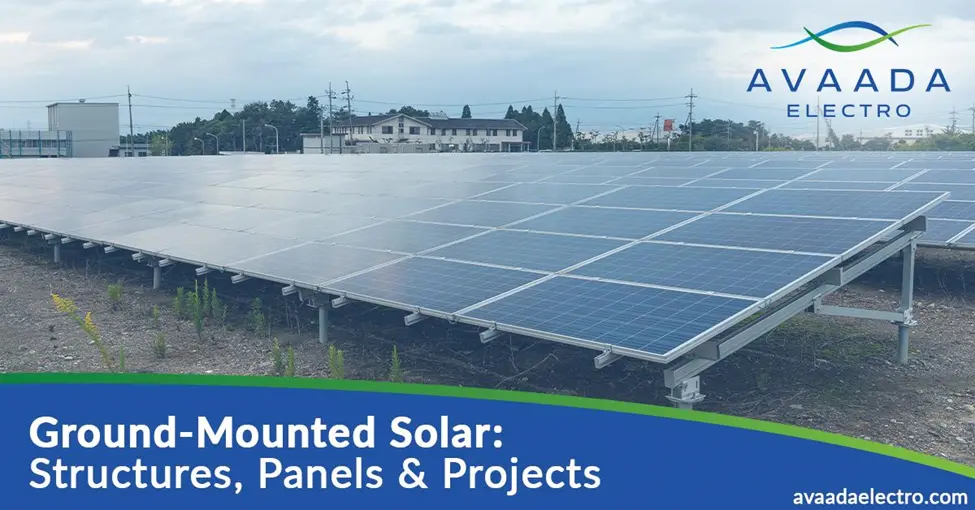
When rooftop space is not enough for a large solar installation, open land provides another way to build the required capacity. Ground-Mounted solar systems place photovoltaic modules on structures fixed to the ground, allowing developers to design the array around available land, solar exposure, electrical infrastructure and project requirements.
India’s current solar capacity makes the scale of this approach clear. As of 31 July 2026, India had 165.59 GW of installed solar capacity, including 122.57 GW from ground-mounted solar plants. Ground-mounted installations account for the largest share of the country’s installed solar capacity.
Understanding the structure, foundation, land requirements, module selection and project process can help developers assess whether a ground-based installation is suitable for a particular site.
What Is Ground-Mounted Solar?
A ground-mounted solar system consists of photovoltaic modules installed on metal structures anchored into the ground rather than fixed to a building’s roof. The structure supports the modules at a calculated height and tilt while allowing electrical cables and other equipment to be arranged around the site.
The approach is particularly relevant for utility-scale projects, solar parks, commercial and industrial installations, and decentralized projects under government programs. India’s PM-KUSUM scheme, for example, provides for 10,000 MW of decentralized ground- or stilt-mounted grid-connected renewable energy plants under Component A.
The National PM-KUSUM portal recorded 1,437.77 MW of installed capacity under Component A as of 31 May 2026, showing the growing role of smaller decentralized ground-mounted projects alongside large solar parks.
Read Also: Advantages of Solar Energy
Types of Ground-Mounted Solar Systems
The structure and movement mechanism determine how a ground-mounted array is positioned to capture available sunlight.
Fixed-Tilt Systems
Fixed-tilt structures hold modules at a predetermined angle throughout the year. They have a relatively simple mechanical arrangement because the modules do not move after installation.
The final tilt and row spacing should be determined through project-specific engineering based on the site’s latitude, shading conditions, module characteristics, wind loading and other design parameters.
Single-Axis Tracking Systems
Single-axis trackers rotate rows of modules along one axis during the day. This allows the modules to follow the sun’s movement and can increase energy production compared with a fixed orientation.
However, tracker selection depends on factors such as land conditions, project economics, wind conditions, terrain and maintenance requirements. A specific percentage gain should not be treated as universal because performance varies between projects.
Dual-Axis Tracking Systems
Dual-axis trackers can adjust the module position along two axes. They provide greater control over module orientation but involve additional mechanical components and control systems.
For this reason, the decision between fixed structures and tracking systems should be based on a project’s energy-yield assessment rather than generation gain alone.
Solar Ground Mounting Structure: Materials and Foundations
A solar ground mounting structure transfers module weight and environmental loads to the foundation. Its design must account for site-specific soil conditions, wind loads, module dimensions, row configuration and the expected operating life of the project.
Common Foundation Options
- Driven piles: Steel posts are driven directly into the soil using specialized piling equipment. The suitability of this approach depends on soil conditions and geotechnical results.
- Concrete foundations: Reinforced concrete foundations can be used where driven piling is unsuitable because of ground conditions or project requirements.
- Ground screws: Helical foundations can be considered for certain soil conditions and projects where reduced excavation is desirable.
- Ballasted systems: Concrete ballast can hold the structure in place without conventional deep foundations where site conditions and engineering requirements permit.
Always select a final foundation type after a geotechnical assessment, not from a general site rule.
Structural Standards
Structural calculations for solar mounting systems need to account for applicable Indian standards. IS 875 Part 3:2015 covers wind loads for buildings and structures, while BIS also maintains standards covering the design qualification and testing of photovoltaic modules.
The exact structural design should therefore be based on the project’s location, soil investigation and applicable engineering standards rather than a fixed wind-speed or foundation-depth assumption.
Ground-Mounted Solar vs Rooftop Solar
| Factor | Ground-Mounted Solar | Rooftop Solar |
| Available Space | Depends on suitable open land | Limited by usable roof area |
| Structure | Requires dedicated ground foundations | Uses the building’s roof structure |
| Orientation | Greater design flexibility | Influenced by roof orientation |
| Maintenance Access | Generally easier to access around the array | Access depends on the roof |
| Expansion | Easier where additional land is available | Limited by roof area |
| Project Scale | Suitable from decentralized to utility-scale projects | More commonly suited to building-based applications |
The choice depends on land availability, electricity requirements, structural conditions, project scale and grid connectivity.
How Much Land Does a Ground-Mounted Solar Project Need?
Land requirements vary by module efficiency, row spacing, terrain, orientation, technology, access roads, and electrical infrastructure. Therefore, do not apply a single acreage figure to every project.
For PM-KUSUM Component A, government guidelines state that a 1 MW project may require around 4–5 acres of land, with contiguous land of at least 5 acres preferred and proximity to a substation considered important.
Site selection should also consider:
- Availability of suitable and contiguous land
- Soil and geotechnical conditions
- Flood and drainage risks
- Shading from surrounding objects
- Road access for construction and maintenance
- Distance from the point of grid interconnection
- Applicable land-use and local approvals
Under PM-KUSUM Component A, plants can be installed on barren, uncultivable, pasture or marshy land. Agricultural land can also be considered under specified conditions, including elevated structures and sufficient spacing so agricultural activity is not affected.
How Is a Ground-Mounted Solar Power Plant Installed?
A ground-mounted solar power plant generally passes through several engineering and construction stages:
- Site assessment: The project team evaluates solar resources, land conditions, access and grid connectivity.
- Geotechnical investigation: The team assesses soil characteristics to determine an appropriate foundation design.
- Site preparation: The team completes necessary grading, drainage, and access works.
- Foundation installation: Piles, concrete foundations or another approved foundation system are installed.
- Structure assembly: Columns, rails and other structural members are assembled.
- Module installation: Ground-mounted solar panels are fixed to the completed structures.
- Electrical installation: DC strings, inverters, transformers and associated electrical systems are installed.
- Testing and grid connection: Complete electrical testing and required grid-compliance procedures before commissioning the plant.
Grid-connected projects must meet applicable technical requirements for safe and reliable grid integration. The Central Electricity Authority’s connectivity regulations establish technical requirements for systems connected to the electricity grid.
Read Also: How Do Solar Panels Work
Why Are Ground-Mounted Solar Panels Used for Large Projects?
Ground-mounted solar panels are particularly useful where a project requires substantial installed capacity and suitable land is available. Developers can design the module layout, row spacing, access paths and electrical infrastructure as part of the overall site plan.
India’s solar-park program was created partly to address the infrastructure challenges associated with scattered projects. Solar parks can provide developed land along with common infrastructure such as transmission facilities, roads, water, drainage and communication networks. The scheme generally considers solar parks of 500 MW and above, while smaller parks may be considered in locations where contiguous land is difficult to acquire.
Major Ground-Mounted Solar Projects in India
India’s large solar parks demonstrate how ground-mounted installations can operate at multi-gigawatt scale.
Pavagada Solar Park in Karnataka has an installed capacity of 2,050 MW and covers approximately 12,937 acres. The project became operational in December 2019 and was developed under the Government of India’s solar-park program.
Bhadla Solar Park in Rajasthan has a capacity of 2,245 MW and covers approximately 14,085 acres, according to the Rajasthan government’s investment-promotion material.
These projects illustrate why ground-mounted solar projects form such a large part of India’s installed solar capacity.
Choosing Modules for Ground-Mounted Projects
Module selection should be based on power output, efficiency, degradation characteristics, warranty terms, operating conditions and project economics.
Bifacial modules can be considered for ground installations because the rear side of the module can receive reflected and scattered light. However, the additional generation depends on factors such as ground reflectivity, module height, row spacing and site design. Therefore, do not assume a fixed percentage gain for every project.
For projects covered by India’s ALMM requirements, you also need to check module eligibility against the applicable rules. MNRE states that models and manufacturers included in ALMM List-I for solar PV modules are eligible for specified government, government-assisted, open-access and net-metering projects installed in India.
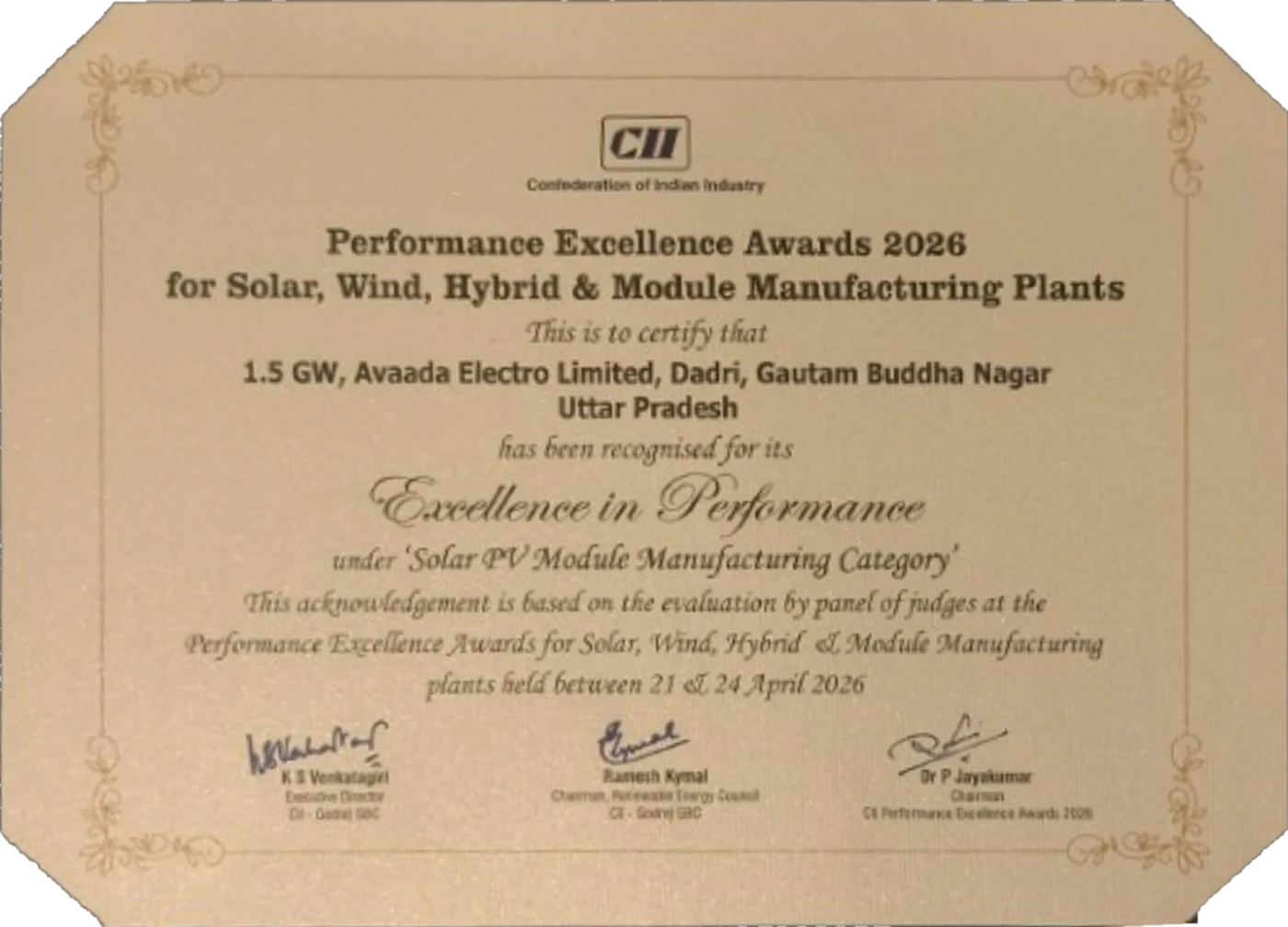
Avaada Electro manufactures solar PV modules for utility, commercial and other applications. Its product portfolio includes N-Type TOPCon modules designed for high-power solar installations.
For a ground-mounted project, assess module selection alongside the mounting structure, inverter configuration, land conditions, electrical design, and expected energy yield. This project-level approach helps determine whether a particular module technology suits the intended installation.
Conclusion
Ground-mounted solar projects have become a major part of India’s solar capacity, with 122.57 GW of ground-mounted capacity recorded as of 31 July 2026.
For a successful installation, developers need to evaluate land, soil conditions, foundation design, module technology, electrical infrastructure and grid connectivity together. Selecting suitable ground-mounted solar panels and a properly engineered ground-mounted solar power plant can help create a scalable solar asset suited to the site’s specific requirements.
Explore Avaada Electro’s efficient N-Type TOPCon and bifacial solar modules for reliable ground-mounted solar projects. Contact the technical team to find a module solution suited to your project’s capacity and site requirements.
FAQs
What is ground mount solar?
How much land is required for a 1 MW ground-mounted project?
Government guidelines for PM-KUSUM indicate that around 4–5 acres may be required for 1 MW, although actual requirements vary with the project design and site conditions.
What is a solar ground mounting structure made of?
Do ground-mounted panels produce more electricity than rooftop panels?
Not automatically. Ground-mounted systems can offer greater freedom in orientation, tilt and row layout, but actual generation depends on solar resource, shading, module technology, system design and operating conditions.
Are ground-mounted projects covered under ALMM?
Applicable projects must follow the current ALMM requirements. MNRE states that eligible models and manufacturers on ALMM List-I can be used for specified government, government-assisted, open-access and net-metering projects.