
Imagine investing millions in a utility-scale solar plant or installing solar modules on your home rooftop, only to find the panels cannot connect to the power grid because of missing compliance paperwork. Going through regulatory approvals and quality standards can feel complicated for project developers, facility managers and homeowners alike. Solar deployment across India continues to surge, with market analysts reporting near-record additions of 36.6 GW of solar capacity in 2025 alone. To ensure grid stability, consumer safety and return on investment, regulatory bodies require specific compliance standards before modules can be installed or exported.
What are ALMM, BIS & IEC Requirements for Solar Panels?
Quality standards verify that solar PV modules meet strict safety, durability and performance benchmarks under harsh field conditions. Knowing these definitions helps project owners buy certified hardware for their deployment needs.
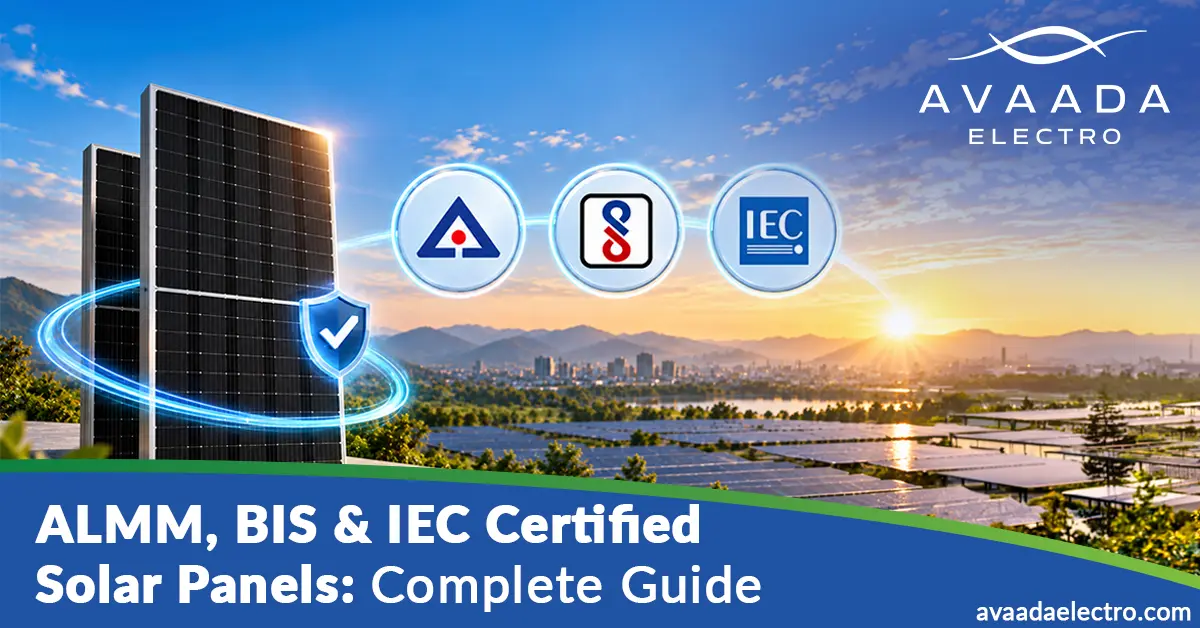
ALMM Certification Explained
The Approved List of Models and Manufacturers (ALMM) is a framework maintained by the Ministry of New and Renewable Energy (MNRE) under its ALMM Order. It acts as a non-tariff barrier to verify domestic manufacturing standards. Only modules listed under ALMM can be used in government-subsidized programs, open access projects and public sector tenders in India.
BIS Certification Explained
The Bureau of Indian Standards (BIS) enforces mandatory quality and safety testing for solar equipment under the Solar Photovoltaics, Systems, Devices and Components Goods Order. Any manufacturer selling solar panels in India must obtain BIS certification (primarily IS 14286 / IS/IEC 61215 for design quality and IS/IEC 61730 for safety).
IEC Standards Explained
The International Electrotechnical Commission (IEC) publishes international benchmarks for electrical technologies. Key certifications include IEC 61215 for design qualification, IEC 61730 for module safety, IEC 62804 for potential-induced degradation (PID) resistance and IEC 61701 for salt mist corrosion resistance. These testing standards are required for international supply contracts and global export markets.
Key Differences: ALMM vs BIS vs IEC
| Requirement/Framework | Scope | Primary Requirement | Market Reach | Testing Focus |
| ALMM | Government tenders, subsidy programs, utility projects | Required for MNRE-backed & open access projects | India only | Domestic manufacturing verification & traceability |
| BIS | Mandatory baseline quality & electrical safety | Mandatory for all modules sold in India | India mandatory | Physical durability, fire safety, electrical insulation |
| IEC | Global quality, performance and environmental testing | Mandatory for international trade & exports | Global | Severe weather, salt mist, ammonia, PID resistance |
Read Also: 3 Kilowatt Solar Panel Price
BIS-Compliant Solar Modules for Commercial & Institutional Projects
Commercial enterprises, hospitals, universities and industrial facilities deploy solar arrays to lower operating costs and meet clean energy goals.
Why Institutions Choose BIS-Certified Solar Modules
Institutional buyers require verified hardware to meet strict procurement policies, building safety codes and lender insurance criteria. BIS-compliant modules pass rigorous thermal cycling, humidity-freeze and mechanical load stress tests. This testing verifies that the panels can withstand extreme weather without structural or electrical failure.
Top BIS-Certified Manufacturers Serving Institutions in India
Institutions looking for top BIS-certified solar panel manufacturers for institutions turn to integrated domestic producers like Avaada Electro. Avaada Electro operates advanced manufacturing units in Dadri (Uttar Pradesh) and Butibori, Nagpur (Maharashtra). These facilities use advanced manufacturing and quality-control processes to produce solar cells and modules.
Read Also: How To Check Quality Of Solar Panels
Solar Modules Meeting IEC Standards for Export Markets
Global solar projects demand compliance with internationally recognized test standards to qualify for international project funding.
IEC Certification Requirements for Global Export
Exporters must obtain valid test reports from recognized testing or certification bodies, depending on the destination market, buyer and project requirements. International compliance requires:
- IEC 61215 / IEC 61730: Core design qualification and electrical safety testing for international project approval.
- IEC 62804: Verification of resistance to Potential-Induced Degradation (PID) under high voltage and humidity.
- IEC 61701 / IEC 61716: Testing for resistance to salt mist (coastal installs) and ammonia environments (agricultural installs).
Top IEC-Certified Manufacturers with Global Track Record
Project developers seeking the best certified solar modules for export markets rely on tier-one global suppliers. Avaada Electro’s applicable N-Type TOPCon module models are tested against relevant IEC standards, including IEC 61215 and IEC 61730, with additional environmental and reliability testing depending on the product. These products serve developers across the Middle East, Southeast Asia and international markets. Other major international exporters include global manufacturers like LONGi, JinkoSolar, Trina Solar and Canadian Solar.
ALMM Approved Solar Modules in India – Where to Get Them
Understanding the ALMM framework helps project developers comply with local content and procurement mandates set by government agencies.
Understanding the ALMM Approved List
The ALMM framework protects asset owners from substandard imports by validating domestic producers’ manufacturing facilities, operational capacity and raw material traceability. If a solar project receives central financial assistance (CFA) or sells power to state DISCOMs, it must exclusively use modules listed on the ALMM portal.
Where to Buy ALMM-Approved Solar Modules in India
If you are wondering where to get ALMM-approved solar modules in India, you can procure them directly from approved manufacturers like Avaada Electro. Buyers can verify which solar panels are on the ALMM-approved list by checking the official MNRE portal, which publishes updated lists of registered models and factory locations quarterly.
Avaada Electro - Certified Solar Module Manufacturer
Avaada Electro leads next-generation solar manufacturing in India by combining advanced engineering with complete quality compliance.
All Certifications Held by Avaada Electro
- BIS Certification: Fully compliant with IS 14286, IS/IEC 61215 and IS/IEC 61730 design and safety standards.
- ALMM Listing: Enlume and Integlow N-Type TOPCon module series are officially listed on the MNRE ALMM registry.
- IEC Standards: Certified under IEC 61215, IEC 61730, IEC 62804 (PID), IEC 61701 (Salt Mist), IEC 61716 (Ammonia) and IEC 60068 (Sand & Dust) by international testing agencies like TÜV Rheinland.
- Integrated Quality Management: Manufacturing facilities hold ISO 9001:2015, ISO 14001:2015 and ISO 45001:2018 certifications for quality, environmental and occupational safety management.
Why Choose Avaada Electro for Certified Solar Panels?
- High-Efficiency N-Type TOPCon Technology: Modules feature up to 23.60% efficiency, multi-busbar designs and low temperature coefficients (-0.30%/°C) for optimal output in hot climates.
- Bifacial Energy Gain: Glass-to-glass module designs deliver an 80±5% bifaciality factor, generating up to 30% additional power gain from rear-reflected light.
- Long-Term Performance Assurance: Backed by a 12-year workmanship warranty and a 30-year linear performance warranty limiting annual degradation to 0.40% after year one.
- Sustainable Manufacturing: Produced in facilities running on clean power, using robotic dry-cleaning systems and Zero Liquid Discharge (ZLD) processes.
Final Thoughts
Securing certified solar panels is the most reliable way to protect clean energy investments from premature degradation, safety risks and regulatory fines. Selecting modules backed by ALMM, BIS and IEC approvals ensures long-term energy generation for residential rooftops, commercial complexes and utility-scale power plants.
Avaada Electro continues to advance high-performance manufacturing standards, delivering engineered solar products to build a sustainable future.
Are you planning your next solar installation? Contact Avaada Electro’s technical specialists today to procure ALMM, BIS and IEC-certified solar modules for your utility, commercial or residential projects.