
Have you ever looked at a device in your house, seen a number printed on the back followed by a letter and wondered what that rating actually means for your home energy setup? Reading appliance manuals or solar quotes can be confusing when terms like kilowatts, units and power ratings are used interchangeably. If you are searching for “what is a kilowatt (KW)?”, it refers to a unit of electrical power that shows how quickly electricity is being consumed. Understanding what a kilowatt measures makes reading your electrical labels simple, helps you calculate true running costs and allows you to choose energy equipment with total confidence.
What is a Kilowatt (kW)?
A kilowatt (kW) is a unit used to measure electrical power. The prefix “kilo” means one thousand, so 1 kilowatt equals 1,000 watts. Power shows the rate at which electrical energy is being used at a given moment.
If you are still wondering “What are kilowatts?”, a simple way to understand this is to compare electrical power with the speed of a car. A speedometer shows how fast a car is moving at a particular time. Similarly, kilowatts indicate how quickly an appliance uses electrical power while running. An appliance with a higher kW rating generally places a greater load on the electrical system.
Read Also: Photovoltaic Cell
How Many Watts Are in a Kilowatt (kW)?
There are exactly 1,000 watts in 1 kilowatt. The conversion is simple:
- Watts to kilowatts: Divide the watt rating by 1,000. For example, a 1,500 W geyser equals 1.5 kW.
- Kilowatts to watts: Multiply the kW rating by 1,000. For example, a 2 kW water pump equals 2,000 W.
Small appliances may use only a fraction of a kilowatt. A 9 W LED bulb has a rated power of 0.009 kW, while a 1,000 W microwave has a rated power of 1 kW.
kW and kWh: Understanding Power and Energy
A kilowatt is a unit of power, not energy. Electrical energy is measured in kilowatt-hours (kWh). If you are asking “What is a kilowatt in relation to your electricity bill?”, it indicates the rate at which an appliance uses power. At the same time, kWh shows the total energy consumed over time. In India, electricity consumption on electricity bills is commonly expressed in ‘units’, where one unit equals one kilowatt-hour (kWh).
The relationship can be shown as:
Energy (kWh) = Power (kW) × Operating Time (hours)
For example, if a 1 kW appliance runs for one hour, it consumes 1 kWh or one unit of electricity. A 2 kW air conditioner running for three hours would consume 6 kWh or six units.
| Measurement | What it tells you |
| kW | How much power an appliance uses at a given time |
| kWh | How much energy it consumes over a period |
| 1 kWh | Equal to one unit of electricity |
This distinction is particularly useful when comparing appliance ratings with electricity consumption.
For example, consider a 2 kW water geyser used for two hours every day:
| Calculation | Result |
| Appliance rating | 2 kW |
| Daily usage | 2 hours |
| Daily consumption | 4 kWh |
| Monthly consumption (30 days) | 120 kWh |
| Cost at ₹7 per unit | ₹840 |
The actual amount paid can vary depending on the applicable tariff, fixed charges, taxes and other billing components.
Read Also: 1KW Solar Panel Price
Common Appliance Power Ratings
Different appliances have different power ratings. Heating and cooling appliances generally require more power than lighting and smaller electronics.
Appliance | Power Rating | Power in kW |
LED bulb | 9 W | 0.009 kW |
Ceiling fan | 70 W | 0.07 kW |
Refrigerator | 150–400 W | 0.15–0.4 kW |
Microwave/Mixer | 800–1,200 W | 0.8–1.2 kW |
1.5-ton air conditioner | 1,500–2,000 W | 1.5–2.0 kW |
Water geyser | 2,000 W | 2.0 kW |
The actual electricity consumption of an appliance can vary based on its usage pattern, settings, efficiency and operating cycle.
How to Calculate Your Electricity Usage
You can estimate the electricity consumed by an appliance in a few simple steps:
- Check the wattage: Look at the appliance label, manual or nameplate for its power rating.
- Convert watts to kW: Divide the wattage by 1,000.
- Estimate daily consumption: Multiply the power in kW by the number of operating hours per day.
- Estimate the cost: Multiply the resulting kWh by the applicable electricity tariff.
For example, a 1.5 kW appliance running for four hours consumes:
1.5 kW × 4 hours = 6 kWh
So, it uses six units of electricity during that period.
Using energy-efficient appliances and avoiding unnecessary operation can help reduce overall electricity consumption.
How Are Kilowatts Related to Solar Panel Generation?
Kilowatts and kilowatt-hours are both important when evaluating a solar power system. The capacity of a solar system is measured in kilowatts (kW), while the electricity it generates over time is measured in kilowatt-hours (kWh).
If you are wondering “What are kilowatts in a solar setup?”, a 5 kW solar system refers to its installed capacity, while the electricity it produces is measured in kWh. Knowing how many watts are in a kilowatt also makes it easier to understand the capacity mentioned in solar quotes. The amount of electricity that the system generates each day depends on factors such as sunlight availability, location, weather, system orientation, module efficiency and system losses.
This can be understood as:
Solar system capacity (kW) → Sunlight → Electricity generation (kWh)
A higher-capacity system can generate more electricity under comparable conditions, but actual generation depends on site conditions, system design and performance
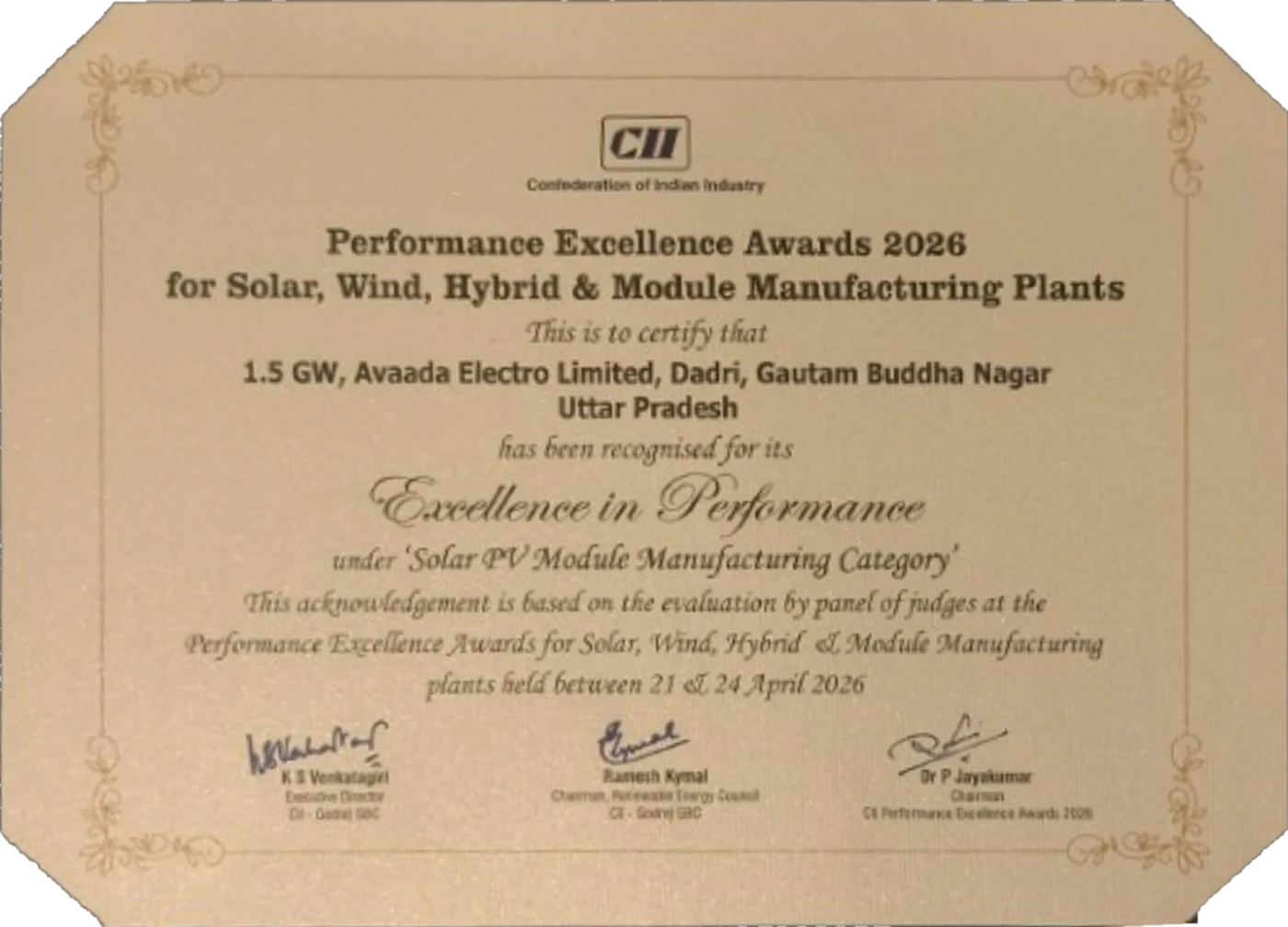
Avaada Electro manufactures N-Type TOPCon solar modules designed for high energy generation and long-term performance. Our manufacturing capabilities include facilities in Nagpur and Dadri, with integrated production and quality-control processes. Relevant quality and management certifications support the company’s modules and manufacturing operations.
For solar projects, selecting suitable module technology is important because module efficiency, system design, available installation space, and local conditions all affect the amount of electricity generated per kilowatt of installed capacity.
Conclusion
A kilowatt measures electrical power, while a kilowatt-hour measures energy consumption over time. Knowing the difference makes it easier to understand appliance ratings, estimate electricity use and assess the capacity required for a solar power system.
For solar installations, the right module technology and system capacity should be selected based on electricity requirements, available space, local conditions and expected energy generation. Avaada Electro’s N-Type TOPCon modules provide an option for projects seeking solar PV technology.
To explore Avaada Electro’s solar PV modules for your project, contact the team for product and technical information.
FAQs
How many kilowatt-hours does an average home consume per day?
Household electricity consumption varies considerably based on the number of occupants, appliances used, property size, weather conditions and usage habits. Homes using air conditioners, geysers or other high-power appliances generally consume more electricity than smaller households.
What appliances can run on 1 kilowatt of power?
A 1 kW power limit can support several low-power appliances, provided their combined power demand remains within the available capacity. For example, lights, fans and smaller electronic devices can be used together, while appliances such as geysers and air conditioners may require a significant share of that capacity.
What is sanctioned load in kW on an electricity connection?
Sanctioned load refers to the load approved for an electricity connection by the concerned distribution company. It represents the electrical load that the connection is permitted to support under the applicable terms.
Does a higher-wattage appliance always cost more to run?
No, running cost depends on both the appliance’s power rating and how long it operates. A high-wattage appliance used for a short period may consume less electricity than a lower-wattage appliance that runs continuously.
Does an appliance always draw its full rated power?
An appliance’s rated power indicates its specified electrical load, but actual consumption can vary during operation. Appliances such as inverter air conditioners and refrigerators can adjust their power use based on operating conditions.