
A rooftop solar installation may look like a collection of panels, but the way those panels are connected determines how the system produces and delivers electricity. If terms such as solar panel array, PV system, and photovoltaic array seem interchangeable, understanding the difference can make solar planning much easier. From the number of panels you need to the effect of shade and inverter selection, several factors determine whether a solar array is suitable for your home.
Solar Cell, Panel, Array and System: What Is the Difference?
Solar equipment is built in stages, with each level serving a different purpose:
- Solar cell: The basic photovoltaic unit. Silicon is one of the most widely used semiconductor materials in solar cells.
- Solar panel or module: Multiple solar cells are connected to form a larger electricity-generating unit.
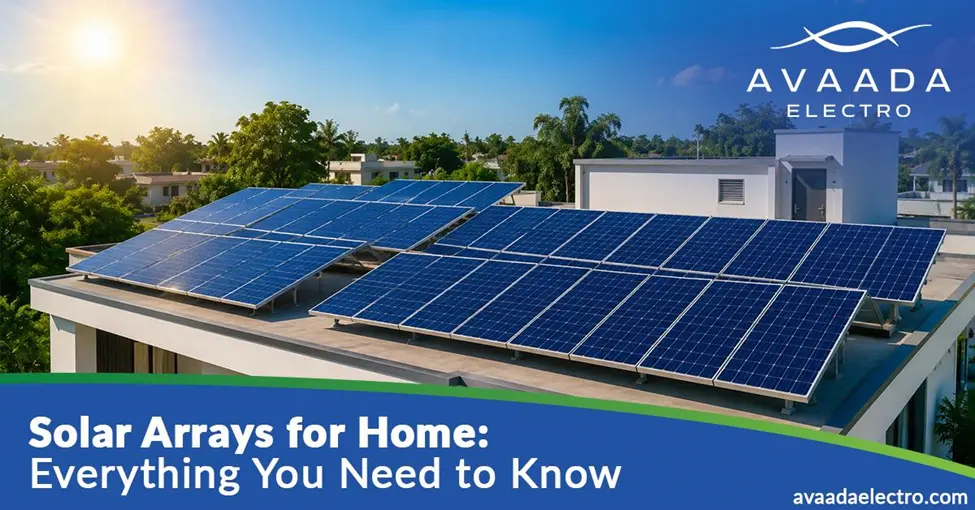
- Solar array: A group of photovoltaic modules connected electrically to form a larger PV generating unit.
- Solar PV system: The array works with an inverter, mounting structures, electrical protection, wiring and other balance-of-system components to supply usable electricity.
Cells generate electricity, panels group cells together, and a photovoltaic array combines multiple panels to provide the required power capacity.
Read Also: Photovoltaic Cell
Understanding a Solar Array
So, what is a solar array in practical terms? It is a group of photovoltaic modules connected to operate as a larger electricity-generating unit. The capacity of an array is determined by adding the rated capacity of its individual modules.
For example, eight 500 W modules would have a combined rated capacity of 4 kW under standard test conditions. The actual electricity produced during the day will vary with sunlight, temperature, shading, orientation, system losses and other operating conditions.
This modular design allows a solar array to be sized for different applications, from small residential installations to large utility projects.
How Does a Solar Array Work?
A solar panel array follows the same basic photovoltaic process as an individual module, but several modules work together to increase the available power.
- Sunlight reaches the cells: Photovoltaic cells absorb sunlight through semiconductor materials.
- Electric charges are released: Light energy transfers energy to electrons within the semiconductor.
- DC electricity is produced: The movement of these charges creates direct current.
- Panels deliver combined output: Electrical connections bring the output of individual modules together.
- The inverter converts the electricity: An inverter changes DC electricity into alternating current (AC) for use by household appliances and the electrical grid.
The electricity produced by the array can be consumed on-site, while grid-connected systems can export surplus generation to the grid in accordance with the applicable metering arrangement.
How are Solar Arrays Connected?
The electrical configuration of a photovoltaic array affects voltage, current, system design, and the installation’s response to shading.
Panels Connected in Series
When modules are connected in series, their voltages add while the current remains broadly tied to the string’s operating current. String-based designs are widely used in PV systems.
However, shading or a performance issue affecting one module can reduce the output of the affected string, with the extent of the impact depending on the module design, bypass diodes and system configuration.
Panels Connected in Parallel
Parallel connections increase the available current while maintaining the voltage of the connected circuits. The configuration can therefore be useful when the system design requires greater current at a particular voltage.
The exact series-parallel arrangement should be selected according to the module electrical characteristics and inverter specifications rather than simply the number of panels.
Microinverters and Panel-Level Optimisation
Microinverters operate at the individual module level. This allows each panel to operate independently, which can be useful where different parts of a roof receive different amounts of sunlight.
Read Also: What Are Kilowatts
What Size Solar Array Does a Home Need?
There is no single solar array size suitable for every home. The required capacity depends mainly on electricity consumption, available roof area, solar resource, shading, system design and the homeowner’s energy goals.
A simple starting point is to examine the electricity consumed during the previous 12 months. For example, a household using 4,800 units annually consumes an average of 400 units per month. The required PV capacity should then be estimated based on the expected generation at the property’s location, rather than assuming that every installed kilowatt will produce the same amount of electricity.
For a basic illustration:
Required capacity = Annual electricity requirement ÷ Expected annual generation per kW
Actual generation should be estimated using local solar conditions and a proper site assessment. A professional installer can also account for roof orientation, tilt, shading, inverter efficiency and other system losses.
How Many Panels Are Needed?
Once the required system capacity is known, the approximate number of modules can be calculated:
Number of panels = Required system capacity ÷ Individual panel capacity
For example, a 4 kW system using 550 W modules would require approximately:
4,000 W ÷ 550 W = 7.27
This means eight modules would provide 4.4 kWp of nominal module capacity. The final design, however, must follow the inverter’s electrical limits and the available roof area.
Is a Solar Array Suitable for Your Home?
A solar panel array can be considered for a home when several practical conditions are favourable.
1. Available Roof Space
The roof should provide enough usable area for the required number of modules, mounting structures and access space. Shading from trees, neighbouring buildings, parapets and rooftop equipment can affect generation.
2. Sunlight Exposure
A roof with good solar exposure can produce more energy than a heavily shaded roof. Site-specific solar assessment is therefore more useful than relying only on a generic annual generation figure.
3. Electricity Consumption
The size of the array should relate to actual electricity consumption. Reviewing recent electricity bills gives a better starting point than choosing a system based only on the available roof area.
4. Roof Condition
The roof should be structurally suitable for the proposed mounting system. If major roof repairs are expected soon, completing them before installation can prevent the need to remove and reinstall the modules later.
5. Grid Connection and Backup Requirements
A grid-connected PV system is designed differently from a battery-backed system. A standard grid-following inverter shuts down when grid power is unavailable, while systems designed for backup require appropriate grid-forming equipment and energy storage.
Avaada Electro Solar Modules
Avaada Electro manufactures N-Type TOPCon solar PV modules for residential, commercial and utility-scale applications. We have 8.5 GW of operational module capacity and manufacture modules at facilities including Dadri and Nagpur. It includes modules with up to 720 Wp of output and up to 23.18% efficiency.
For a home project, the module’s rated output is only one part of the selection process. Roof dimensions, shading, inverter compatibility, expected generation and local installation conditions should also be assessed before finalising the array design.
Conclusion
A solar array is the group of photovoltaic modules that forms the electricity-generating part of a PV installation. The right size depends on electricity consumption, usable roof area, sunlight exposure, shading, inverter specifications and future requirements. India’s growing rooftop market, supported by schemes such as PM Surya Ghar: Muft Bijli Yojana, makes accurate system planning increasingly important.
For projects requiring efficient modules, Avaada Electro offers N-Type TOPCon solar PV modules for residential, commercial and utility applications, with manufacturing facilities in India.
FAQs
What is a solar array made of?
A solar array consists of multiple photovoltaic modules electrically connected to provide a larger generating capacity. The modules themselves contain interconnected photovoltaic cells made from semiconductor materials such as silicon.
Is a solar array the same as a solar panel?
No, a solar panel or module is an individual electricity-generating unit made from interconnected solar cells. A solar array consists of multiple modules connected together.
How many solar panels are needed for a house?
The number depends on the required system capacity and the rated output of each module. Roof area, shading, electricity consumption and inverter limits also affect the final design.
Can a solar array work during a power cut?
A standard grid-connected system generally shuts down when grid power is unavailable. Battery-backed systems with suitable grid-forming equipment can provide electricity during outages.
Does shading affect the entire solar array?
The impact depends on the electrical configuration. Shading can reduce output from a string, while microinverters allow individual modules to operate more independently.
Can more panels be added later?
Additional modules can sometimes be installed if the inverter, electrical system, roof space and applicable approvals support the expansion. The existing system should be assessed before adding modules.