
Have you ever wondered why two solar installations occupying a similar physical area can produce different amounts of electricity on a scorching afternoon? When choosing solar panels, you may encounter different cell technologies and module designs, including monocrystalline and polycrystalline cells, as well as bifacial module configurations. These characteristics can affect efficiency, space requirements, energy yield and overall system cost. Every panel relies on silicon to turn sunlight into clean power, but different manufacturing methods create key trade-offs in output, space efficiency, temperature resilience and overall system cost. India’s cumulative installed solar capacity reached 168.04 GW as of 31 August 2026, according to the Ministry of New and Renewable Energy. During the first five months of FY 2026–27 (1 April–31 August), India added 17.78 GW of solar capacity. Understanding these differences helps developers, commercial enterprises and homeowners choose the right solar configuration for their ROI goals.
What is a Monocrystalline Solar Panel?
A monocrystalline solar panel uses solar cells made from a single silicon crystal. This structure allows the cells to convert sunlight into electricity efficiently. Most modern monocrystalline panels have efficiencies of around 19% to 22%, with newer N-type technologies offering higher efficiencies.
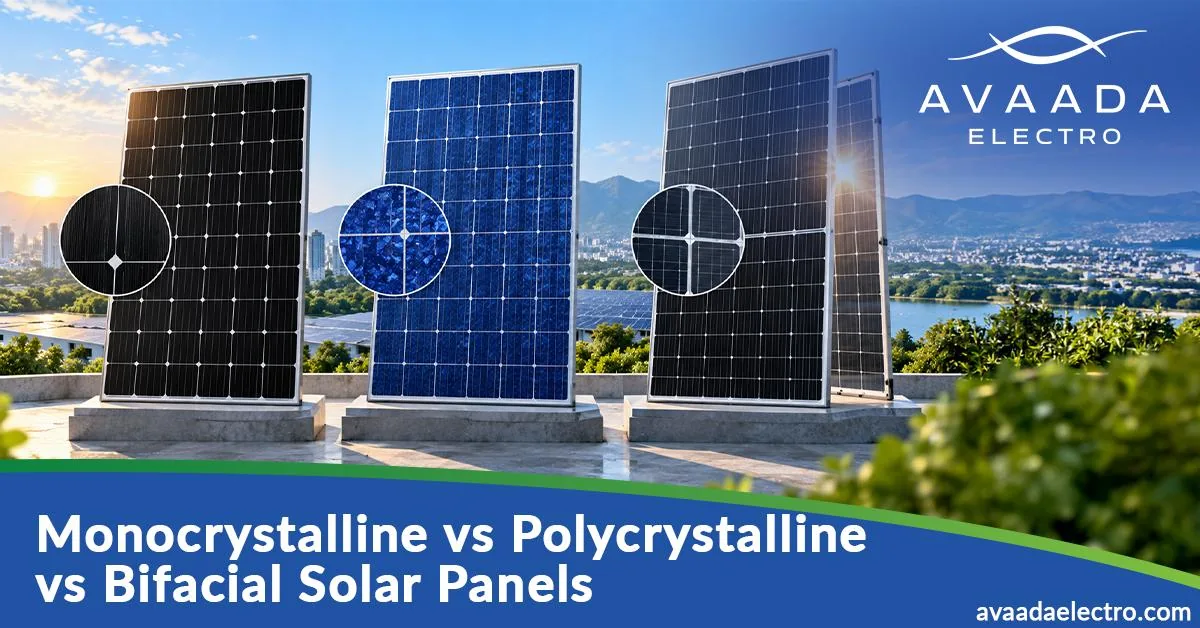
These panels generally have a uniform black appearance and produce more electricity per square meter than polycrystalline panels. This makes them suitable for rooftops with limited space.
What is a Polycrystalline Solar Panel?
A polycrystalline solar panel is made from multiple silicon crystals melted together to form the cells. This gives the panels their characteristic blue, speckled appearance.
Polycrystalline panels generally have lower efficiency than modern monocrystalline panels, so they may require more space to produce the same amount of electricity. They were widely used because of their lower manufacturing cost, but monocrystalline technology has become more common in newer installations.
What Are Bifacial Solar Panels?
A bifacial solar panel can generate electricity from both its front and rear sides. The front side captures sunlight, while the rear side can generate electricity from irradiance reaching the back of the module, including reflected and diffuse light.
Bifacial is a module design, not a separate type of solar cell. Most modern bifacial modules use high-efficiency monocrystalline cells. Their additional energy generation depends on factors such as installation height, surface reflectivity, panel spacing and mounting structure.
Also Read – Best Solar Panels in India
Difference between Monocrystalline, Polycrystalline and Bifacial Solar Panels
The main differences between these panels relate to efficiency, installation requirements and the conditions in which they can generate additional power.
Feature | Monocrystalline | Polycrystalline | Bifacial |
Efficiency | Around 19%–22%+ | Around 15%–17% | Similar to the underlying cell technology, plus rear-side generation |
Cost | Moderate to high | Generally lower | Varies; often higher for comparable specifications |
Roof Space | Requires less space for the same capacity | Requires more space for the same capacity | Similar to comparable monocrystalline modules |
Rear-Side Generation | No | No | Yes |
Appearance | Usually uniform black | Usually blue and speckled | Varies by cell and module design |
Common Applications | Residential and commercial rooftops | Legacy and budget-focused installations | Ground-mounted, commercial and suitable rooftop applications |
The difference between monocrystalline and polycrystalline solar panels is primarily related to how their silicon cells are manufactured. Monocrystalline cells are made from a single silicon crystal, while polycrystalline cells are formed from multiple silicon crystals.
Which Solar Panel Type Should You Choose?
The right panel depends on available space, the installation structure and your budget.
- For most Indian rooftops: Monocrystalline panels are a practical option because they offer high efficiency and good power output from limited roof space.
- For ground-mounted or commercial projects: Bifacial panels can be considered when the installation allows sufficient light to reach the rear side of the modules.
- For budget-focused installations with sufficient space: Polycrystalline panels may still be considered where they are available and where additional installation area is not a constraint.
Avaada Electro produces N-type TOPCon solar modules, including bifacial glass-to-glass modules rated up to 720 Wp.
Also Read – Solar Power Companies in India
Conclusion
Monocrystalline and polycrystalline describe solar-cell technologies, while bifacial describes a module configuration that can generate electricity from both sides. Each can suit different installation requirements. Monocrystalline panels offer high efficiency and suit rooftops with limited space. Polycrystalline panels can still be considered for certain budget-focused projects where space is available. Bifacial panels can provide additional generation when their rear side receives sufficient reflected light.
For an Indian rooftop, consider available space, local conditions, panel efficiency, installation structure, warranty and overall system cost before deciding. The panel technology should match the site, not efficiency or price alone.
Looking for the right solar module for your project? Contact the Avaada Electro team for product datasheets, technical specifications and project-specific guidance.
FAQs
Are bifacial solar panels monocrystalline or polycrystalline?
Bifacial refers to a module’s ability to generate electricity from both sides. Most modern bifacial solar panels use monocrystalline cells, including high-efficiency N-type technologies.
How can I tell monocrystalline and polycrystalline panels apart?
Monocrystalline panels generally have a uniform black appearance, while polycrystalline panels usually have a blue, speckled appearance because they use multiple silicon crystals.
Do monocrystalline panels perform better in high temperatures?
Panel performance in heat depends on the specific cell technology and its temperature coefficient. Modern N-type monocrystalline panels can offer favorable temperature performance, but check the module specifications before comparing.
Are polycrystalline solar panels still available in India?
Yes, although monocrystalline technology is now more common in new installations. Availability may vary by manufacturer and market.
Are bifacial solar panels suitable for home rooftops?
They can be suitable when the rear side receives enough reflected light. Their additional generation may be limited on rooftops where panels are installed close to an opaque or dark surface.
Which panel type is eligible for rooftop solar subsidy in India?
Subsidy eligibility depends on the applicable government scheme and its current technical requirements. For eligible residential rooftop projects, requirements relating to Domestic Content Requirement (DCR) and ALMM-listed modules may apply depending on the scheme and applicable guidelines. Check the latest MNRE and scheme-specific requirements before installation.
What is the difference between mono vs poly solar panels?
Mono vs poly solar panels differ mainly in cell construction, efficiency, appearance and space requirements. Monocrystalline panels generally offer higher efficiency and can produce more power from a given area, while polycrystalline panels generally have lower efficiency and may require more installation space for the same capacity.