
Energy demands across commercial, utility and residential infrastructure require continuous technical innovation. Solar power developers seeking maximum energy yield are shifting toward higher-efficiency cell structures. Standard PV technology is reaching its physical limits, driving industry adoption toward Tunnel Oxide Passivated Contact cells. This advanced architecture delivers higher power density and longer operational life. India added over 26 GW of solar capacity in the first half of 2026 alone, highlighting the critical need for long-term module performance. Understanding how N-Type TOPCon works helps developers, enterprises and homeowners choose the best solar panels in India for maximum return on investment.
Key Takeaways
- N-Type TOPCon avoids the boron-oxygen defect mechanism associated with conventional p-type silicon, helping reduce light-induced degradation and support strong long-term performance.
- Dual-sided light absorption yields up to 30% additional energy gain through an 80±5% bifaciality factor.
- Lower temperature coefficients (-0.30%/°C) maintain optimal power output under extremely high-temperature environments.
- Integrated automated manufacturing ensures full compliance with ALMM, BIS and IEC requirements for utility, C&I, and residential deployments.
Understanding N-Type TOPCon Technology
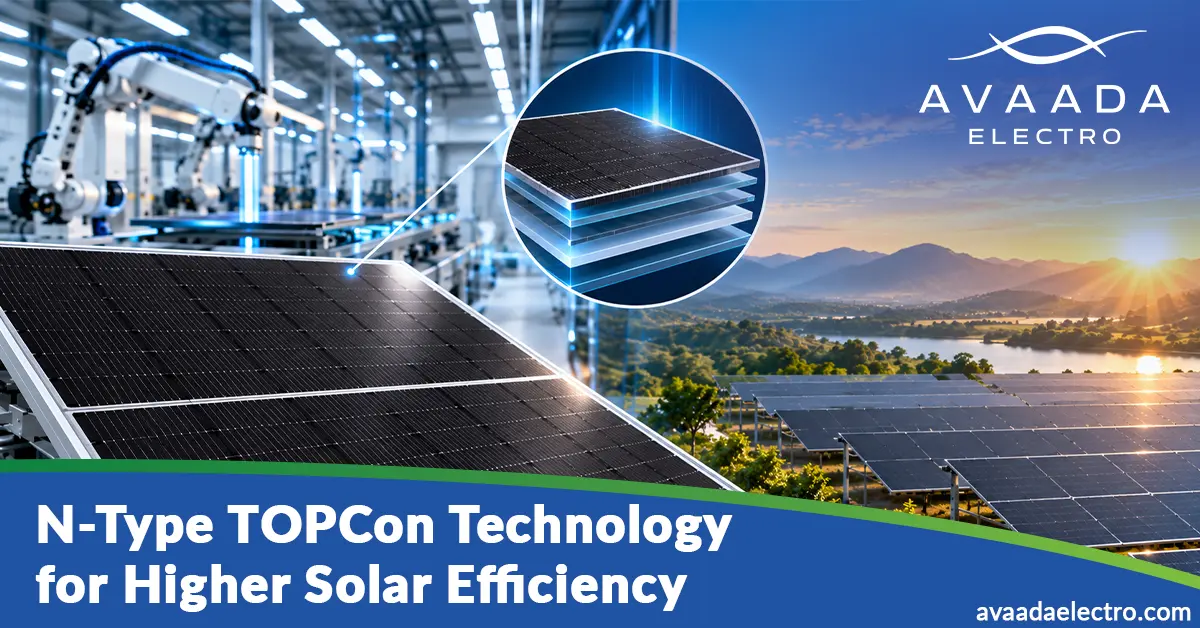
N-Type TOPCon (Tunnel Oxide Passivated Contact) is an advanced cell architecture designed to minimize electron recombination. Standard P-type wafers rely on boron-doped silicon, which reacts with oxygen to cause light-induced power loss. N-Type TOPCon uses phosphorus-doped silicon substrates instead.
The core innovation lies in a thin silicon oxide tunnel layer, followed by a polycrystalline silicon layer on the rear of the cell. This ultra-thin oxide layer acts as a physical barrier. It lets charge carriers pass through while preventing electron recombination at the contact points. As a result, the solar cell generates higher voltage and maintains higher conversion efficiency during operation.
Read Also: Best Solar Panels In India
Why the Industry is Moving Towards TOPCon
The commercial and technical limits of older cell architectures have accelerated TOPCon adoption across global manufacturing facilities.
Superior Efficiency
TOPCon cell structures deliver higher conversion efficiency than legacy designs. Avaada Electro maintains these efficiency gains across its product portfolio, achieving module efficiency levels up to 23.60%.
| Product Series | Cell Count | Maximum Output | Module Efficiency | Busbars |
| Integlow – M10L | 144 Cells | 610 Wp | 23.60% | 16 BB |
| Enlume – G12R | 132 Cells | 630 Wp | 23.30% | 16 BB |
| Enlume – G12 | 132 Cells | 720 Wp | 23.18% | 18 BB |
Better Performance in Hot Climates
High temperatures degrade solar panel output. Standard solar modules experience significant performance loss as ambient temperatures rise. Avaada Electro TOPCon panels feature a superior temperature coefficient of -0.30%/°C. This helps maintain stable power output during extreme summers, making TOPCon a reliable option for deployments in hot geographic regions.
Bifaciality and Energy Gain
N-Type TOPCon modules feature glass-to-glass construction, allowing light absorption from both sides. With a bifaciality factor of 80±5%, these modules generate up to 30% additional power gain from the rear side, depending on surface reflectivity (albedo).
Extended Lifespan
N-type silicon substrates eliminate Boron-Oxygen defects, preventing initial Light-Induced Degradation (LID) and Light- and Elevated Temperature-Induced Degradation (LeTID). Avaada Electro provides a 12-year workmanship warranty alongside a 30-year linear performance warranty. Degradation is limited to 1.0% in the first year and 0.40% annually from Year 2 to Year 30, keeping 87.4% of original power output intact.
Avaada's Implementation of N-Type TOPCon Technology
Avaada Electro manufactures high-efficiency N-Type TOPCon modules across its advanced manufacturing network. Our integrated production ecosystem includes operational facilities in Dadri (Uttar Pradesh) and Butibori, Nagpur (Maharashtra), alongside a new facility under development in Greater Noida (Uttar Pradesh).
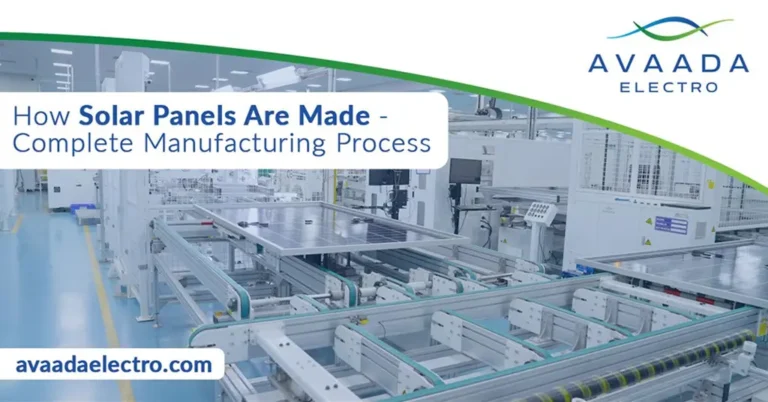
Our backward-integrated approach centralizes manufacturing from ingot and wafer production to cell and module assembly. Production lines feature automated AI defect detection, self-adaptive processing systems, split junction box designs (IP68) and a 16-second Takt time. These facilities run entirely on renewable energy and meet strict environmental and quality standards.
Applications of N-Type TOPCon Modules
The high power density and environmental durability of N-Type TOPCon modules suit a wide range of installation environments.
Utility-Scale Projects
High-wattage modules like the Enlume G12 (720 Wp) maximize output per square meter. High bifaciality and power capacity lower Balance of System (BOS) costs by reducing land, cabling, racking and inverter requirements. This significantly reduces the Levelized Cost of Energy (LCOE) for utility developers.
Commercial and Industrial (C&I) Rooftops
Commercial facilities, hospitals and industrial plants face space constraints. High-efficiency modules deliver greater power generation per unit area, helping businesses cut operating expenses, meet compliance mandates and achieve long-term sustainability goals.
Residential Systems
Homeowners seeking maximum energy output from constrained roof areas benefit from N-Type TOPCon technology. Superior weak illumination response ensures consistent energy production during overcast weather, early morning and late evening hours.
Cost, Pricing and Availability in India
N-Type TOPCon modules carry a slight initial price premium over legacy module designs due to advanced production requirements. However, this upfront cost is offset by higher total energy generation, lower installation overhead and extended asset longevity.
Avaada Electro modules meet ALMM, BIS and IEC requirements, ensuring full eligibility for government schemes, commercial PPAs and domestic grid connections. Localized, large-scale production ensures supply chain resilience and reliable delivery timelines for projects across India.
Read Also: Solar Cell Efficiency
Final Thoughts
The solar industry’s transition to N-Type TOPCon technology provides higher module efficiency, lower degradation and superior energy yields in challenging climates. As developer demands shift toward lower LCOE and long-term asset reliability, TOPCon has become the leading technology for scalable clean energy adoption. Avaada Electro continues to advance high-precision manufacturing to deliver durable solar solutions for India and global clean energy markets.
FAQs
What is N-Type TOPCon solar technology?
How is N-Type TOPCon different from older PERC cells?
Is N-Type TOPCon better than P-type solar panels?
What is the efficiency of N-Type TOPCon panels?
Are N-Type TOPCon panels bifacial?
Does N-Type TOPCon degrade slower than other panel types?
What is the price difference between TOPCon and older panels?
Is N-Type TOPCon suitable for residential rooftops?
Which certifications should an N-Type TOPCon panel have?
Look for ALMM, BIS, IEC (61215, 61730, 61701, 61716) and ISO quality standards (ISO 9001, ISO 14001, ISO 45001).