
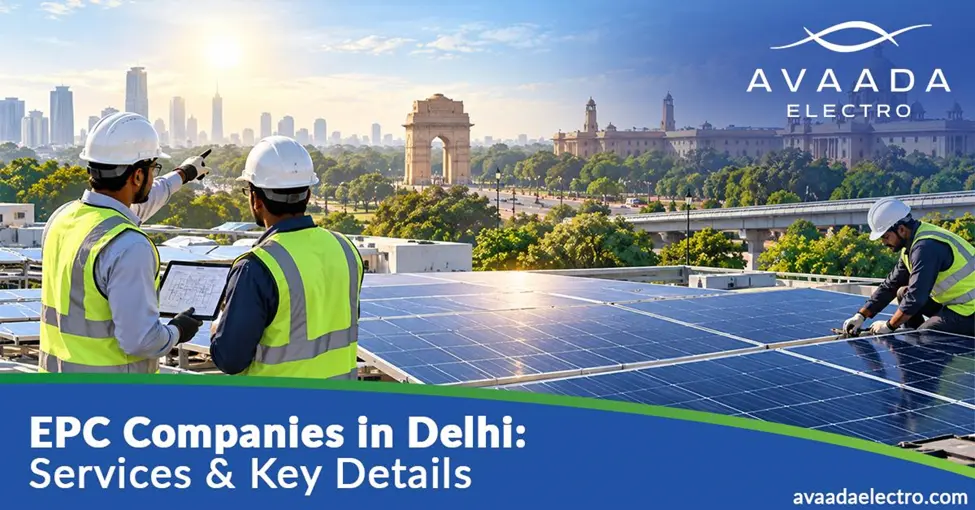
Planning a rooftop or ground-mounted solar project in Delhi NCR involves more than selecting modules and an installer. The right EPC partner should assess the site, design the system, source equipment, manage installation, coordinate electrical work and support commissioning. For commercial and industrial projects, the scope can also extend to open-access arrangements, Power Purchase Agreements (PPAs), operations and maintenance.
Delhi NCR is particularly important for solar EPC because projects across Delhi, Noida, Gurugram, Ghaziabad and Faridabad fall under different electricity utilities and state-level regulations. This makes local execution experience an important factor when comparing solar EPC companies in Delhi.
What Does a Solar EPC Company Do?
EPC stands for Engineering, Procurement and Construction. EPC companies manage multiple stages of a solar project instead of requiring customers to coordinate separate designers, equipment suppliers, electrical contractors and construction teams.
An EPC scope can include:
| EPC Stage | What It Covers |
| Engineering | Site survey, system sizing, electrical design, structural assessment and layout |
| Procurement | Solar modules, inverters, mounting structures, cables and protection equipment |
| Construction | Mounting, module installation, cabling, earthing and electrical work |
| Project Management | Scheduling, quality control, safety and coordination |
| Commissioning | Testing, synchronization, inspection and system handover |
| O&M | Monitoring, preventive maintenance and corrective maintenance |
The scope varies between providers. When comparing EPC companies in Delhi NCR, check whether each quotation covers the complete project lifecycle or only equipment supply and installation.
Why Choose a Solar EPC Company in Delhi NCR?
Choosing an EPC company with local experience can make solar project execution easier. Key advantages include:
- Local site expertise: Teams can assess rooftop space, shading, structural conditions and access requirements specific to Delhi NCR properties.
- Utility knowledge: EPC providers familiar with local DISCOM procedures can assist with grid connectivity, documentation and net-metering requirements.
- End-to-end execution: Engineering, procurement, installation, testing and commissioning can be managed under one project scope.
- Regional project experience: Providers with experience across Delhi, Noida, Gurugram, Ghaziabad and Faridabad can account for varying site and regulatory requirements.
- Post-installation support: Local availability can make monitoring, maintenance and issue resolution easier.
Businesses comparing EPC contractors in Delhi NCR should therefore assess local experience alongside technical capabilities, project execution and O&M support.
Top Solar EPC Companies in Delhi NCR
The following list focuses on EPC providers serving different residential, commercial and industrial requirements in the Delhi NCR market.
1. Avaada Electro
Avaada Electro is a solar PV manufacturing company within the Avaada Group. Our manufacturing facilities are located in Dadri, Uttar Pradesh and Nagpur, Maharashtra. The Dadri facility gives the company a manufacturing presence within the Delhi NCR region.
Avaada Electro manufactures N-Type TOPCon solar cells and modules, including bifacial module technologies for solar applications.
For C&I and larger projects, buyers evaluating Avaada Electro can assess its module specifications, power ratings, efficiency, warranties and certification requirements against the project’s technical design.
2. PowerMore
PowerMore focuses on commercial and industrial solar projects and offers rooftop, ground-mounted and open-access solar solutions. Its current offering includes both CAPEX ownership and zero-upfront OPEX/PPA models.
This makes it relevant for businesses evaluating solar as both an energy-generation asset and a long-term electricity-cost strategy. Its services also extend into battery energy storage for applications such as factories, hospitals, data centers and cold chains.
Businesses considering EPC contractors in Delhi NCR can compare PowerMore on factors such as engineering capability, project financing model, expected generation and long-term O&M support.
3. Jakson Group
Jakson has a substantial EPC presence across energy and infrastructure projects. Its solar EPC services cover design, procurement, construction, testing and commissioning.
The company has a particularly relevant Delhi NCR presence, with its headquarters in Noida and registered office in Jasola, New Delhi. Its published solar EPC portfolio includes projects at President’s Estate, DMRC, Shastri Bhawan and Yamuna Sports Complex in Delhi.
This mix of local presence and experience across rooftop and larger solar projects makes Jakson worth considering when comparing EPC companies in Delhi NCR.
4. Thermosun
Thermosun focuses on residential and smaller commercial solar installations. For customers installing smaller rooftop systems, the ability to manage documentation, installation and net-metering procedures can be as important as the module specifications.
For residential projects, customers should also check whether the EPC provider is currently impaneled under the applicable government rooftop-solar program and whether it can support the required subsidy process.
The PM Surya Ghar scheme provides Central Financial Assistance for eligible residential rooftop solar installations, subject to applicable scheme conditions.
5. Ishi Solar
Ishi Solar provides solar EPC, rooftop, on-grid and off-grid solutions along with O&M services. Its current portfolio shows projects across Delhi NCR, including installations at residential societies and institutional sites.
Its published projects include a 300 kWp installation at Ranjit Vihar in Dwarka, along with 60 kWp projects at Godrej Apartment and Himachal Pradesh CGHS in Dwarka.
Ishi Solar also states that it operates across Delhi NCR, including Delhi, Gurugram and Noida, as well as other NCR locations.
This makes local project experience particularly relevant for housing societies, residential communities and smaller C&I installations.
6. Tata Power Solar
Tata Power Solar provides end-to-end solar EPC services covering site design, sourcing, installation and commissioning, along with O&M services.
Its rooftop business serves residential as well as commercial and industrial customers. Tata Power reported that its Solaroof business crossed 1 GWp of rooftop installations during the first nine months of FY26, with its overall cumulative rooftop capacity exceeding 4 GWp at that time.
The company’s broader EPC portfolio also extends to large utility-scale projects. In December 2025, Tata Power announced the commissioning of a 1 GW solar project for SJVN in Rajasthan.
For buyers comparing EPC companies in Delhi NCR, Tata Power can therefore be evaluated across both distributed rooftop and larger solar project requirements.
Services to Compare Before Selecting an EPC Contractor
Choosing among solar EPC companies in Delhi NCR should begin with the complete project scope rather than the quoted price per kW.
Site Assessment and Engineering
The EPC team should assess roof condition, available area, shading, orientation, structural capacity and existing electrical infrastructure. For commercial projects, the assessment should also consider the facility’s load profile and daytime electricity consumption.
Equipment Selection
Ask for complete technical specifications of the proposed modules, inverters, mounting structures and electrical equipment.
For projects where ALMM requirements apply, verify the proposed module model and manufacturer against MNRE’s current Approved List of Models and Manufacturers.
Installation and Commissioning
The EPC contractor should clearly define responsibilities for mounting structures, DC and AC cabling, earthing, protection systems, testing and commissioning.
DISCOM Coordination
Ask whether the EPC quotation includes support for technical feasibility, documentation, inspection, net-metering and grid synchronization. The exact process depends on the applicable utility.
O&M Support
Solar projects are long-term assets. Compare preventive-maintenance schedules, monitoring, cleaning, response times, equipment replacement procedures and warranty support before signing the contract.
How to Select the Right Solar EPC Company in Delhi NCR
- Check Local Experience: Ask for completed projects in Delhi, Noida, Gurugram, Ghaziabad and Faridabad. Experience with similar roof types, project capacities and electricity utilities can be useful.
- Verify Equipment Compliance: Check ALMM eligibility where applicable, BIS requirements, module warranties, inverter certifications and technical datasheets before approving the equipment list.
- Compare the Complete EPC Scope: A lower quotation may exclude structural work, cable upgrades, monitoring equipment, approvals or O&M. Compare quotations line by line instead of focusing only on the price per kW.
- Review Generation Estimates: Ask how annual generation has been calculated. The estimate should account for location, system size, orientation, shading, module characteristics, temperature and expected system losses.
- Examine Warranty and O&M Terms: Review module product and performance warranties separately from inverter, workmanship and O&M terms. Also check response times, preventive-maintenance schedules and the process for handling equipment failures.
Residential vs Commercial Solar EPC in Delhi NCR
Residential systems generally have smaller capacities and may qualify for applicable government incentives. The PM Surya Ghar scheme provides Central Financial Assistance for eligible residential rooftop solar installations subject to the scheme’s conditions.
Commercial and industrial systems usually require more detailed electrical and structural planning. Businesses may choose a CAPEX model, where the customer owns the solar asset or an OPEX/PPA or RESCO model, where a third party owns and operates the system under an electricity-purchase arrangement. BYPL’s published rooftop-solar information describes both CAPEX and RESCO models.
Final Thoughts
Choosing among the solar EPC companies in Delhi requires more than comparing installation prices. Engineering capability, local utility experience, equipment compliance, project execution, warranties, generation estimates and O&M support can all affect the long-term performance of a solar project.
The same considerations apply when evaluating EPC companies in Delhi NCR, particularly for projects spanning different cities and utility jurisdictions. Customers should verify the provider’s experience in the exact location where the solar system will be installed.
Planning a commercial, industrial or utility-scale solar project in Delhi NCR? Contact the Avaada Electro team for product specifications and technical guidance tailored to your project requirements.
FAQs
What does an EPC contractor do?
An EPC contractor manages key stages of a solar project, including engineering, procurement, construction, testing and commissioning. The exact scope depends on the contract.
How do I choose between solar EPC companies in Delhi?
Compare their local project experience, engineering capabilities, equipment specifications, DISCOM experience, warranties, generation estimates, O&M services and total project cost.
Do EPC contractors in Delhi NCR handle net metering?
Many providers offer support for documentation and utility procedures, but the exact scope should be confirmed in the EPC contract. Delhi’s DISCOMs maintain their own rooftop-solar procedures.
Is CAPEX or OPEX better for commercial solar?
CAPEX involves purchasing and owning the solar asset, while OPEX/PPA models generally involve a third party financing or owning the system and selling the generated electricity under an agreed arrangement. The appropriate model depends on capital availability, ownership preference, electricity consumption and contract terms.
Are TOPCon modules suitable for C&I projects?
TOPCon modules can suit C&I projects where high power output and efficient use of available roof area are important. However, the final choice should consider the complete system design, module specifications, inverter compatibility, warranties and project economics.