
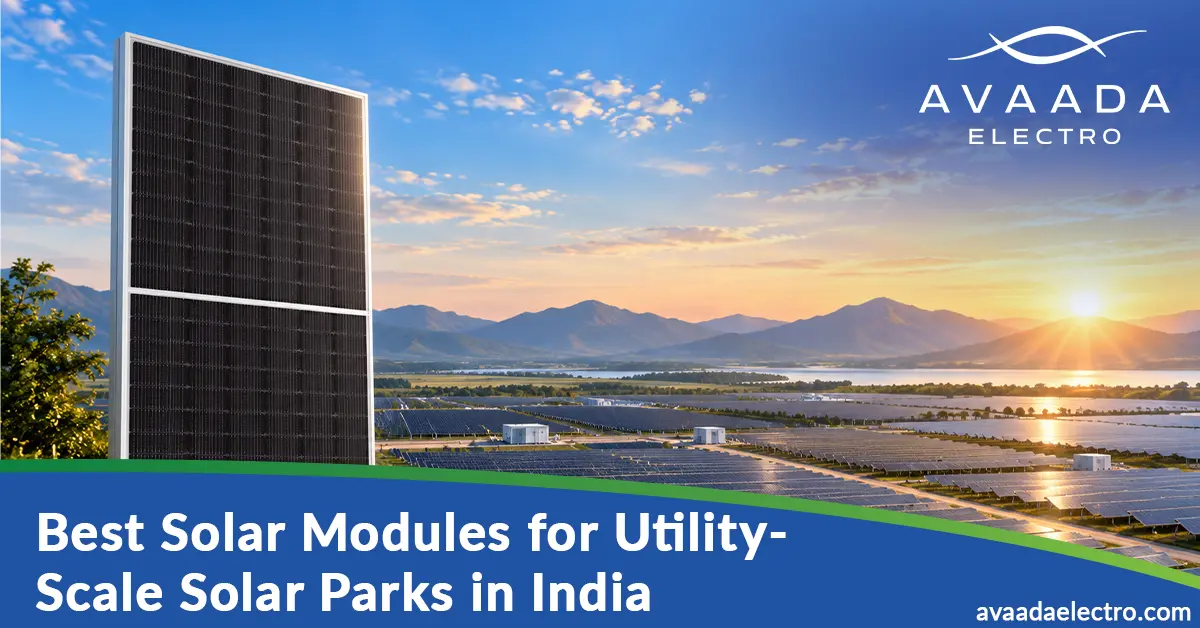
Imagine deploying thousands of solar panels across desert acres, expecting reliable daily power, only to watch energy output drop under extreme summer heat. Selecting the right technology for utility-scale solar installations directly dictates project financial returns over a 30-year lifecycle. According to recent industry research by JMK Research & Analytics, India installed approximately 19 GW of utility-scale solar capacity in the first half of 2026 alone, marking a 32 percent year-over-year increase. Large-scale projects require hardware engineered to maximize power density, lower installation costs and resist extreme environmental degradation.
What are Utility-Scale Solar Modules?
Utility-scale solar modules are heavy-duty photovoltaic panels specifically designed to generate massive electric power for direct grid feed-in. Unlike standard residential units, these large-format modules range from 585 Wp to 720 Wp per panel to maximize energy yield over vast land areas.
These modules feature higher system voltage ratings (1500 VDC) to enable longer panel strings, reducing overall cabling and balance-of-system costs. Utility-grade modules must withstand high mechanical loads, extreme temperature swings and continuous high-current operation over decades of field service.
Types of Solar Modules for Utility-Scale & Mega Parks
Selecting the right cell architecture affects land use and long-term generation capacity for power plant developers.
Monocrystalline Modules
Standard monocrystalline silicon modules are reliable baseline options for utility solar projects. Built with single-crystal silicon, p-type PERC monocrystalline panels offer module efficiencies around 20% to 21.5%. However, traditional P-type PERC technology is approaching its physical efficiency ceiling, driving utility developers toward advanced cell options.
Bifacial Monocrystalline Modules
Bifacial monocrystalline modules absorb sunlight from both the front and rear glass surfaces. By capturing light reflected from the ground (albedo), bifacial panels produce up to 30% additional energy compared to monofacial panels. Dual-glass construction also provides superior protection against moisture and mechanical strain in open-terrain deployments.
TOPCon (N-Type) Modules
N-Type TOPCon (Tunnel Oxide Passivated Contact) represents the premier cell architecture for modern utility power plants. By substituting boron-doped wafers with phosphorus-doped silicon, TOPCon modules completely eliminate light-induced degradation (LID) defects. These modules deliver efficiency rates up to 23.60% and maintain superior temperature coefficients, ensuring optimal energy output in hot regions.
HJT (Heterojunction) Modules
Heterojunction (HJT) modules combine thin-film amorphous silicon with crystalline silicon wafers. While HJT offers high cell efficiency and low temperature coefficients, its higher production costs make it less common for multi-gigawatt solar park procurements than TOPCon.
Read Also: Bifacial Solar Modules
Solar Module Specification & Performance Comparison Table
Utility power plant engineering teams evaluate specific mechanical, thermal and electrical metrics before selecting hardware suppliers.
Specification Metric | Standard Monocrystalline PERC | Bifacial Monocrystalline PERC | N-Type TOPCon (Bifacial) |
Module Efficiency Range | 20.0% – 21.5% | 21.0% – 22.0% | 22.5% – 23.6% |
Max Power Output | 540 Wp – 600 Wp | 550 Wp – 650 Wp | 585 Wp – 720 Wp |
Bifaciality Factor | Monofacial (0%) | 70% ± 5% | 80% ± 5% |
Temperature Coefficient (Pmax) | -0.35% / °C | -0.35% / °C | -0.30% / °C |
First Year Degradation | ~2.0% | ~2.0% | 1.0% |
Annual Degradation (Yr 2-30) | ~0.55% | ~0.55% | 0.40% |
Efficiency Ratings, Lifespan and Durability Standards
High-efficiency panels generate more megawatt-hours per acre, minimizing land acquisition and racking requirements. Avaada Electro’s N-Type TOPCon panels offer a 30-year linear performance warranty guaranteeing 87.4% retained power output at Year 30.
Module Certifications Required for Utility-Scale Projects
Utility-scale modules must possess strict safety, quality and grid-compliance certifications. Essential standards include BIS certification (IS 14286 / IS/IEC 61730), ALMM enlistment and international TÜV Rheinland certifications (IEC 61215, IEC 61730). Environmental tests such as IEC 61701 (Salt Mist Corrosion) and IEC 61716 (Ammonia Resistance) are mandatory for harsh-terrain deployments.
Best Solar Modules for Mega Solar Parks - Lowest Cost of Energy (LCOE)
Mega solar park projects exceeding 1,000 MW focus primarily on minimizing the Levelized Cost of Energy (LCOE).
Module Type | Efficiency | Cost Per Watt | 30-Year Retained Power | LCOE Ranking | Best Use Case |
N-Type TOPCon Bifacial | 22.5% – 23.6% | Competitive | 87.4% | Rank 1 (Lowest LCOE) | Mega Solar Parks & Utility Power Plants |
P-Type PERC Bifacial | 21.0% – 22.0% | Lower Upfront | ~83.0% | Rank 2 | Standard Ground-Mounted Solar Farms |
Standard Monofacial PERC | 20.0% – 21.5% | Lowest Upfront | ~80.0% | Rank 3 | Space-Unconstrained Flat Ground Sites |
Which Solar Modules Deliver the Lowest Cost of Energy (LCOE)?
N-Type TOPCon bifacial modules rank highest for achieving the lowest LCOE. Higher wattage ratings (such as 720 Wp) drastically reduce Balance of System (BOS) expenses. Developers spend less per megawatt installed on steel mounting structures, DC cabling, combiner boxes and civil works.
How to Choose the Right Solar Module for Your Project
Selecting hardware for multi-megawatt facilities requires systematic technical evaluation across six main factors.
6-Step Selection Guide
- Assess Site Climate: Match temperature coefficients to local heat patterns.
- Evaluate Ground Reflectivity (Albedo): High reflective ground (sand or light soil) justifies high bifaciality panels (80±5%).
- Calculate BOS Savings: Model how ultra-high-power modules (600Wp–720Wp) reduce racking and inverter counts.
- Verify Degradation Guarantees: Ensure long-term performance warranties match project debt terms.
- Check Supply Chain Integration: Select vertically integrated manufacturers to prevent delivery delays.
- Confirm Mandatory Certifications: Ensure ALMM, BIS and IEC compliance for immediate grid connection.
Read Also: How Do Solar Panels Work
Best Solar Modules for Hybrid Solar-Wind Projects
Hybrid solar-wind sites demand panels that handle fluctuating solar irradiation and high mechanical stress from wind gusts. Robust glass-to-glass TOPCon modules with IP68 split junction boxes offer superior durability and continuous power delivery for grid balancing.
Why Choose Avaada Electro for Utility-Scale Module Supply?
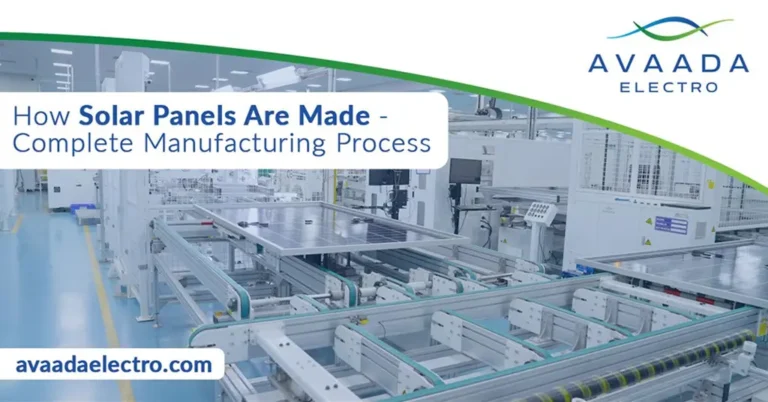
Avaada Electro operates world-class automated production lines powered by 100% green energy. Operating key facilities in Dadri (1.5 GW) and Nagpur (7 GW operational module capacity), our manufacturing hubs feature self-adaptive production lines running at a Takt time of 16 seconds. Backed by an integrated value chain spanning ingot, wafer, cell and module production, Avaada Electro guarantees quality, scale and supply reliability.
Our flagship product line includes the Enlume G12 series, delivering up to 720 Wp power output and 23.18% module efficiency, making it a high-power option for utility-scale and mega solar projects. All facilities maintain Quality Management (ISO 9001:2015), Environmental Management (ISO 14001:2015) and Occupational Health and Safety (ISO 45001:2018) standards.
Final Thoughts
Choosing high-efficiency solar modules shapes the financial success of large power plants. High power density, low thermal degradation and robust bifacial gains make N-Type TOPCon technology the preferred solution for utility deployments. Developers can achieve superior LCOE and long-term grid stability by investing in advanced, certified module technologies.
Ready to optimize your utility solar project or mega solar park with certified, high-efficiency TOPCon modules? “Powering the Future with Advanced Solar Manufacturing” starts with proven engineering excellence. Contact Avaada Electro’s utility technical team today to discuss procurement schedules, technical specifications and custom project solutions.