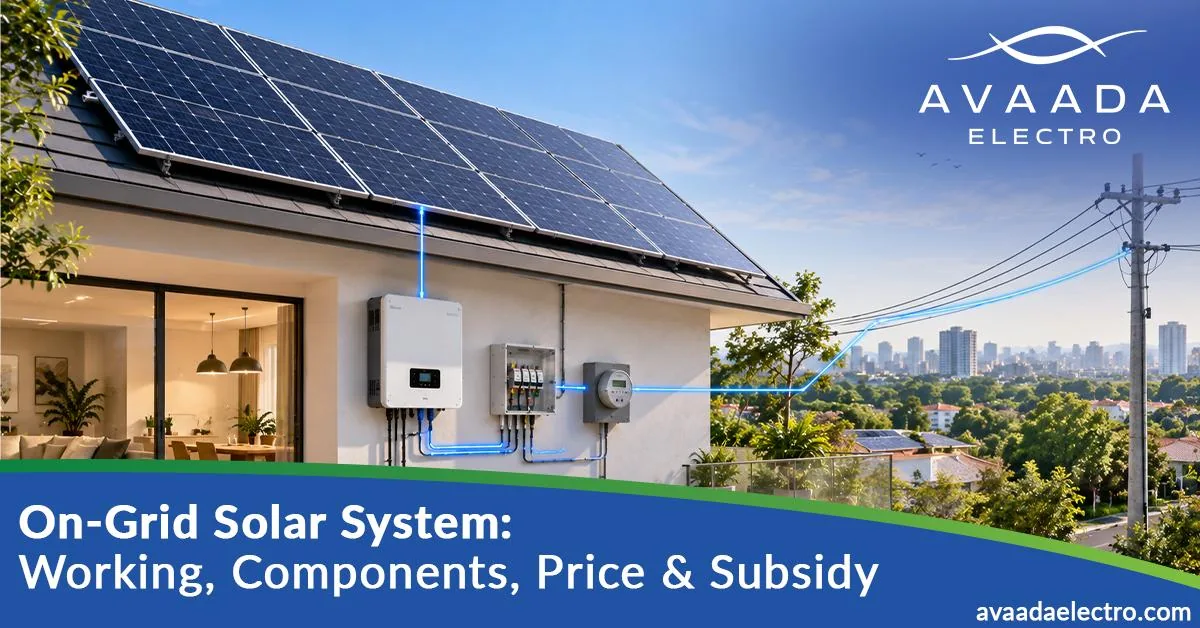

Electricity bills have been climbing year after year, and for most Indian households, the 3 kW solar panel system hits the sweet spot. It is powerful enough to run a 2–3 BHK home fans, lights, refrigerator, washing machine, and even a 1.5-ton AC yet affordable enough to pay itself back in under 5 years.
With the PM Surya Ghar Muft Bijli Yojana subsidy now covering up to ₹78,000 for a 3 kW solar system setup, the post-subsidy cost has dropped to roughly ₹82,000–₹1.07 lakh. That makes this one of the highest-ROI home investments available today.
In this guide, you will find the complete 3 kilowatt solar panel price in India and 3 kilowatt solar system price breakdown component by component along with subsidy details, monthly savings estimates, payback data, and a step-by-step installation walkthrough.
3 kW Solar Panel System: Key Specifications, Cost & Return on Investment
Parameter | Details |
System Capacity | 3 kW (kilowatts) |
No. of Panels | 4-5 panels (630–720 Wp) |
Daily Generation | 16–20 units (kWh) |
Space Required | ~270–300 sq. ft. of rooftop |
Price (Before Subsidy) | ₹1.6 lakh – ₹2.15 lakh |
PM Surya Ghar Subsidy | Up to ₹78,000 (for residential 3 kW) |
Net Price (After Subsidy) | ₹82,000 – ₹1.07 lakh |
Monthly Savings | ₹4,000 – ₹5,000 |
Payback Period | 3.5 – 4.5 years |
System Lifespan | 30+ years |
3 kW Solar System Price in India
The overall 3kW solar panel price in India sits between ₹1.6 lakh and ₹2.15 lakh before any government support. Factor in the PM Surya Ghar subsidy, and the net outlay drops significantly making it one of the most financially rewarding home upgrades available.
3 kW Solar System Price and Subsidy Table
System Type | Cost (Before Subsidy) | Subsidy | Net Cost (After Subsidy) | Perfect For |
On-Grid | ₹1.6 – ₹1.8 lakh | ₹78,000 (max limit) | ₹82,000 – ₹1.02 lakh | Homes with stable grid power |
Hybrid (with Battery) | ₹2.1 – ₹2.3 lakh | ₹78,000 (solar portion only) | ₹1.32 – ₹1.52 lakh | Homes with frequent power cuts |
Off-Grid | ₹2.4 – ₹2.6 lakh | Not eligible | ₹2.4 – ₹2.6 lakh | Remote / rural areas |
The 3kw hybrid solar system price in India reflects the added cost of a hybrid inverter and battery-ready wiring — a worthwhile investment for households dealing with frequent outages.
3 kW Solar System Price by State
Installation costs vary by state due to differences in DISCOM charges, local labour rates, and logistics. Here is a general range across key states for 3kw solar system for home price in India:
State | Approx. Cost (Before Subsidy) | Net Cost (After Subsidy) | Key Note |
Gujarat | ₹1.60 – ₹1.75 lakh | ₹82,000 – ₹97,000 | Strong solar irradiance, competitive market |
Rajasthan | ₹1.60 – ₹1.80 lakh | ₹82,000 – ₹1.02 lakh | Highest solar generation potential |
Maharashtra | ₹1.70 – ₹1.90 lakh | ₹92,000 – ₹1.12 lakh | Higher labour costs in metro areas |
Karnataka | ₹1.65 – ₹1.85 lakh | ₹87,000 – ₹1.07 lakh | Active BESCOM net metering policy |
Tamil Nadu | ₹1.65 – ₹1.85 lakh | ₹87,000 – ₹1.07 lakh | TANGEDCO net metering support |
Uttar Pradesh | ₹1.70 – ₹1.95 lakh | ₹92,000 – ₹1.17 lakh | Rapidly expanding solar adoption |
Delhi / NCR | ₹1.75 – ₹2.00 lakh | ₹97,000 – ₹1.22 lakh | Urban logistics premium |
What Can a 3 kW Solar System Run
One of the first questions most homeowners ask is: will 3 kilowatt solar panel be enough for my home? The short answer for a 2–3 BHK household is yes comfortably.
Typical Appliance Load for a 3 kW System
Appliance | Qty | Wattage (each) | Daily Usage | Units/Day |
LED Lights | 8–10 | 9–12W | 6 hrs | 0.54–0.72 |
Ceiling Fans | 4–5 | 60W | 10 hrs | 2.4–3.0 |
Refrigerator | 1 | 150W | 24 hrs | 3.6 |
Television | 1 | 100W | 5 hrs | 0.5 |
Washing Machine | 1 | 500W | 1 hr | 0.5 |
1.5 Ton AC | 1 | 1500W | 4–5 hrs | 6.0–7.5 |
Laptop + Router | 2–3 | 50W | 8 hrs | 0.8–1.2 |
How Much Does a 3 kW System Generate Season by Season
Understanding 3kw solar panel unit generation across seasons helps set realistic expectations:
Season | Avg. Daily Generation | Monthly Units | What This Means for You |
Summer (Mar–Jun) | 18–20 units | 540-600 units | Peak savings; often covers 100% of bill |
Monsoon (Jul–Sep) | 12–15 units | 360–450 units | Lower generation; partial grid dependency |
Post-Monsoon (Oct–Nov) | 15–16 units | 450–480 units | Recovers strongly after rains |
Winter (Dec–Feb) | 15–16 units | 450–480 units | Shorter days reduce output slightly |
Read More – Is Solar Panel Worth It
PM Surya Ghar Subsidy How It Works
The PM Surya Ghar: Muft Bijli Yojana is currently India’s most significant rooftop solar incentive. For a 3 kilowatt solar system residential setup, it provides a subsidy of up to ₹78,000 credited directly to your bank account after installation is verified by your local DISCOM.
How the Subsidy Amount Is Calculated for a 3 kW System
Many homeowners assume the full 3 kilowatt solar panel price gets subsidised. Here is how the actual calculation works:
Capacity Slab | Subsidy Rate | MNRE Benchmark Cost | Subsidy Amount |
First 2 kW | 40% of benchmark | ~₹50,000 per kW | ₹40,000 |
Additional 1 kW (3rd kW) | 20% of benchmark | ~₹50,000 per kW | ₹10,000 |
Maximum cap (up to 3 kW) |
|
| ₹78,000 (total cap) |
Additional State-Level Subsidies
Some states offer top-up subsidies over and above the central PM Surya Ghar subsidy. Check with your local DISCOM before signing any contract for your 3 kw solar plant price quote.
State | Additional Subsidy / Incentive | Where to Check |
Gujarat | Additional GEDA subsidy for some categories | geda.gujarat.gov.in |
Maharashtra | MEDA empanelled scheme for select consumers | mahaurja.com |
Rajasthan | RRECL subsidy for BPL households | rrecl.rajasthan.gov.in |
Uttar Pradesh | UP New and Renewable Energy Development Agency support | upneda.org.in |
Detailed Cost Breakdown Component by Component
Understanding what you are paying for is half the battle. Below is a component-wise breakdown for 3kw solar panel price verification:
Component | Estimated Cost Range (₹) | Description |
Solar Panels (3 kW @ ₹25–28/Wp) | ₹75,000 – ₹84,000 | N-Type TOPCon or Mono-PERC panels |
Inverter (String / Hybrid) | ₹22,000 – ₹35,000 | Converts DC to AC; hybrid adds battery support |
Mounting Structure & Accessories | ₹12,000 – ₹18,000 | Aluminium or galvanised structure |
Cables, DCDB, ACDB, SPD, Earthing | ₹8,000 – ₹12,000 | Electrical safety and interconnections |
Installation and Labour | ₹10,000 – ₹15,000 | Includes design, wiring, and testing |
Net Metering and Documentation | ₹3,000 – ₹5,000 | DISCOM fees and coordination charges |
Total (Before Subsidy): ₹1.6 – ₹2.15 lakh | Total (After Subsidy): ₹82,000 – ₹1.07 lakh
Payback Period and ROI Analysis
A 3 kW solar system is not just a green choice it is a financial decision that delivers strong, predictable returns. Here is how the numbers work:
How Savings Change Based on Your Electricity Tariff
Electricity Rate | Annual Savings | Payback Period | Lifetime Savings (25 Yrs) |
₹5 per unit | ₹24,000 | 4.5–5.5 years | ₹5–6 lakh |
₹7 per unit (avg.) | ₹33,600 | 3.5–4.5 years | ₹7–8 lakh |
₹9 per unit | ₹43,200 | 2.5–3.5 years | ₹9–10 lakh |
₹11 per unit (Delhi/Mumbai) | ₹52,800 | 2–3 years | ₹11–12 lakh |
₹12 per unit | ₹57,600 | 2 to 2.5 years | ₹14.4 lakh |
₹13 per unit | ₹62,400 | 1.8 to 2.3 years | ₹15.6 lakh |
₹14 per unit | ₹67,200 | 1.7 to 2.2 years | ₹16.8 lakh |
₹15 per unit | ₹72,000 | 1.5 to 2 years | ₹18 lakh |
Factors That Affect Your 3 kW Solar System Cost
When you get quotes for 3kw on grid solar system price in india with subsidy or other configurations, price differences can seem confusing. Here is what actually drives those variations:
- Panel Technology N-Type TOPCon panels (23%+ efficiency) cost ₹3–5 more per Wp than Mono-PERC but generate more units in the same space
- Inverter Choice A 3 kW string inverter costs ₹22,000–₹28,000; a hybrid inverter with battery readiness runs ₹30,000–₹35,000
- Roof Type Standard RCC rooftops are cheapest to mount on. Sloped or tin roofs add ₹5,000–₹10,000 for custom brackets
- City and Location Metro areas carry higher labour and logistics charges. Expect to pay 8–12% more in Mumbai or Delhi versus tier-2 cities
- ALMM Compliance Always verify that the panels are on the ALMM list. Non-listed panels are cheaper but disqualify you from the subsidy
Step-by-Step Installation Process Under PM Surya Ghar
The installation under PM Surya Ghar is now transparent and digitalised. Here is how it works for your 3kw off grid solar system price in india or on-grid setup:
Step 1 Submit the Application on the National Portal (Existing)
Visit pmsuryaghar.gov.in and register using your DISCOM consumer number and state. The entire process from vendor approval to subsidy disbursement is tracked on the portal.
Step 2 Select an Empanelled Vendor (Existing)
Choose a solar installer from the MNRE-approved vendor list for your state. Only these vendors can perform subsidy-eligible installations.
Step 3 Technical Feasibility and Site Visit (Existing)
The vendor visits your home to assess the rooftop, sunlight availability, and load requirements. They then submit a system proposal for DISCOM approval.
Step 4 Equipment Installation and Verification (Existing)
After approval, installation typically takes 3–7 days. The DISCOM subsequently inspects the system to confirm it meets standards.
Step 5 Net Metering and Synchronisation (Existing)
Your net meter is connected so surplus power can be exported to the grid for credits. Once validated, the system goes live.
Step 6 Subsidy Transfer (Existing)
After inspection, the subsidy of up to ₹78,000 is directly deposited into your bank account no middlemen.
1 kW vs 3 kW vs 5 kW Which System Is Right for You
System | Ideal For | Daily Generation | Monthly Savings | Net Cost (After Subsidy) | Payback | Roof Space |
Small home (1BHK) | 6–7 units | ₹1,300 to ₹1,700 | ₹35,000 to ₹45,000 | 2–2.5 yrs | 100 sq. ft. | |
3 kW | Mid-size (2–3 BHK) | 18–21 units | ₹4,000 to ₹5,000 | ₹82,000 to ₹1.37 lakh | 2–3 yrs | 270–300 sq. ft. |
Large family or villa | 30–35 units | ₹6,700 to ₹8,300 | ₹1.4 lakh to ₹1.6 lakh | 2.5–3.5 yrs | 450–500 sq. ft. |
Read More – 4kW Solar System Price In India With Subsidy
Why Choose Avaada Electro for Your 3 kW System
Feature | Avaada Electro Advantage |
Core Business | Solar module manufacturing |
Panel Technology | N-Type TOPCon (bifacial glass-to-glass, 23%+ efficiency) |
Manufacturing Facility | AI-enabled, automated plant at Butibori, Maharashtra |
Certifications | ALMM, BIS, UL, IEC subsidy-compliant |
Warranty | 30-year linear performance guarantee |
Market Reach | Nationwide distribution |
How to Maintain Your 3 kW Solar System
Solar panels have no moving parts, which makes them low-maintenance by nature. But a simple routine can prevent 10–15% generation loss from dust and debris.
Basic Maintenance Checklist
Task | Frequency | Who Does It | Cost |
Panel cleaning (water wash) | Every 2–4 weeks (more often in dusty areas) | Self or cleaning service | ₹200–₹500/cleaning |
Inverter display check | Monthly | Self | Free |
Wiring and junction box inspection | Every 6 months | Certified technician | Part of AMC |
Generation output review | Monthly (via app or inverter) | Self | Free |
Annual AMC service | Once a year | Installer / Avaada | ₹2,000–₹5,000/year |
Conclusion
One of the best solutions that will make Indian homeowners energy independent in 2026 is the implementation of a 3 kW solar system. It is one of the smartest and most cost-effective methods to attain energy independence.
It is no longer an eco-choice, but an economic upgrade, with affordability and a quick 4-5-year payback, with subsidies of INR 2000-3000 a month and savings.
Using ALMM-listed N-Type TOPCon panels can support subsidy eligibility and long-term system performance when installed as per standards.
Frequently Asked Questions
How much does a 3 kW solar system cost in India?
A 3 kW rooftop solar system costs between ₹1.6 lakh and ₹2.15 lakh before subsidy. After the PM Surya Ghar subsidy of up to ₹78,000, the net cost comes down to ₹82,000–₹1.07 lakh depending on system type and location.
What is the power output of a 3 kW system per day?
A 3 kW system typically generates 18–21 units (kWh) per day under good sunlight conditions. Annual output is approximately 6,500–7,700 units.
What appliances can a 3 kW solar system run?
It can comfortably run 8–10 LED lights, 4–5 ceiling fans, a refrigerator, television, washing machine, and a 1.5-ton AC for 4–5 hours a day covering most 2–3 BHK household needs.
How much roof space is needed for a 3 kW system?
You need approximately 270–300 square feet of shade-free rooftop area. Using higher-efficiency N-Type TOPCon panels (630–720 Wp) can reduce the number of panels and space needed.
Is there a subsidy for a 3 kW solar system?
Yes. Under the PM Surya Ghar: Muft Bijli Yojana, a 3 kW residential on-grid solar system is eligible for a subsidy of up to ₹78,000. The amount is calculated as 40% of benchmark cost for the first 2 kW and 20% for the remaining 1 kW.
What is the payback period for a 3 kW solar system?
With a post-subsidy cost of about ₹1 lakh and annual savings of ₹30,000–₹45,000 (depending on your electricity tariff), the typical payback period is 3.5–4.5 years.
Can I install a 3 kW solar system myself?
No. Solar installations under the PM Surya Ghar scheme must be carried out by MNRE-empanelled vendors to qualify for the subsidy. DIY installations are not subsidy-eligible and may create safety and warranty issues.
How long do 3 kW solar panels last?
Quality solar panels are rated for 30+ years of performance. Most reputable brands offer a 25–30-year linear output warranty, guaranteeing the panel will still produce at least 80–87% of its rated capacity at the end of the warranty period.
Can I expand my 3 kW system later?
Yes, most on-grid and hybrid inverters support system expansion. Consult your installer at the time of initial setup to ensure the inverter and wiring are sized to accommodate a future expansion to 5 kW or more.