
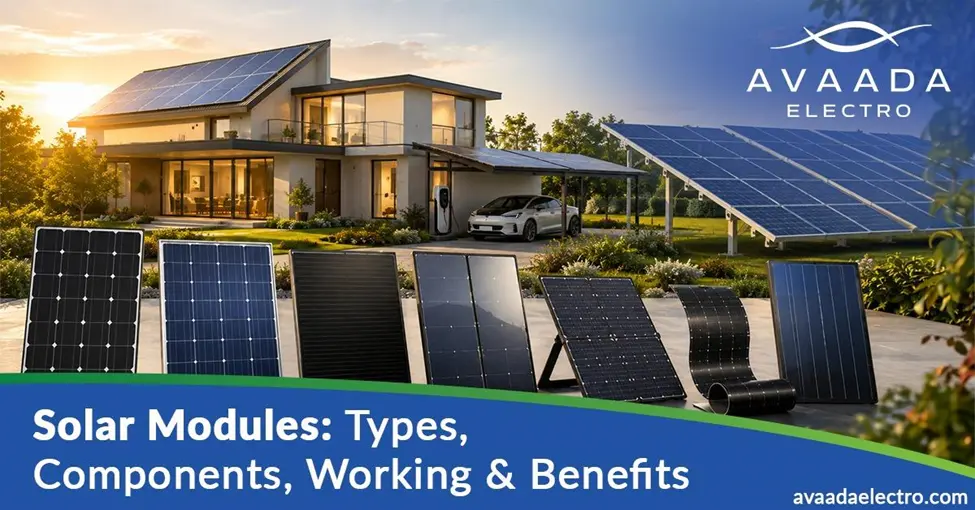
Have you ever looked at a rooftop solar quotation and wondered what the large glass-covered unit actually does when sunlight reaches your roof? The choice of this component can affect how much electricity a solar system generates and how reliably it performs over the years. If you are searching for what a solar module is, understanding its construction, how it works, types, efficiency and price can make it easier to compare solar options and assess which technology suits a project.
Understanding a Solar Module
A solar module is a group of interconnected silicon solar cells sealed within a protective structure to convert sunlight into direct current (DC) electricity. While a single solar cell produces a relatively small amount of electricity, multiple cells connected together form a practical electricity-generating unit.
A solar module is designed to protect these cells from moisture, dust, mechanical stress and other outdoor conditions while allowing sunlight to reach the semiconductor material.
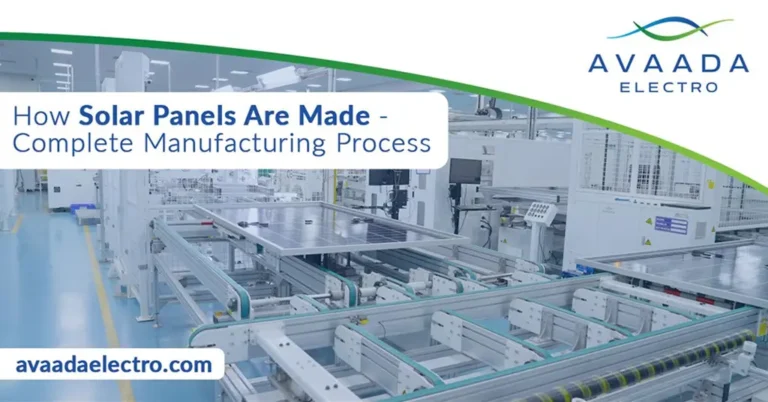
Avaada Electro manufactures solar modules through a backwards-integrated manufacturing process covering stages from polysilicon and ingots to wafers, solar cells and finished modules.
Read Also: Best Solar Panels in india
What is a Solar Module Made Of?
A solar module contains several layers and components that work together to protect the cells and transfer the electricity they generate.
| Component | Purpose |
| Front Tempered Glass | Protects the solar cells and allows sunlight to reach them. |
| Encapsulant | Holds the cells in place and protects them from moisture and other external conditions. |
| Solar Cells | Convert sunlight into electricity using semiconductor materials such as silicon. |
| Rear Layer | Provides additional protection and electrical insulation for the solar module. |
| Aluminium Frame | Provides structural support and helps secure the module to its mounting system. |
| Junction Box | Connects the module’s internal circuits to external cables and electrical equipment. |
Each component contributes to the durability, safety and performance of the finished module.
Solar Module vs Solar Panel: Are They the Same?
The terms solar module and solar panel are often used interchangeably, although they can have different technical meanings depending on the context.
A solar module is an individual electricity-generating unit made by connecting multiple solar cells. Several modules connected together form a larger solar array.
For residential and commercial purchases, however, sellers and installers often use “solar panel” and “solar module” to describe the same product. Understanding the terminology is useful when comparing technical specifications, quotations and warranties.
Read Also: Solar Cell Efficiency
How Does a Solar Module Work?
A solar module begins generating electricity when sunlight reaches its solar cells. The silicon semiconductor material absorbs energy from sunlight, causing electrons to move and creating an electric current.
The process can be understood in a few steps:
- Sunlight reaches the cells: Photons from sunlight strike the surface of the solar cells.
- Energy is absorbed: The semiconductor material absorbs energy from the incoming light.
- Electrons begin moving: The absorbed energy causes electrons to move within the cell.
- Current is generated: The movement of electrons produces direct current (DC) electricity.
- Electricity is transferred: Conductive pathways collect the generated electricity and send it through cables.
- DC is converted to AC: A solar inverter converts DC electricity into alternating current (AC) for use by appliances or the electricity grid.
The amount of electricity generated depends on factors such as module efficiency, sunlight availability, temperature, orientation & tilt, shading, system design and installation conditions.
India’s solar capacity reached 164.5 GW by 30 July 2026, including 122.57 GW of ground-mounted solar and 30.74 GW of grid-connected rooftop solar, according to the Ministry of New and Renewable Energy (MNRE). This growing installed base highlights the increasing role of solar modules in India’s electricity system.
Types of Solar Modules
Different cell technologies offer different efficiency levels, power outputs and performance characteristics. Common types include monocrystalline, TOPCon and bifacial modules.
Monocrystalline Solar Modules
Monocrystalline modules use solar cells made from single-crystal silicon wafers. Their uniform cell structure allows them to achieve and strong power output within a relatively small installation area.
They are particularly suitable for rooftops where available space is limited and higher power generation per square metre is important.
N-Type TOPCon Solar Modules
N-Type TOPCon is an advanced crystalline-silicon cell architecture. TOPCon stands for Tunnel Oxide Passivated Contact.
The design uses a thin oxide layer and passivated contact structure to reduce recombination losses and improve charge collection. Depending on the product, N-Type TOPCon modules can offer efficiency, low degradation and strong temperature performance.
Avaada Electro’s Enlume G12 720 Wp N-Type TOPCon module, for example, offers a module efficiency of up to 23.18%. The module also has an 18-busbar configuration and a 30-year linear performance warranty.
Bifacial Solar Modules
A bifacial solar module can generate electricity from both its front and rear sides. The rear side captures reflected and scattered sunlight from the surface below the module.
The additional generation depends on factors such as ground reflectivity, mounting height, row spacing, orientation and installation conditions. Bifacial modules can therefore be particularly useful for suitable ground-mounted and commercial projects.
Read Also: Bifacial Solar Modules
Factors to Consider Before Buying a Solar Module
Choosing the right solar module requires more than comparing its wattage or price. Consider the following factors:
- Module Efficiency: efficiency can help maximise electricity generation where installation space is limited.
- Power Output: Compare the module’s rated wattage with the required system capacity and available installation area.
- Degradation Rate: A lower degradation rate can help maintain stronger electricity output over the module’s operating life.
- Temperature Coefficient: Solar module output changes with temperature. A lower temperature coefficient can help limit power losses as module temperatures increase.
- Warranty: Check the product warranty and performance warranty, including their duration and applicable terms.
- Certifications: Verify applicable safety and quality certifications before purchasing modules for a solar project.
- Installation Compatibility: Ensure that module dimensions, weight, electrical characteristics, mounting requirements and inverter compatibility match the proposed system design.
Avaada Electro Solar Modules
Avaada Electro manufactures N-Type TOPCon solar modules for residential, commercial, industrial and utility-scale applications.
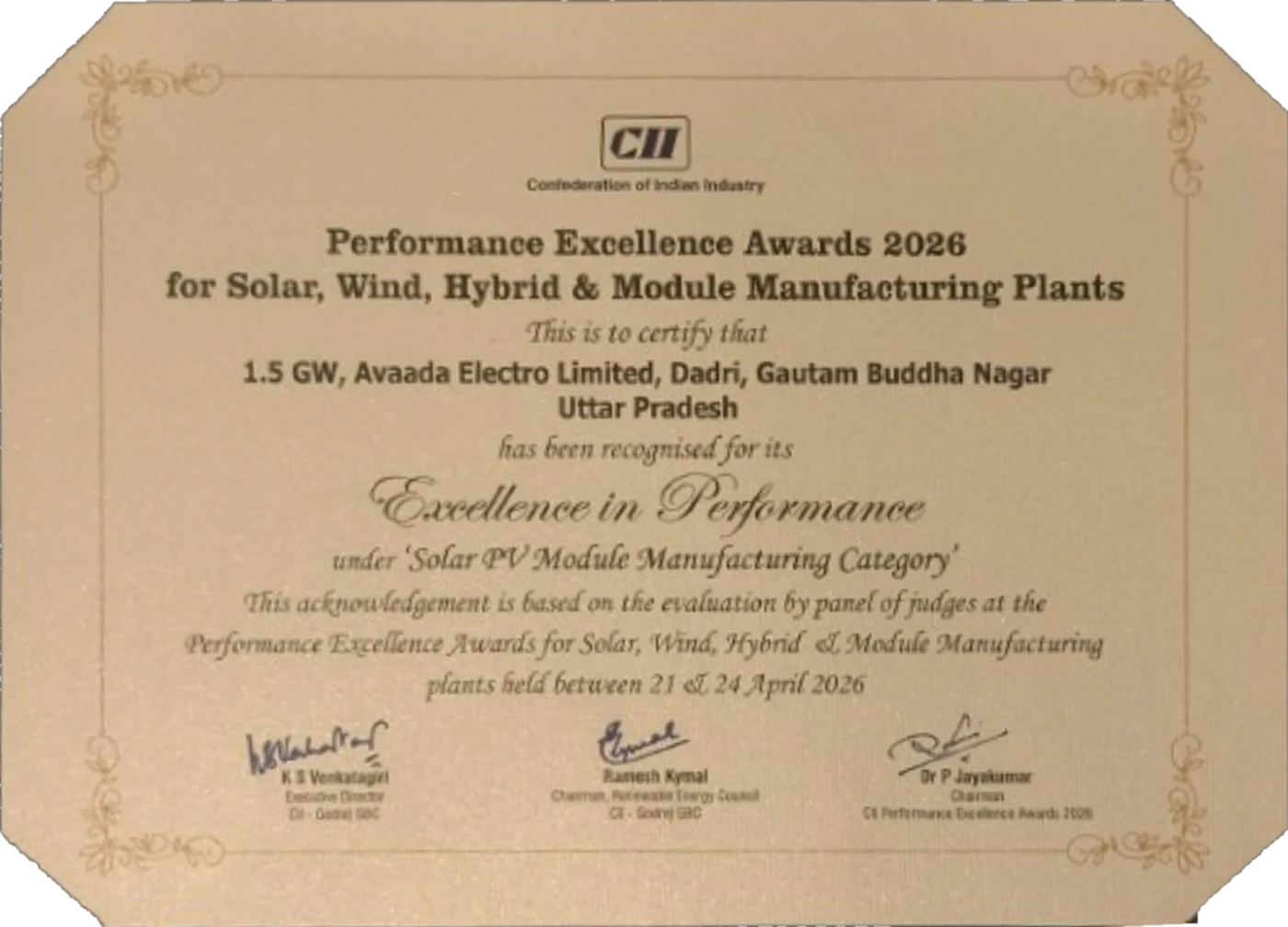
Its manufacturing operations include facilities in Nagpur, Maharashtra and Dadri, Uttar Pradesh. The company follows an integrated manufacturing approach across different stages of solar production.
Its module portfolio includes:
- Enlume G12 Series: Up to 720 Wp output with module efficiency reaching 23.18%.
- Integlow M10L Series: 585 Wp to 610 Wp output with efficiency of up to 60%.
- Enlume G12R Series: 610 Wp to 630 Wp output with efficiency of up to 23.30%.
The company also states that its manufacturing facilities hold certifications including ISO 9001:2015, ISO 14001:2015 and ISO 45001:2018, along with BIS certification, ALMM and ALMM List-I listing, KIWA and TÜV Rheinland certifications, and Wood Mackenzie recognition.
Conclusion
A solar module converts sunlight into electricity through interconnected silicon solar cells protected within a durable assembly. Its efficiency, power rating, degradation rate, temperature performance, warranty and certifications all influence long-term value. Understanding these factors can help buyers compare products based on more than price alone. For projects requiring high power output from limited space, N-Type TOPCon modules offer a efficiency option. Avaada Electro manufactures N-Type TOPCon modules for residential, commercial, industrial and utility-scale applications, supported by its integrated manufacturing capabilities and quality-control processes.
FAQs
What happens inside a solar module when sunlight hits it?
Sunlight reaches the silicon cells inside the module and provides energy that causes electrons to move. This movement generates direct current electricity.
Why are solar modules covered with glass?
The front glass protects the solar cells from rain, dust, impact and other outdoor conditions while allowing sunlight to pass through to the cells.
Can solar modules generate electricity in winter?
Yes, solar modules can generate electricity during winter as long as sufficient daylight is available. Cooler temperatures can also support efficient module performance.
What factors can reduce solar module performance?
Shading, high temperatures, dust, ageing, electrical losses and gradual degradation can reduce the amount of electricity a module produces over time.
Can solar modules be installed on any type of roof?
Solar modules can be installed on many roof types, provided the roof has adequate structural strength, suitable sunlight exposure, sufficient space and an appropriate mounting solution.
What is the difference between a solar module and a solar array?
A solar module is one electricity-generating unit containing interconnected solar cells. Multiple modules connected together form a solar array that provides a larger system capacity.